

★ 4.8 / 5.0 from 520 client reviews on ReviewSolicitors (including Google reviews)
Your buyer’s lender has come back with a question you were not expecting. Does the lease contain a mortgagee protection clause? Or perhaps you are the buyer, reading a shared ownership lease for the first time, and a long paragraph about “Mortgagee Protection Claims” sits in the middle of it. Either way, the clause matters. Without it, many lenders will not lend on the property at all.
This guide explains what a mortgagee protection clause is, how it works if a shared owner falls into mortgage arrears, why it shapes whether you can buy, sell or remortgage, and what can be done when an older lease does not contain one. It is written for shared ownership buyers and sellers in England. Shared ownership in Wales operates under separate arrangements, so Welsh leaseholders should take advice on their own lease terms.
SUMMARY
An MPC is a lease term that compensates a mortgage lender from the landlord’s retained share when a repossessed shared ownership home sells for less than the debt. It is one of six fundamental clauses Homes England lists for its model lease, alongside staircasing, rent review and alienation provisions.
A mortgagee protection clause is a provision in a shared ownership lease that allows the buyer’s mortgage lender to recover a defined shortfall from the landlord if the lender repossesses and sells the home. It applies to shared ownership leases in England granted on the Homes England model, and it exists because a lender’s security covers only the share the buyer owns. Homes England’s current guidance for lenders, landlords and conveyancers names it as a fundamental clause of the model lease.
Shared ownership is part buy, part rent. You buy a share of the lease, often between 10 and 75 per cent, and pay rent to the landlord (usually a housing association) on the rest. Your lender lends against your share only. That is where the risk sits, and the MPC is the answer the sector designed to manage it.
In the Homes England model lease, the MPC appears in its own clause with a definition of the “Mortgagee Protection Claim”, the most a lender can recover, which is capped as the total of four sums.” The wording runs to several paragraphs and is easy to skim past, especially as it does not mention you by name until near the end. Your conveyancer will look for it when reviewing the lease and will report on whether it follows the model wording.
Leases granted by housing associations with grant funding generally follow the model closely. Leases that depart from the model in content or format are more likely to cause problems on resale, and the Homes England guidance says so directly.
A lender on a standard leasehold flat can usually recover its money by selling the whole lease. A shared ownership lender cannot do that straight away, because the landlord still owns the unsold share. If the buyer defaults, the lender needs a way to sell the whole property and still be paid.
The MPC gives it two things: a route to buy out the landlord’s share (known as final staircasing) and a right to deduct its losses from the money that would otherwise go to the landlord for that share.
Without that protection, a lender could end up holding security over a part share that few buyers want. Most mainstream lenders therefore treat the MPC as a condition of lending on shared ownership homes.
Yes. Homes England’s guidance lists six fundamental clauses for its model leases: alienation provisions, the mortgagee protection clause, the rent review clause, staircasing provisions, Designated Protected Areas clauses and the right of first refusal clause.A landlord that varies a fundamental clause without Homes England’s consent may be required to repay grant.
On the MPC specifically, Homes England’s published procedures for varying leases state that it will not normally agree to any variation that reduces the effect of the Mortgagee Protection Clause, and that an exceptional variation would also need the lender’s agreement. In practice, the clause in your lease is very unlikely to be weakened after you buy.
→ Related: Leasehold vs Freehold: What’s the Difference and Which Should You Buy?
SUMMARY
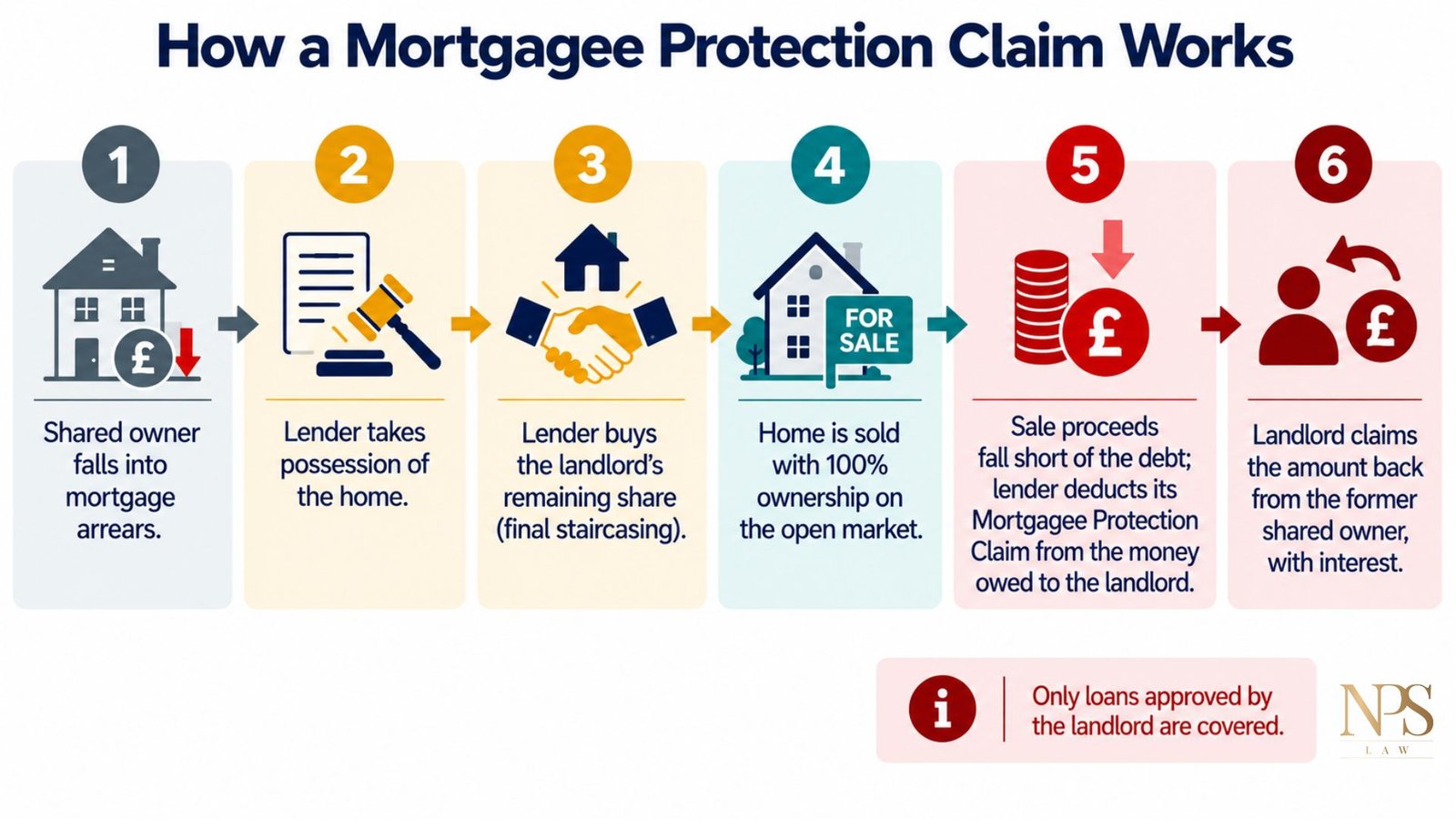
If a shared owner defaults, the lender repossesses, buys out the landlord’s share and sells the whole home. Any shortfall within four capped heads of claim is deducted from what the landlord would have received. The landlord can then pursue the former shared owner for that sum.
The MPC works by letting the lender take its loss out of the price it pays the landlord for the landlord’s remaining share. It is triggered only after a default and repossession, and only for loans the landlord approved. The amount is limited to four categories set out in the model lease, so the lender is not guaranteed to recover everything.
The sequence below follows the current Homes England model lease. Older leases may differ in detail, which is one reason your conveyancer reads the actual clause rather than assuming the model applies.
Arrears come first. Lenders in England and Wales must follow the Pre-Action Protocol for possession claims based on mortgage arrears before going to court, which means contact, information and a genuine attempt to agree a way forward. Repossession is a last resort, not an automatic outcome of a missed payment.
If possession is ordered, the lender can exercise its right to complete final staircasing, buying the landlord’s remaining share so that it can sell 100 per cent of the property. The sale proceeds go towards the mortgage debt. Where they fall short, the lender calculates its Mortgagee Protection Claim and deducts it from the money otherwise payable to the landlord for that final share. Lenders are not obliged to staircase after repossession, and the clause only helps them if they do.
Under the current model lease, the claim is capped at four sums. Anything the lender loses outside these heads stays with the lender.
| Capped sum | What it covers (current Homes England model lease) |
|---|---|
| 1. Approved loans | All loans secured by a first-ranking mortgage over the property, provided the amount and terms of each loan were approved in advance by the landlord |
| 2. Interest | Up to 18 months of interest on the sum in (1), calculated at the lender's standard variable rate at the time of default |
| 3. Arrears paid by the lender | Money the lender advanced to clear rent and service charge arrears under the lease to protect its security |
| 4. Enforcement costs | Fees and costs of enforcing the security, capped at 3% of the market value of the leasehold interest at the time of enforcement |
Some older leases allow less. Interest cover of 12 months rather than 18 is found in earlier versions of the clause, so the date and form of your lease affect how much protection the lender has, and in turn how comfortable a lender is with it.
The clause has conditions. The most important is landlord consent: a claim can only be made to the extent the lender obtained the landlord’s consent to the terms of each loan. A further advance taken without telling the landlord may sit outside the MPC entirely.
The second condition is timing. The MPC does not apply if the leaseholder had already completed final staircasing before the default, because at that point the landlord no longer holds a share to deduct from. The model lease does treat consent as given for money the lender advances to protect its security, such as paying off arrears, so that part of a claim does not depend on separate approval.
You do. The model lease states that if the landlord makes a payment to the lender, or the lender deducts a sum, the landlord is entitled to claim that amount back from the leaseholder together with interest. The MPC moves the risk from the lender to the landlord, but the debt itself remains with the person who borrowed.
This surprises many shared owners. The clause reads as a safety net, and it is one, for the lender and the landlord. It does not reduce what a shared owner in default may end up owing.
⚠ Common Pitfall
Taking a further advance or switching lender without the landlord’s written consent can leave part of the loan outside the mortgagee protection clause. Lenders know this, and some will refuse to proceed until consent is in place. If you are remortgaging a shared ownership home, ask your conveyancer to confirm that the landlord has approved the new loan before completion.
SUMMARY
For buyers, the MPC is a lending condition: no compliant clause and no landlord consent usually means no mortgage offer. For sellers, it decides how many buyers can get finance, which affects price, timing and whether a sale completes at all.
The mortgagee protection clause matters because it controls access to mortgage finance on shared ownership homes. Most buyers need a mortgage, and most mainstream lenders lend on shared ownership only where the lease contains an acceptable MPC and the landlord has approved the loan. That makes the clause a practical issue at every purchase, sale and remortgage, not a technical footnote.
Your lender will review the lease, often through your conveyancer, before releasing funds. Homes England’s guidance notes that the conveyancer acting for the buyer and lender will usually obtain the landlord’s consent to the mortgage, and that this requirement appears in the UK Finance Mortgage Lenders’ Handbook for Conveyancers.
The same guidance says the landlord must respond promptly to a consent request, give its decision within 28 days, and give any consent in writing. Build that time into your plans. A missing consent is one of the more common reasons a shared ownership purchase is ready to exchange in every other respect but cannot.
Even if you bought with cash or have staircased part of the way, your buyer’s lender will read your lease against its own requirements. If the clause is missing or non-standard, the buyer may lose their mortgage offer late in the transaction.
Homes England’s guidance warns that landlords using leases which differ too much from the model “may find it difficult to sell or re-sell” those homes. Checking your lease before you list the property gives you time to fix a problem rather than discover it through a failed sale.
→ Related: New Build Conveyancing: What to Expect and Why You Need a Specialist
SUMMARY
A lease without an MPC can still be valid, but many lenders will not accept it as security, which narrows the pool of buyers. Homes England generally supports adding its model clause to older leases, and does not need to approve the change if the wording is copied exactly.
A shared ownership lease without a mortgagee protection clause is not void, but it is harder to mortgage and therefore harder to sell. The issue usually affects older leases drafted before the model clause became standard. Homes England’s guidance treats adding the clause as a way to “improve mortgageability” and supports it in most cases.
The comparison below sets out how lease type affects the position in broad terms. Your own lease may not fit neatly into one column, which is why the actual wording needs checking.
| Lease type | Mortgagee protection | Lending position | Resale position |
|---|---|---|---|
| Older lease with no MPC | None | Many mainstream lenders decline; some specialist lenders may consider it | Narrower pool of buyers; cash buyers or variation often needed |
| Earlier model lease | Included; interest cover may be 12 months | Usually acceptable, subject to lender criteria | Generally sellable on normal terms |
| Current model lease (incl. new model from 1 April 2021) | Fundamental clause; up to 18 months interest; costs capped at 3% | Widely accepted | Standard for most buyers and lenders |
Leases granted many years ago, and leases drafted on a landlord’s own form rather than the model, are the usual candidates. Some early schemes, including some run by local authorities, used bespoke leases that never included mortgagee protection. Resales of these homes are where the problem tends to surface, because the original buyer may have bought with cash or with a lender whose criteria have since changed.
The age of the lease is a clue rather than an answer. Only the wording tells you whether the clause is there and whether it matches what lenders expect.
Without the MPC, a lender that repossesses has no contractual route to recover a shortfall from the landlord’s share. It may be left with security over a part share that is difficult to sell. Each lender sets its own criteria, so a lease one lender declines may be acceptable to another, but the choice is usually narrower and the rates may be less competitive.
Often, yes. A deed of variation is a formal agreement between landlord and leaseholder that changes the terms of the lease, and it is the standard way to insert an MPC. Homes England “generally supports adding an MPC clause to older leases where one does not currently exist”, and it does not need to approve the change provided its current model clause is copied without variation. The landlord still has to agree, and there will be legal costs, which are often met by the leaseholder who asks for the change.
If your lease is mortgaged, your existing lender will normally need to consent to the variation as well. The deed is then registered at HM Land Registry so that it binds future owners.
Where a variation is refused or delayed, there are other routes, though each has limits.
None of these is a complete substitute for a lease that lenders accept. Staircasing to full ownership needs funds most sellers do not have, and the cash buyer market is small. A variation, where the landlord will agree to one, is usually the cleanest long-term fix.
⚠ Common Pitfall
Do not wait until you have a buyer to check your lease. A deed of variation needs the landlord, and sometimes your lender, to sign. That can take weeks. Starting the process when you first decide to sell gives your buyer’s lender a lease it can accept from day one.
SUMMARY
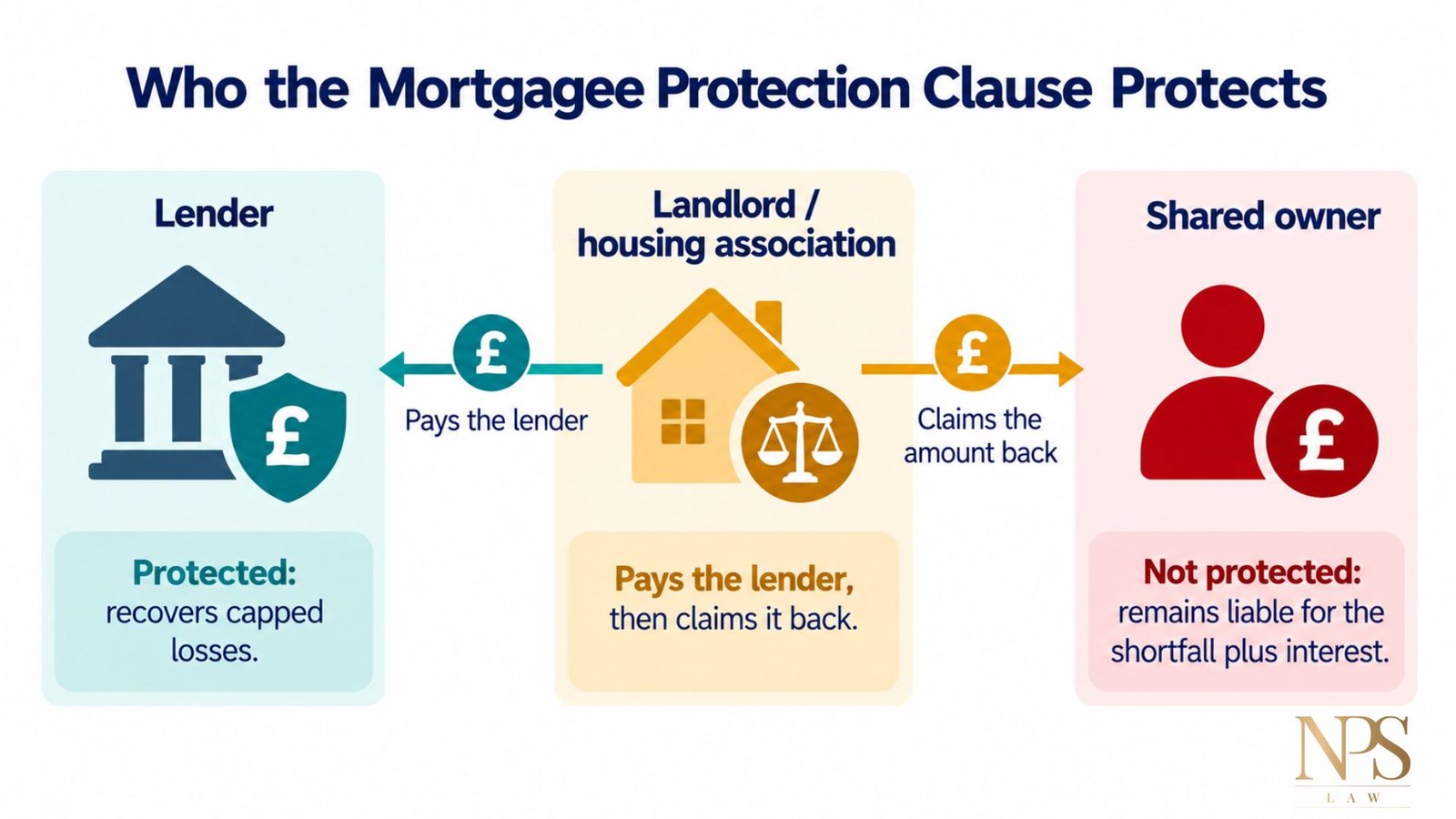
The MPC does not shield a shared owner from the consequences of default. The landlord can recover any MPC payment from the leaseholder with interest. Acting early, before possession proceedings start, keeps the most options open.
If you fall into mortgage arrears on a shared ownership home, the mortgagee protection clause will not reduce what you owe. Its job is to make sure the lender is paid. Under the model lease, any sum the landlord pays or loses under the clause can be claimed back from you, with interest.
That makes early action more valuable for shared owners than for many other homeowners, because the losses on a forced sale can follow you after the home has gone.
No. It protects the lender and, indirectly, keeps shared ownership mortgageable for everyone. The person who borrowed remains responsible for the debt. A shared owner who reads the MPC as a form of insurance can be caught out badly.
Yes. The model lease gives the landlord a right to claim against the leaseholder for any amount paid to the lender or deducted by it, together with interest. How hard a landlord pursues that debt varies, and a former shared owner can ask about repayment arrangements, but the right exists in the lease you signed.
Contact your lender and your landlord straight away. Shared owners pay rent as well as a mortgage, and arrears on either can put the home at risk. Lenders must follow the Pre-Action Protocol before seeking possession, which gives room to agree a payment plan or other arrangement.
Free, government-backed debt advice is available through MoneyHelper, and many housing associations have specialist teams for residents in financial difficulty. Raising the problem early will not make it disappear, but it keeps options open that are much harder to reach once a court date is set.
→ Related: Shared Ownership Conveyancing: Buying and Selling With NPS Law
SUMMARY
Five checks cover most MPC problems: whether the clause exists, whether it follows the model wording, what interest it covers, whether landlord consent to the mortgage has been obtained, and whether any variation has been registered. Sellers should run them before marketing, buyers before exchange.
Checking a shared ownership lease for mortgagee protection means confirming that the clause is present, that it follows the Homes England model, and that the landlord has approved the mortgage being used. These checks apply to buyers, sellers and anyone remortgaging, and they are part of the standard review a conveyancer carries out on a shared ownership transaction.
The table below sets out what is checked, where the answer comes from, and why it affects the transaction.
| What to check | Where to find it | Why it matters |
|---|---|---|
| Is there an MPC? | The lease itself, usually in a clause headed "Mortgagee Protection" | Many lenders will not lend without one |
| Does it follow the model wording? | Comparison with the Homes England model lease for the relevant period | Non-standard clauses can fail a lender's criteria |
| How much interest does it cover? | The definition of the Mortgagee Protection Claim and the four sums that cap it | 12 months of cover may be treated differently from 18 |
| Has the landlord approved the mortgage? | Written consent from the landlord, requested by the conveyancer | The MPC only covers loans the landlord approved |
| Has the lease been varied? | Title register at HM Land Registry and any deed of variation | An unregistered variation may not bind a future owner |
At NPS Law, we review the mortgagee protection clause as part of every shared ownership purchase, sale and remortgage, and we request the landlord’s consent to the mortgage early so that it does not hold up exchange.
Where a lease has no MPC, we can approach the landlord about a deed of variation using the Homes England model wording and deal with your lender’s consent and registration. Our conveyancing is on a fixed fee with a free initial consultation, so you know the cost before the lease review begins.
→ Related: Average Conveyancing Fees UK 2026: What Buyers and Sellers Should Expect
→ Related: What Is Conveyancing? A Step-by-Step Guide for Buyers and Sellers
These are the questions shared ownership buyers and sellers most often ask about mortgagee protection clauses, along with questions about how NPS Law handles them.
No. Leases granted on the Homes England model include one as a fundamental clause, but some older leases, and some drafted on a landlord’s own form, do not. The only way to know is to read the lease. If your clause is missing, a deed of variation adding the model wording is often possible with the landlord’s agreement.
Not in a way that weakens it, in normal circumstances. Homes England treats the MPC as a fundamental clause and has said it will not normally agree to variations that diminish its effect. Any exceptional change would also need the lender’s agreement. Adding the clause to an older lease is a different matter, and Homes England generally supports it.
Generally, no. The MPC only applies where the leaseholder has not completed final staircasing before a default, because the landlord no longer holds a share to deduct from once you own 100 per cent. After final staircasing, lenders assess the property much like any other leasehold or freehold home, depending on what you acquire.
Yes. We check the mortgagee protection clause against the Homes England model, confirm the interest and cost limits it contains, and report on anything a lender is likely to query. We also request the landlord’s written consent to your mortgage at the start of the transaction, because a late consent is one of the most common causes of delay on shared ownership purchases.
Yes. We can approach your landlord to agree a deed of variation inserting the Homes England model clause, deal with your existing lender’s consent, and register the variation at HM Land Registry. If you are selling, starting this before you accept an offer gives your buyer’s lender a lease it can approve without delaying the chain.
The mortgagee protection clause is one of the less visible parts of a shared ownership lease, and one of the most consequential. It is the reason lenders will finance a part share at all. Where it is present and approved, it rarely causes trouble. Where it is missing or the landlord has not consented to the loan, it can stop a purchase, a sale or a remortgage at the last stage.
It also does less for the shared owner than its name suggests. The lender is protected; the borrower remains liable for any shortfall, with interest. Understanding that before you buy is better than discovering it in arrears.
If you are buying, selling or remortgaging a shared ownership home and want the lease checked before you commit, contact NPS Law for a free initial consultation and a fixed-fee quote.
Buying or Selling a Shared Ownership Home? Have the Lease Checked First.
NPS Law reviews the mortgagee protection clause, obtains landlord consent and handles deeds of variation as part of shared ownership conveyancing. Fixed fees and a free initial consultation on every instruction.
Disclaimer: This article is for general informational purposes only and does not constitute formal legal advice. The guidance described applies to shared ownership in England unless otherwise stated. For specific legal matters, please consult with a qualified solicitor.
Leases granted many years ago, and leases drafted on a landlord’s own form rather than the model, are the usual candidates. Some early schemes, including some run by local authorities, used bespoke leases that never included mortgagee protection. Resales of these homes are where the problem tends to surface, because the original buyer may have bought with cash or with a lender whose criteria have since changed.
The age of the lease is a clue rather than an answer. Only the wording tells you whether the clause is there and whether it matches what lenders expect.
Without the MPC, a lender that repossesses has no contractual route to recover a shortfall from the landlord’s share. It may be left with security over a part share that is difficult to sell. Each lender sets its own criteria, so a lease one lender declines may be acceptable to another, but the choice is usually narrower and the rates may be less competitive.
Often, yes. A deed of variation is a formal agreement between landlord and leaseholder that changes the terms of the lease, and it is the standard way to insert an MPC. Homes England “generally supports adding an MPC clause to older leases where one does not currently exist”, and it does not need to approve the change provided its current model clause is copied without variation. The landlord still has to agree, and there will be legal costs, which are often met by the leaseholder who asks for the change.
If your lease is mortgaged, your existing lender will normally need to consent to the variation as well. The deed is then registered at HM Land Registry so that it binds future owners.
Where a variation is refused or delayed, there are other routes, though each has limits.
None of these is a complete substitute for a lease that lenders accept. Staircasing to full ownership needs funds most sellers do not have, and the cash buyer market is small. A variation, where the landlord will agree to one, is usually the cleanest long-term fix.
©️ Copyright 2026 NPS Law is a trading name for NPS Law LLP. Solicitors of England and Wales. Authorised and Regulated by the Solicitors Regulation Authority. SRA Number 570169. A list of all Partners is available on the SRA directory for this firm. website designed by origin-media