

★ 4.8 / 5.0 from 520 client reviews on ReviewSolicitors (including Google reviews)
At a traditional auction, the moment the gavel falls you have bought the property. Contracts are exchanged there and then, a 10 per cent deposit is due the same day, and in most cases you have around four weeks to find the rest of the money. There is no cooling-off period and no chance to renegotiate if the survey you did not get round to would have found damp.
Buying a house at auction in the UK can still be a good way to buy, especially for people who are ready for it. This guide explains how auctions work, how a traditional auction compares with the Modern Method of Auction, the step-by-step process, whether a mortgage can be arranged in time, the costs to budget for and the legal pack checks to make before you bid. It is written for buyers and covers property in England and Wales only.
SUMMARY
Buying at a traditional auction means agreeing a binding contract the instant your bid wins. You pay a deposit on the day and must complete by a fixed date, usually 20 business days later. All checks have to happen before the auction, not after.
Buying a house at auction works by turning the winning bid into a binding contract on the spot. In England and Wales, many auction houses sell under the RICS Common Auction Conditions or a version of them, which treat the fall of the gavel as exchange of contracts. The buyer then has a fixed period to complete, with no right to withdraw.
That single feature shapes everything else. On a normal purchase, surveys, searches and mortgage offers happen between offer and exchange. At auction, there is no “between”. Everything that matters has to be done before you raise your hand.
When the auctioneer accepts your bid, you become the buyer under a contract. You will be asked to sign the sale memorandum, provide proof of identity and pay the deposit before you leave the room, or immediately after an online auction closes. The deposit is usually 10 per cent of the price, subject to a minimum set by the auctioneer.
Allsop, one of the largest UK auctioneers, puts it plainly: the successful bidder is “legally bound to purchase”. The Common Auction Conditions go further and state that the buyer buys with full knowledge of the documents, “whether or not the BUYER has read them”.
Sellers choose auction for speed and certainty. Lenders selling repossessed homes, executors winding up an estate, housing associations disposing of stock and landlords selling tenanted property all use auctions. So do owners of homes that are hard to sell conventionally: properties needing major work, those with short leases or unusual construction, and homes that have already fallen through on the open market.
Some lots are simply good value. Others are at auction because a problem has put other buyers off. The legal pack is usually where you find out which.
Most property auctions now run online, either as timed auctions that close at a set time or as live-streamed events. In-room auctions still exist, and many auctioneers take telephone or proxy bids. Online platforms usually ask you to register in advance and authorise a “bidder security” payment on your card before you can bid.
Allsop, for example, sets residential bidder security at between £2,000 and £10,000 per lot depending on the guide price. The method changes how you bid, not the legal effect of winning.
→ Related: Exchange of Contracts: What It Means and What Happens Next
SUMMARY
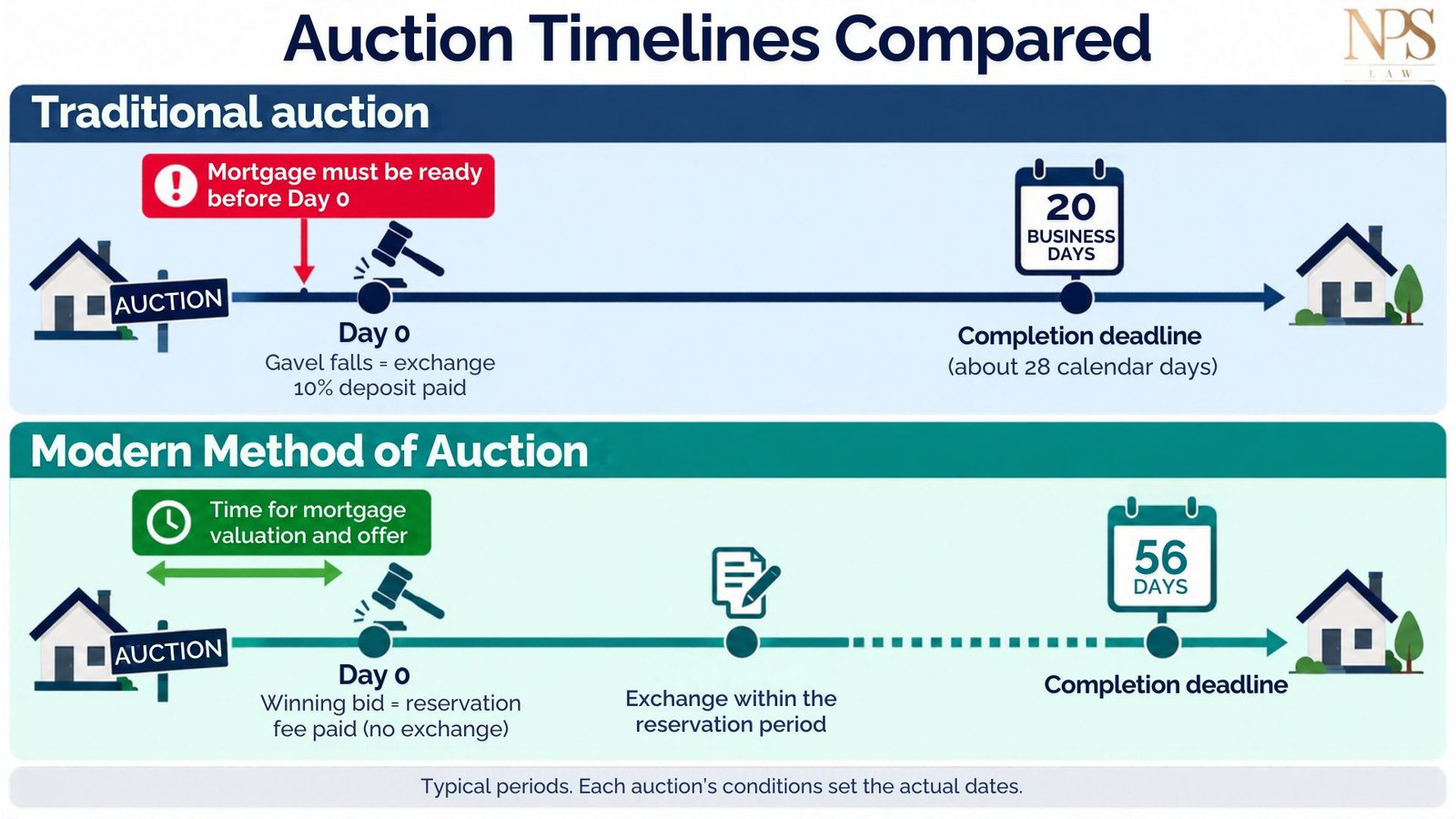
Traditional auctions bind you on the day and give roughly 20 business days to complete. The Modern Method of Auction binds you only at exchange, gives around 56 days, and charges a non-refundable reservation fee instead. The table compares five points that affect buyers.
The difference between a traditional auction and the Modern Method of Auction is when you become legally committed. At a traditional auction, it is the moment you win. Under the Modern Method, winning gives you an exclusive right to buy for a set period, and the contract only becomes binding when contracts are exchanged later, much like a private sale. Both are sold as “auction”, and listing sites do not always make clear which one you are looking at.
| Traditional auction | Modern Method of Auction | |
|---|---|---|
| When exchange happens | When the gavel falls (or the online auction closes) | Later, after your solicitor reviews the contract; winning only reserves the property |
| Time to complete | Usually 20 business days under the Common Auction Conditions (often called 28 days) | Usually 56 days from the draft contract being received |
| Money due on winning | Deposit, typically 10% (subject to a minimum), plus any buyer's or administration fee | Non-refundable reservation fee, often a percentage of the price with a minimum, plus any information pack fee |
| Mortgage suitability | Tight. Finance must be ready before you bid | Better. The longer period gives lenders time to value and offer |
| Can you pull out? | No. Withdrawing risks your deposit and a damages claim | Yes, before exchange, but you lose the reservation fee |
These are the usual positions, not fixed rules. Every auction publishes its own conditions, and special conditions for a particular lot can shorten or extend the completion date. Read them for each property you bid on.
A traditional auction contract is complete the moment your bid is accepted. Under the RICS Common Auction Conditions, unless the special conditions say otherwise, the completion date is 20 business days after the contract date. The deposit is the greater of 10 per cent of the price and the auctioneer’s stated minimum. If you do not complete on time, interest runs on the money due and the seller can serve a notice to complete.
Because the contract is formed instantly, there is no conveyancing stage in the usual sense. Your solicitor’s work happens almost entirely before the auction.
Under the Modern Method of Auction, the winning bidder pays a reservation fee to secure the property and then has a fixed window to exchange and complete. iamsold, which runs Modern Method auctions for many estate agents, describes the reservation fee as paid in addition to the selling price and “received on a non-refundable basis”.
On one current iamsold listing, the fee is 4.5 per cent of the purchase price including VAT, subject to a minimum of £6,600, plus £300 for the buyer information pack.
The fee may also count towards the chargeable consideration for Stamp Duty Land Tax, so it can increase your tax bill as well as your upfront costs. That makes the Modern Method more flexible on timing but often more expensive in fees. Compare the total cost, not just the guide price.
SUMMARY
The process has five stages: research and legal pack review, finance, registration, auction day and completion. Most of the work happens before you bid, because a traditional auction leaves no time to investigate afterwards.
The process of buying a house at auction runs in five stages, and the order matters more than on a normal purchase. Due diligence, finance and legal advice all come before the auction, because winning a traditional auction creates an immediate contract. After the auction, the only remaining job is to complete on time.
Start with the property and its paperwork. Book a viewing, and if the lot is a home you plan to live in or mortgage, consider a survey. The auctioneer will publish a legal pack containing the title documents, searches, any lease, replies to enquiries and the special conditions of sale. Ask a solicitor to review it before you decide how much to bid.
Packs are sometimes updated close to auction day. Check for an addendum on the morning of the sale, because changes announced on the day still bind you.
You need the deposit and fees available on the day and the balance available within the completion period. Cash buyers have the simplest path. Mortgage and bridging buyers need an agreement in principle, a lender that accepts auction purchases, and ideally a valuation before the auction. The mortgage section below covers this in detail.
Auctioneers must carry out anti-money laundering checks on buyers, so expect to provide photo ID, proof of address and sometimes evidence of the source of your funds. Online auctions also take card details for bidder security. Register early. A late registration that is not approved in time means you cannot bid at all.
Set your maximum before bidding starts and leave room for fees. Guide prices are an indication of where bidding may start, and a reserve price (the seller’s minimum) is usually confidential. If your bid wins, you sign the sale memorandum and pay the deposit and any buyer’s fee immediately. Under the Common Auction Conditions, the property is at your risk from that moment, so arrange buildings insurance to start on auction day.
Your solicitor raises any final points with the seller’s solicitor, prepares the transfer and arranges for the balance to be sent on the completion date. Your lender, if you have one, releases funds to your solicitor. After completion, Stamp Duty Land Tax must be returned and paid to HMRC within 14 days for property in England. In Wales, Land Transaction Tax is paid to the Welsh Revenue Authority within 30 days. The purchase is then registered at HM Land Registry.
Twenty business days goes quickly. A slow lender valuation, a missing document or a bank holding a transfer can each push you past the deadline and into interest charges.
→ Related: How Long Does Conveyancing Take in 2026?
SUMMARY
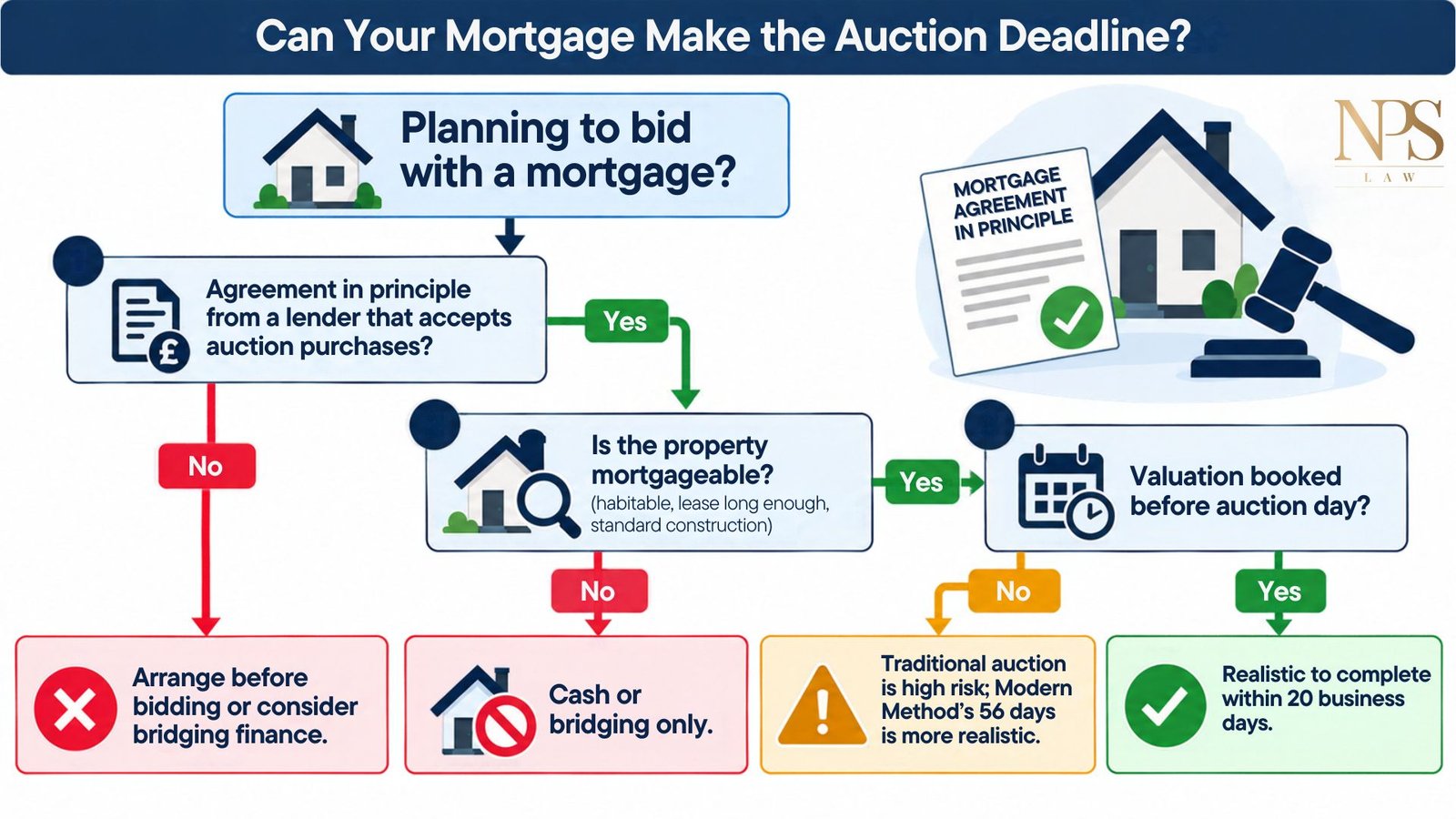
Yes, but only if the lender can value the property and release funds inside the completion period. That is realistic under the Modern Method’s 56 days, tight under a traditional auction’s 20 business days, and impossible if the property is not mortgageable at all.
You can buy a house at auction with a mortgage, provided your lender agrees to lend on that property and can complete within the auction’s deadline. The risk is timing. If the mortgage is not ready by the completion date, the contract still binds you, and the seller can pursue you for the shortfall.
Mortgage buyers should therefore treat finance as part of the pre-auction checks, not something to arrange after winning.
Sometimes. A lender needs an application, a valuation and underwriting before it issues an offer, and your solicitor needs the offer before completion. With an agreement in principle in place and a valuation booked before the auction, completing within 20 business days is possible.
Without that groundwork, it is a gamble.The Modern Method of Auction’s longer period makes mortgage purchases far more manageable.
Lenders lend against the value of a property they can sell if needed. Many auction lots fail that test: homes without a working kitchen or bathroom, properties with structural problems, flats with short leases, and buildings of non-standard construction.
A lender may also down-value the property below your winning bid, leaving you to cover the gap. A survey and a solicitor’s read of the legal pack will tell you whether the lot is likely to be mortgageable before you commit.
Bridging finance is a short-term loan designed to complete purchases quickly, often within the auction deadline. Buyers use it to complete on time and then refinance onto a standard mortgage once the property has been renovated or the lender’s requirements are met.
Bridging loans carry higher interest rates and arrangement fees, so build the cost of the loan and the exit into your budget. If the property will be your home, the loan is likely to be regulated, and you should take advice from an authorised broker.
SUMMARY
On top of the hammer price, budget for the buyer’s or administration fee, a reservation fee on Modern Method sales,any costs passed to you in the special conditions, Stamp Duty Land Tax (or Land Transaction Tax in Wales), legal fees and a survey. Some of these are due on auction day.
The cost of buying a house at auction is the winning bid plus a set of fees that are often higher, and payable sooner, than on a private purchase. Several are due the moment you win, so they need to be in your bank account on the day. The exact amounts vary by auctioneer and by lot, so check the auction conditions and the special conditions for each property.
| Cost | What it is | When it is paid |
|---|---|---|
| Deposit | Usually 10% of the price, subject to the auctioneer's minimum | On the day (traditional auction) |
| Buyer's premium / administration fee | Auctioneer's charge to the buyer, fixed or a percentage with a minimum, plus VAT | On the day, with the deposit |
| Reservation fee | Non-refundable fee on Modern Method sales, often a percentage of the price with a minimum | On winning the bid |
| Special conditions costs | Seller's legal and search costs, ground rent or service charge arrears, or other sums passed to the buyer | Usually at completion |
| Stamp Duty Land Tax | Tax on the purchase price (and possibly the reservation fee) | Stamp Duty Land Tax (England) / Land Transaction Tax (Wales) / Within 14 days of completion (England); within 30 days (Wales) |
| Legal fees and survey | Pre-bid legal pack review, conveyancing and any survey | Before and after the auction |
The deposit is part of the price, not an extra cost, but it must be paid immediately. The buyer’s premium, also called a buyer’s fee or administration fee, is extra. Auction House UK explains that the fee “(plus VAT) will be payable by the buyer along with the 10% deposit after the gavel falls”, and that it can be a fixed sum or a percentage of the price subject to a minimum. The figure is shown in each lot’s details.
A reservation fee replaces the deposit-on-the-day model and is paid on top of the price. As set out above, a current iamsold listing charges 4.5 per cent including VAT with a minimum of £6,600. On a £150,000 purchase, that is £6,750 you will not get back if you withdraw. Because it may be treated as chargeable consideration, it can also increase your Stamp Duty Land Tax.
Special conditions often require the buyer to reimburse the seller’s legal costs, pay for searches the seller commissioned, or settle arrears of ground rent and service charge on a leasehold lot. Each item may be modest, but together they can add thousands of pounds to the price. These costs are easy to miss because they sit in the contract, not the property listing.
Stamp Duty Land Tax applies to auction purchases in England in the same way as to private sales, including the higher rates for additional properties. In Wales, Land Transaction Tax applies instead, with its own rates and higher rates for additional dwellings.
Legal fees cover the pre-auction review of the legal pack and the conveyancing after the auction. A survey is optional but advisable on any lot you have not been able to inspect fully. Ask for quotes in advance so these figures go into your maximum bid.
→ Related: Stamp Duty Land Tax: Rates, Reliefs and When to Pay
→ Related: Average Conveyancing Fees UK 2026: What Buyers and Sellers Should Expect
SUMMARY
Under standard auction conditions you are treated as knowing everything in the legal pack, read or not. A solicitor for buying a house at auction reviews the pack before you bid, flags title and lease problems, and totals the extra costs, so your maximum bid reflects what you are really buying.
You need a solicitor before you bid because a traditional auction contract is binding the moment you win, and the law treats you as having read every document in the legal pack. A solicitor’s pre-bid review is the only point at which a title problem, an onerous lease term or a hidden cost can change your decision. After the gavel falls, it can only change what you pay.
A legal pack usually contains official copies of the title register and plan, local authority and other searches, any lease, replies to standard property enquiries, management information for leasehold lots, and the special conditions of sale. Packs vary in quality. Some are complete and current. Others contain old searches, missing lease documents or no replies to enquiries at all, which is itself a warning sign.
The issues below come up repeatedly on auction lots. Any one of them can make a property harder to mortgage, more expensive to own or difficult to resell.
| Red flag | Why it matters | Read more |
|---|---|---|
| Short lease | Short leases can be costly to extend, and many lenders set a minimum unexpired term | Leasehold vs Freehold guide |
| Flying freehold | Part of the property sits over land you do not own, which can affect repairs and lending | Flying freehold guide |
| Escalating ground rent | Ground rent that doubles or rises steeply can make a lease unmortgageable | Escalating ground rent guide |
| Restrictive covenants | Limits on use, extensions or alterations may block your plans | Restrictive covenant guide |
| Estate rentcharge | Ongoing charges on a freehold with strong enforcement rights for the owner | Estate rentcharges guide |
| Extra costs in special conditions | Seller's costs, arrears or other sums added to the price at completion | See the costs section above |
None of these automatically rules a property out. Several simply need pricing in. The point of finding them before the auction is that you can adjust your bid or walk away, rather than discover the problem when you already own it.
→ Related: What Is a Flying Freehold? Risks, Mortgages and Solutions
→ Related: Problems With Escalating Ground Rent: Your Options in 2026
→ Related: What Is a Restrictive Covenant on a Property?
→ Related: Estate Rentcharges Explained: What Freehold Buyers Need to Know
At NPS Law, a pre-auction review covers the title, the lease where there is one, the searches, the replies to enquiries and every special condition. We report in plain English on three questions: is there a legal problem, is the property likely to be mortgageable, and what will it cost on top of the hammer price.
Where documents are missing, we tell you what is missing and what risk that leaves. Because most auctions give only a few weeks between the catalogue and the sale, send us the legal pack as soon as it is published.
→ Related: Residential Conveyancing With NPS Law
⚠ Common Pitfall
If you cannot complete by the agreed date, the Common Auction Conditions allow the seller to serve a notice to complete. If you still do not complete, the seller can terminate the contract, keep your deposit, resell the property and claim damages from you, which can include any loss on the resale. Interest also runs on the money due from the agreed completion date. Do not bid unless the whole price, fees and taxes are available within the deadline.
SUMMARY
Auctions reward buyers who have cash or fast finance and have done their checks before the day. They penalise buyers who rely on a mortgage arranged after winning, or who bid on a lot they have not had reviewed.
Buying a house at auction is worth it for buyers who can move quickly, have funds ready and have checked the legal pack and the property before bidding. For those buyers, auctions offer speed, certainty and sometimes a lower price. For buyers who need a standard mortgage arranged after winning, the risks often outweigh the savings.
A traditional auction can take you from bid to keys in about a month. Once you win, the seller cannot accept a higher offer or pull out, which ends the uncertainty that dogs private sales. Some lots sell below what they would fetch on the open market, especially properties needing work. And everyone sees the same bids, so the price is set in the open.
Every cost of investigating a property falls on you before you know whether you will win. If you lose, the legal review and survey are money spent with nothing to show for it. If you win without having done them, you take whatever problems the property has. The deadline is fixed, and missing it can cost the deposit and more.
Consider two buyers bidding on the same flat. One is an investor with cash, a solicitor’s report on the lease and a builder’s quote. The other is a first-time buyer with an agreement in principle and no valuation. Both may win. Only one is in a strong position the next morning.
These are the questions buyers ask most often about buying a house at auction, along with questions about how NPS Law can help before and after the auction.
At a traditional auction, no. The contract is formed when your bid is accepted, and withdrawing exposes you to losing your deposit and a claim for the seller’s losses. Under the Modern Method of Auction, you can withdraw before exchange of contracts, but you will lose the non-refundable reservation fee. The seller’s own breach is a different case, and iamsold states that the fee is refunded if the sale fails because the seller breaches the terms.
Interest runs on the money due from the agreed completion date, and the seller can serve a notice to complete. If you still fail to complete, the seller can end the contract, keep your deposit, resell the property and claim damages from you. The 28-day figure is a common description; under the Common Auction Conditions the default is 20 business days, and each auction’s conditions can set a different date.
It can be, but it is harder. First-time buyers usually rely on a mortgage, and a traditional auction gives little time to secure one. The Modern Method of Auction is often more realistic because of its longer completion period, though the reservation fee adds to the cost. Whichever route you choose, have the legal pack reviewed and a valuation arranged before you bid.
Yes. Send us the legal pack as soon as it is published and we will report on the title, any lease, the searches, the special conditions and the extra costs you would take on. We focus on whether the lot is mortgageable and what it will cost on top of the hammer price, because those are the two points that most often change a buyer’s maximum bid.
We work to the completion date in the auction contract, which is usually 20 business days for a traditional auction and around 56 days for a Modern Method sale. Because we review the pack before the auction, much of the conveyancing work is already done when you win. What we need from you on the day is the signed memorandum, your lender’s details and confirmation of funds.
Buying a house at auction is fast and final. At a traditional auction, you are committed the moment you win, with a deposit due that day and completion around four weeks later. Under the Modern Method, you have longer but pay a non-refundable fee for the privilege. Either way, the decisions that protect you are made before the auction, not after.
That means checking the property, confirming finance that fits the deadline, totalling every fee and having a solicitor read the legal pack. Buyers who do those four things are in a good position to bid with confidence and stop when the price is wrong.
If you are planning to bid on a property in England or Wales, contact NPS Law for a pre-auction legal pack review before auction day.
Bidding at Auction? Have the Legal Pack Checked First.
NPS Law reviews auction legal packs before you bid, flags title, lease and cost risks in plain English, and handles the conveyancing through to completion within the auction deadline.
Disclaimer: This article is for general informational purposes only and does not constitute formal legal advice. The law described applies to England and Wales unless otherwise stated. Auction terms vary between auctioneers and individual lots. For specific legal matters, please consult with a qualified solicitor.
©️ Copyright 2026 NPS Law is a trading name for NPS Law LLP. Solicitors of England and Wales. Authorised and Regulated by the Solicitors Regulation Authority. SRA Number 570169. A list of all Partners is available on the SRA directory for this firm. website designed by origin-media