

★ 4.8 / 5.0 from 520 client reviews on ReviewSolicitors (including Google reviews)
The letter from the buyer’s solicitor is blunt. The ground rent on your lease doubles every ten years. Their client’s lender will not accept it. The sale cannot proceed on these terms. You have owned the property for years, paid the ground rent without a second thought, and now you are stuck.
This guide is written for people already in that position: leaseholders who have found out, often at the worst possible moment, that the ground rent terms in their lease are causing real problems. It explains how escalating ground rents work, why they cause difficulties with mortgages and sales, what the current legal position is (and what is not yet law despite what some articles claim), and what practical options are available. This article applies to property transactions in England and Wales only.
SUMMARY
Ground rent is an annual payment made by a leaseholder to the freeholder under the terms of the lease. For most leases granted since June 2022, ground rent must be set at a peppercorn, which means no payment is due in practice. For older leases, ground rent is often a real financial obligation and in some cases the lease contains terms that cause it to increase over time. These are called escalating ground rents.
Ground rent itself is not the problem. A fixed ground rent of £100 or £150 per year, unchanged for the life of the lease, is unlikely to cause a mortgage or sale difficulty. What causes problems is a mechanism in the lease that increases that ground rent automatically at set intervals, whether or not the freeholder takes any action to trigger the increase.
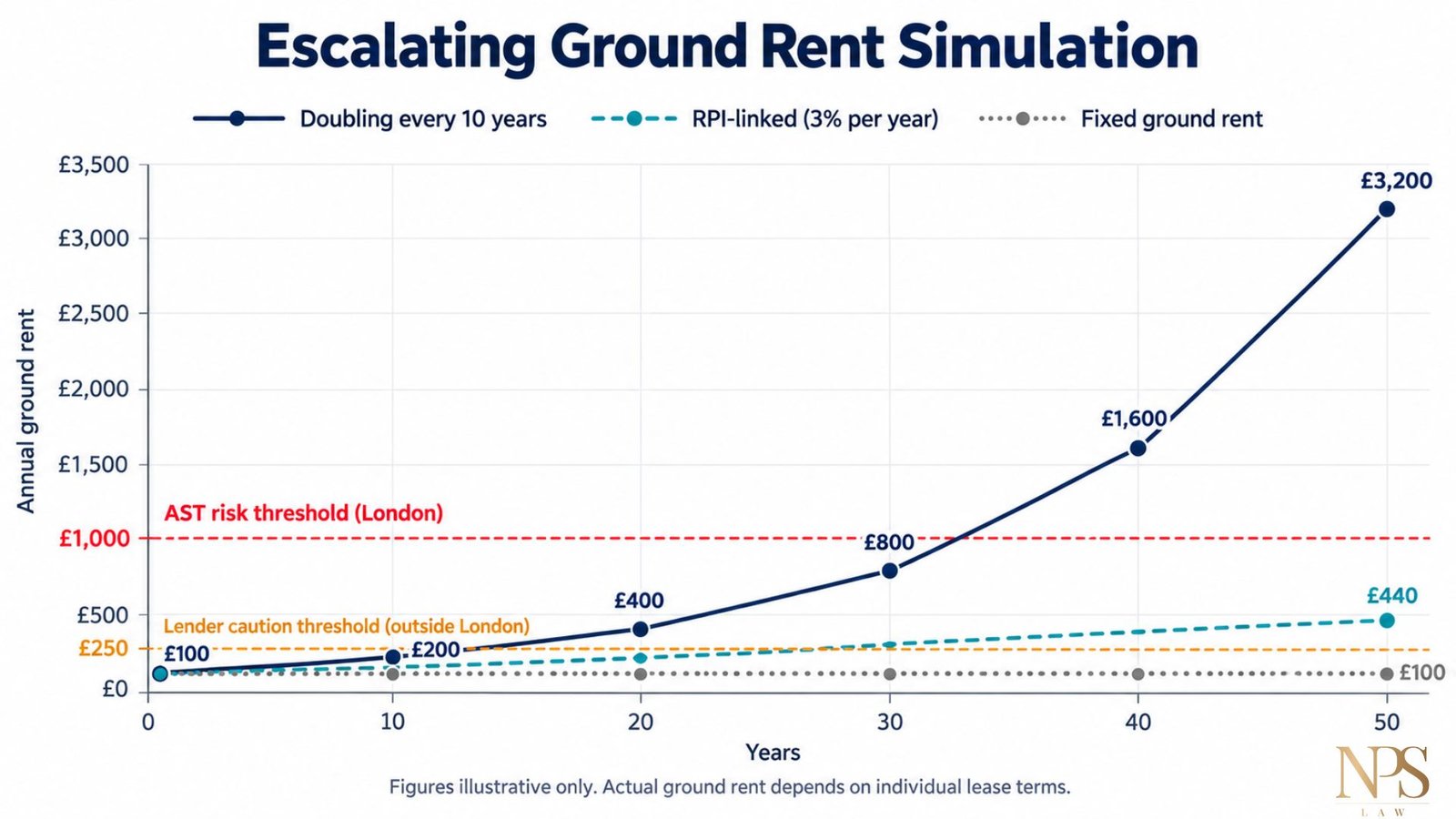
A doubling clause states that the ground rent increases by 100 per cent at set intervals, usually every ten or twenty-five years. A lease starting with a ground rent of £100 per year in 2000 with a ten-year doubling clause would reach £200 by 2010, £400 by 2020, £800 by 2030 and £1,600 by 2040. The starting figure looks manageable. The compounding does not.
Many of these leases were sold as new build properties in the 1990s and 2000s, particularly in the North West and Midlands. The doubling clause was buried in standard lease terms and buyers, often unfamiliar with leasehold law, did not understand its long-term effect. Some developers sold the freehold on to investment companies shortly after completion, which meant buyers found themselves paying an increasing ground rent to a company with no interest in the properties beyond collecting it.
Not all escalating ground rents are doubling clauses. Some leases link ground rent to the Retail Price Index, reviewed every five or ten years. Others allow the freeholder to review the ground rent at set intervals, sometimes to a market rate or to a formula set out in the lease.
RPI-linked ground rents are generally viewed as less problematic than doubling clauses by mortgage lenders, because the increases track inflation rather than compounding geometrically. That said, some lenders still require the ground rent to remain below a set threshold relative to the property value. Review clauses with market rate provisions are viewed with more caution, as the future ground rent level is harder to predict. The key question for any lender is whether they can model the ground rent over the life of the mortgage with confidence.
→ Related: Leasehold vs Freehold: What’s the Difference and Which Should You Buy?
SUMMARY
Escalating ground rent creates three distinct problems, each of which can stop a sale or mortgage in its tracks. A doubling clause that looked harmless at the start of a lease can, within twenty or thirty years, breach the thresholds that lenders and solicitors use to assess whether a leasehold property is acceptable security.
The three problems are related but not identical. A property with a ground rent of £350 a year outside London is unlikely to have a mortgage problem simply because of the AST risk threshold. But it may still have a lender problem because the doubling clause makes the long-term trajectory unpredictable. Understanding which specific problem applies to a given lease matters when deciding what steps to take.
Mortgage lenders assess ground rent risk in two ways: the current level of the ground rent relative to the property value, and the trajectory of the ground rent over the life of the mortgage. The UK Finance Mortgage Lenders’ Handbook sets out each lender’s individual requirements in Part 2, and these vary considerably.
Many lenders require the ground rent to be below a set percentage of the property value, often between 0.1 per cent and 0.5 per cent per year. A ground rent that is currently within tolerance may breach this threshold within ten or twenty years if it doubles. Some lenders refuse outright to lend against any property with a doubling ground rent clause, regardless of the current level. Others will accept it with conditions, such as a requirement that the seller provides indemnity insurance. The important point is that there is no single standard: what one lender refuses, another may accept.
When a property with an escalating ground rent is sold, the lease terms transfer to the buyer unchanged. The buyer’s solicitor will report the ground rent clause to the buyer and to their mortgage lender. If the lender declines, the buyer either needs to find a different lender willing to accept the terms or to negotiate a resolution before proceeding.
This is the point at which many sales stall. A buyer who found the property, had an offer accepted and instructed a solicitor now learns that their chosen lender will not proceed. They may be willing to use a different lender, or they may withdraw. Even where a buyer finds a willing lender, the existence of the problem may give them grounds to renegotiate the price downward. The seller loses control of the timeline and may face a chain collapse if their own purchase is time-sensitive.
In England and Wales, a long residential lease can in some circumstances be treated as an assured shorthold tenancy if the ground rent exceeds certain thresholds: £1,000 per year in Greater London or £250 per year elsewhere. A lease classified as an AST gives the freeholder access to mandatory possession grounds that do not apply to a standard long lease. No lender will accept a property carrying this risk.
Leases granted on or after 1 April 1990 and before 2022 are most at risk. Leases granted before 1990 are governed by different legislation and the AST risk does not apply in the same way. Leases granted since 2022 have peppercorn ground rents and the issue does not arise. For leases in the at-risk window, checking whether the current or projected ground rent crosses the threshold is a standard part of any conveyancing investigation.
⚠ Common Pitfall
A ground rent that is currently below the AST threshold of £250 outside London may cross it within a single doubling cycle. A lease starting with a ground rent of £150 in 2005 with a ten-year doubling clause will reach £300 in 2025, crossing the threshold, and £600 in 2035. The AST risk applies to the ground rent at the time of any transaction, not at the time the lease was granted. Always check the projected ground rent at the point of a proposed sale or remortgage, not just the current level.
SUMMARY
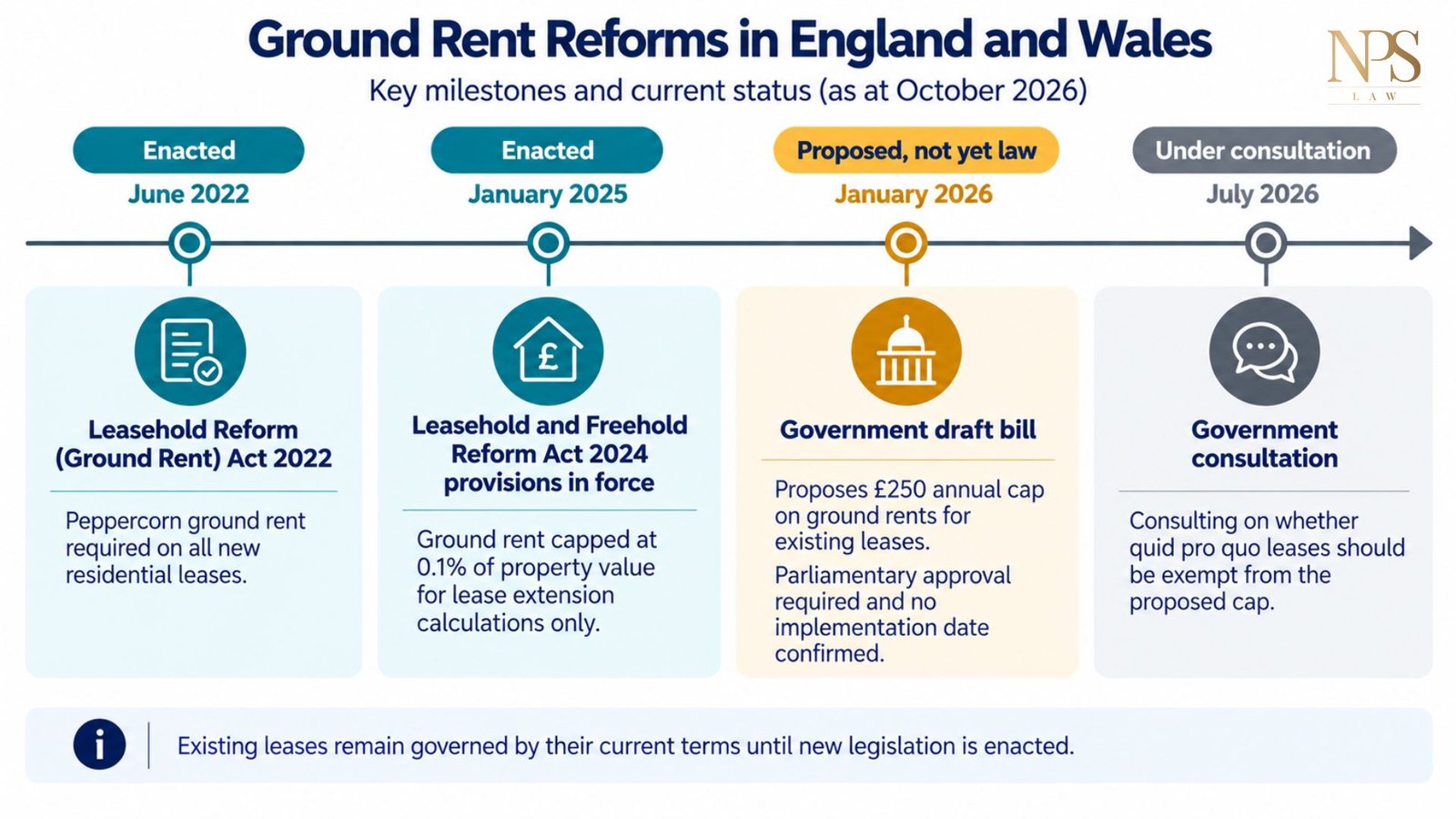
A government draft bill published in January 2026 proposes capping ground rents on existing residential leases at £250 per year. This has not been passed into law. It requires parliamentary approval and no implementation date has been confirmed. Articles describing this as settled law are incorrect. The position as at October 2026 is that the proposal exists, but existing leases remain governed by their current terms.
The government’s January 2026 announcement attracted wide coverage and has led to genuine confusion about the current legal position. The confusion is compounded by the fact that other ground rent changes were made by the Leasehold and Freehold Reform Act 2024, which is a real and partly enacted piece of legislation. The two are separate and affect different things.
The draft Commonhold and Leasehold Reform Bill published in January 2026 proposes capping ground rent on existing residential leases at £250 per year, with a further reduction to a peppercorn after forty years. The government described this as a protection for existing leaseholders who are currently trapped by onerous ground rent terms.
| Measure | What It Covers | Status as at October 2026 |
|---|---|---|
| New leases: peppercorn ground rent | Residential leases granted from 1 June 2022 (retirement properties from April 2023) | Enacted and in force |
| Lease extension: ground rent cap at 0.1% of property value in calculation | Affects how the cost of extending a lease is calculated under LFRA 2024 | Enacted: specific provisions in force from Jan 2025 |
| Existing leases: £250 annual cap | January 2026 draft bill. Would reduce ground rent on pre-2022 leases to £250, then peppercorn after 40 years | Not yet law: draft bill only. Parliamentary approval required. |
| Quid pro quo exemption from £250 cap | Consultation opened July 2026 on whether leases where a lower purchase price was tied to the ground rent should be exempt | Under consultation. No decision taken. |
The table above sets out the current status of each measure. Where a row is marked “not yet law”, existing leases are not affected. If you are deciding whether to extend your lease, sell or remortgage, you should base that decision on the law as it currently stands, not on an expectation that the draft bill will become law by any particular date.
The Leasehold and Freehold Reform Act 2024 is often cited in the context of ground rent reform, and it does make real changes. But it does not cap ground rent on existing leases. What it does is change how ground rent is treated when calculating the cost of a lease extension under the statutory route. From January 2025, the ground rent used in the lease extension valuation formula is capped at 0.1 per cent of the freehold value. This reduces the cost of extending in many cases, but it does not change the ground rent that the leaseholder actually pays day to day.
The practical effect is that extending a lease under the 2024 Act is now less expensive than it was under the previous regime. The ground rent itself under the existing lease remains unchanged until the extension completes, at which point it is replaced with a peppercorn. That outcome, a peppercorn ground rent after extension, is the most reliable way to remove the escalating ground rent problem permanently.
→ Related: Leasehold vs Freehold: What’s the Difference and Which Should You Buy?
SUMMARY
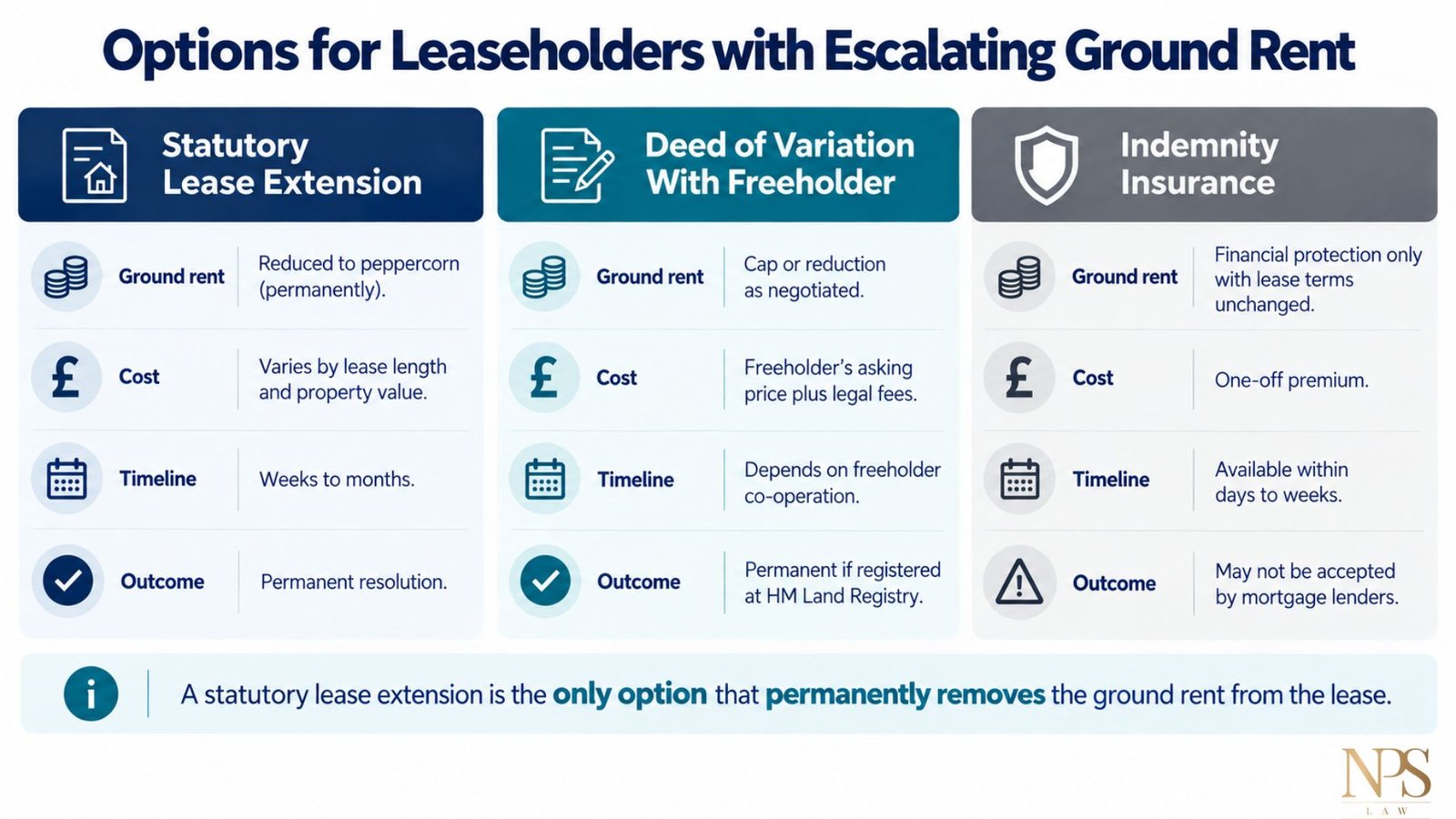
Three main options exist for dealing with an escalating ground rent. Statutory lease extension permanently removes the problem by resetting the ground rent to a peppercorn. Negotiating a deed of variation with the freeholder can also achieve a permanent fix, but requires the freeholder’s agreement. Indemnity insurance manages the financial risk without changing the lease terms, and is accepted by some but not all lenders and buyers.
The right option depends on how much time you have, what the freeholder’s attitude is likely to be, what your mortgage lender will accept and whether you are selling imminently or have time to arrange a permanent solution. These factors interact, and a solicitor can help you map out which path makes most sense given your specific lease and circumstances.
A statutory lease extension under the Leasehold Reform Housing and Urban Development Act 1993 (as modified by LFRA 2024) adds years to the lease and reduces the ground rent to a peppercorn for the extended term. Once complete, the escalating ground rent disappears permanently. The freeholder cannot refuse: this is a legal right, not a matter for negotiation.
The cost of the extension depends on the property value, the current ground rent level, the number of years remaining on the lease and the freeholder’s deferment rate. Thanks to the LFRA 2024 changes, the ground rent cap of 0.1 per cent in the valuation formula has reduced extension costs in many cases compared with the pre-2024 position. The two-year qualifying period has also been removed, so a recent purchaser can now extend without waiting.
Timing matters. A lease with fewer than 80 years remaining is more expensive to extend because marriage value becomes payable to the freeholder. The crossover is a hard line: 81 years costs considerably less than 79. If your lease is approaching that threshold, acting before it falls below 80 years is a financial priority, not just a legal nicety.
A deed of variation is a formal legal agreement between the leaseholder and the freeholder that changes a term of the existing lease. In the context of escalating ground rent, a deed of variation might cap the ground rent at its current level, convert it to a peppercorn or replace the doubling clause with a fixed annual amount acceptable to lenders.
The freeholder is not obliged to agree. Some freeholders are willing to negotiate for a fee; others refuse entirely or demand amounts that make the exercise uneconomic. The approach to the freeholder needs to be managed carefully. Once the freeholder is made aware that the ground rent terms are causing a sale problem, any subsequent indemnity insurance becomes unavailable, because the insurer requires that the freeholder is unaware of the issue. The sequence of steps matters: take legal advice before making any approach to the freeholder.
A deed of variation, once agreed and executed by both parties, must be registered at HM Land Registry to bind future owners. A signed deed that is not registered does not protect a buyer or their lender.
Indemnity insurance for escalating ground rent covers the financial consequences of the ground rent terms causing a loss to the policyholder: for example, if a buyer is unable to obtain a mortgage and the sale falls through, or if the freeholder takes action based on the ground rent. The policy does not change the lease.
The limitations are real. Many mortgage lenders will not accept indemnity insurance as a substitute for a properly resolved ground rent position, particularly for doubling clauses. A lender’s requirement is often that the ground rent must not breach certain thresholds over the life of the mortgage: a policy that pays compensation if it does is not the same as a lease that does not. Insurance is more readily accepted in transactions where the ground rent is close to but not yet at a problem level, or where the lease has a relatively short remaining term.
If you are considering insurance, do not approach the freeholder first. Contact with the freeholder about the ground rent terms is one of the standard grounds for refusing cover.
→ Related: What Is a Restrictive Covenant on a Property?
→ Related: What Is a Flying Freehold? Risks, Mortgages and Solutions for Buyers
⚠ Common Pitfall
The statutory lease extension process begins with a formal notice served on the freeholder, known as a Section 42 Notice. Once served, it cannot be withdrawn without the freeholder’s agreement, and it locks in the valuation date for the extension premium calculation. Serving the notice without first obtaining a professional valuation of the likely extension cost is a mistake that cannot easily be undone. Always instruct a solicitor and a RICS-accredited surveyor before the notice is served.
SUMMARY
Escalating ground rent does not make a property unsellable. It does make the sale more complicated, because the buyer’s solicitor will report the ground rent terms to the lender and the lender may decline. The practical question is not whether to disclose the ground rent, it will be discovered regardless, but how to prepare so that the transaction can proceed.
A buyer’s solicitor reviewing a leasehold title will check the ground rent clause as a standard part of their investigation. They will report it to the buyer and to the mortgage lender. If the lender declines, the seller can either wait for the buyer to find an alternative lender, resolve the ground rent issue before the sale, or accept that the market for the property is narrowed.
A buyer’s solicitor will check three things: the current annual ground rent, the mechanism by which it increases, and the projected level of the ground rent over the next fifty years or so. They will compare the current and projected figures against the lender’s requirements in Part 2 of the UK Finance Mortgage Lenders’ Handbook and against the AST risk thresholds.
A doubling clause will typically be identified as a problem regardless of the current ground rent level, because the long-term trajectory is adverse. A fixed or very slowly increasing ground rent that is currently well below the relevant thresholds is less likely to cause difficulty. The buyer’s solicitor may also ask for evidence of any previous correspondence with the freeholder about the ground rent terms, which is another reason to take advice before approaching the freeholder.
If you know your lease has an escalating ground rent, the most useful thing you can do before listing the property or applying to remortgage is to instruct a solicitor to review the lease and advise on the options. This is not a lengthy or expensive process and it tells you what you are dealing with before a buyer or lender discovers it.
These steps do not need to take months. A solicitor reviewing the lease and providing initial advice can often do so within a few days. The sooner the position is understood, the more options remain open.
→ Related: New Build Conveyancing: What to Expect and Why You Need a Specialist
SUMMARY
Escalating ground rent problems are not resolved by waiting. The draft legislation in Parliament may help some leaseholders in future, but the timeline is uncertain and existing leases remain governed by their current terms in the meantime. NPS Law advises leaseholders on all stages of this process, from initial lease review to statutory extension, deed of variation and sale support.
Our approach starts with understanding the specific lease. Not all escalating ground rent problems are the same, and the right solution depends on the lease terms, the property value, the freeholder’s likely response, the available timeline and the client’s objectives. We will explain the options, the likely costs and the realistic outcomes before recommending a course of action.
If you are facing a ground rent problem on a property you own, are trying to sell or are considering buying, contact NPS Law for a free initial consultation. We will review the position and advise on the realistic options without obligation.
→ Related: Average Conveyancing Fees UK 2026: What Buyers and Sellers Should Expect
The questions below address the most common queries from leaseholders dealing with escalating ground rent in England and Wales.
Yes, though the sale may be more complicated than a standard leasehold sale. The buyer’s solicitor will identify the ground rent clause and report it to the buyer’s mortgage lender. Some lenders will decline; others will accept with conditions.
The pool of available buyers is narrower where the ground rent is high or has a doubling clause. Taking advice before listing the property gives you more options: if there is time to extend the lease or arrange a deed of variation before a buyer is found, the sale is likely to be smoother and the price stronger.
Many lenders will refuse, or will impose conditions. There is no universal rule: lenders’ requirements are set out individually in Part 2 of the UK Finance Mortgage Lenders’ Handbook, and they vary. Some lenders decline any property with a doubling clause regardless of the current level.
Others will proceed if the current ground rent is below a threshold and the next doubling is some years away. A mortgage broker with experience of leasehold properties can identify lenders likely to accept the specific property before a full application is made.
Not yet. The government published a draft bill in January 2026 proposing a £250 annual cap on ground rents for existing residential leases, with a further reduction to a peppercorn after forty years.
As at October 2026, this has not been passed into law. Parliamentary approval is required and no implementation date has been confirmed. If you are making a decision about selling, remortgaging or extending your lease, do not base that decision on an assumption that the cap will apply within any particular timeframe. Take advice on the current legal position.
NPS Law provides a written fixed-fee quote before instruction for all ground rent-related advice, whether that is a lease review, a deed of variation or a statutory lease extension. The fee for a lease review and initial advice is typically modest and can often be provided within a few days.
Statutory lease extension costs depend on the complexity of the matter and the level of negotiation required with the freeholder. There is no hourly billing. Contact us for a free initial consultation and we will confirm what is involved and what it will cost.
We report the ground rent clause to you in writing as part of our standard title report, explaining the current level, the review mechanism and the projected trajectory. We then confirm whether the terms are likely to cause a problem with your mortgage lender and set out the options available to you before exchange.
We will not exchange contracts on a property with an unresolved ground rent problem without your informed agreement to the position and the risk. If you ask us to proceed despite the issue, we will confirm our advice in writing.
An escalating ground rent does not fix itself. The doubling clause in a lease that was signed twenty years ago is still there. The ground rent that was £100 at the start may now be £200 or £400. In another ten years it will be higher still, and the pool of lenders and buyers willing to deal with it will be smaller. Waiting for draft legislation to become law is not a strategy.
The options for resolving the problem are real and available now. A statutory lease extension permanently removes the escalating ground rent. A deed of variation can achieve the same result where the freeholder agrees. Both are within reach for most leaseholders, and the cost of acting now is lower than the cost of trying to sell a difficult property in a narrowed market later.
NPS Law handles all aspects of escalating ground rent cases, from the initial lease review to the statutory extension and sale. If you are concerned about ground rent terms on a property you own or are buying, speak to our team. The earlier the question is asked, the more straightforward the answer tends to be.
Concerned About Escalating Ground Rent? Talk to NPS Law.
NPS Law advises leaseholders on ground rent problems, lease extensions and deeds of variation across England and Wales. Fixed fees, free initial consultation and no completion, no fee protection on every instruction.
Disclaimer: This article is for general informational purposes only and does not constitute formal legal advice. The law described applies to England and Wales unless otherwise stated. Legislative proposals described as draft bills or consultations are not yet law. For specific legal matters, please consult with a qualified solicitor.

©️ Copyright 2026 NPS Law is a trading name for NPS Law LLP. Solicitors of England and Wales. Authorised and Regulated by the Solicitors Regulation Authority. SRA Number 570169. A list of all Partners is available on the SRA directory for this firm. website designed by origin-media