
The conveyancing report arrives in your inbox a few days after your offer is accepted. It runs to thirty pages. Somewhere in the middle, under the title register section, you find a paragraph that begins with the words “restrictive covenant”. Your solicitor has flagged it. You have no idea what it means, why it matters or whether it should concern you. That experience is almost universal among first-time buyers, and not uncommon among experienced ones either.
This guide explains what restrictive covenants are, where they come from, what happens if they are breached and what options exist if one stands in the way of something you want to do with your property. Whether you are buying, selling or planning to extend, the answer to almost every question starts with the same step: read the covenant and take specialist legal advice before you act.
SUMMARY
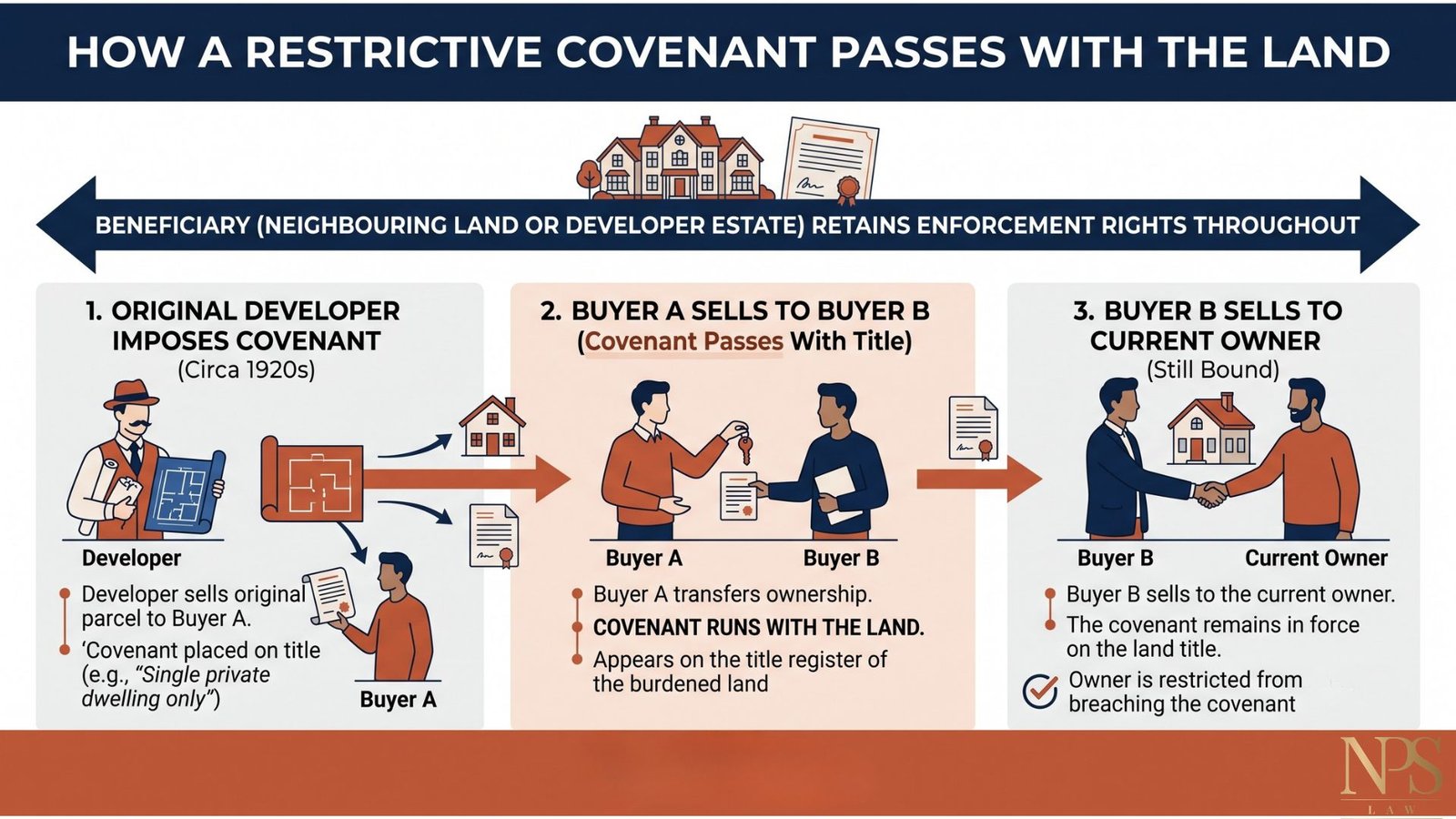
A restrictive covenant is a legal obligation embedded in the title of a piece of land that restricts how the owner can use or develop it. The obligation is not personal to the person who first accepted it: it passes with the land and binds every subsequent owner. The legal basis for this principle was established in the case of Tulk v Moxhay in 1848 and remains foundational to the law of England and Wales today.
When a restrictive covenant is imposed, two parties are involved. The covenantor is the party who accepts the restriction and whose land is burdened by it. The covenantee is the party who benefits from the restriction and whose land or interest is protected by it. The burdened land is the property that must comply. The benefiting land is the neighbouring or associated land that gains from the restriction being in place.
The covenantor and covenantee can be any two parties, but in residential property the most common arrangements are between an original developer and an individual buyer, or between neighbouring landowners. What distinguishes a restrictive covenant from a simple personal contract is that the obligation runs with the land rather than attaching to the individual who made the agreement.
It is also distinct from an easement, which gives someone else a right to use or access your land, such as a right of way or a right to light. Both can appear on a property title and both can affect what you do with it, but they are created and enforced under different legal rules.
Most restrictive covenants on residential property in England and Wales originate from one of two sources: historical land development and modern residential estate building.
The Victorian and Edwardian eras saw large-scale development of residential estates, during which original landowners subdivided their holdings and sold individual plots. To maintain the character and value of the broader estate, they imposed covenants on each plot: no further building without consent, residential use only, no trade or business to be carried out. Those covenants were written into the transfers and, where they met the legal tests, were intended to bind all future owners in perpetuity.
Modern developers impose covenants too, typically to protect the appearance and uniformity of new build developments, to restrict commercial use and to control alterations during the period when the developer still has an interest in unsold plots. The difference is that modern covenants are almost always registered on the title, whereas older ones can exist in the deed history without appearing in the current Land Registry entry.
Not every obligation in a property transaction is a restrictive covenant. A positive covenant requires the landowner to do something: maintain a fence, contribute to the cost of a shared driveway, keep a wall in repair. A restrictive covenant requires the landowner to refrain from doing something: not build beyond a certain footprint, not use the property for commercial purposes, not alter the external appearance without consent.
The legal distinction matters because the law of England and Wales treats the two differently. Under the rule in Tulk v Moxhay, restrictive covenants can run with the land and bind future owners in equity. Positive covenants do not, as a general rule, bind successors in title at common law or in equity (Rhone v Stephens [1994] 2 AC 310) . Various mechanisms exist to achieve a similar result for positive obligations, but they are more complex and less automatic. If a conveyancing report refers to a restrictive covenant, it is specifically the negative, restraining type that carries the more powerful automatic binding effect.
→ Related: What Is Conveyancing? The Complete UK Guide for Buyers and Sellers
SUMMARY
The content of restrictive covenants varies widely, but the patterns that appear on residential property in England and Wales are fairly consistent. Understanding what the most common types restrict helps buyers identify quickly whether a flagged covenant is relevant to their plans.
The following table sets out the most frequently encountered types of restrictive covenant on residential property, along with the typical beneficiary in each case. Knowing who holds the benefit of the covenant is the starting point for any attempt to negotiate its release or modification.
| Type of Restriction | Typical Content | Who Typically Benefits |
|---|---|---|
| No further building | No extension, outbuilding or additional structure without prior consent | Adjoining landowner or original developer estate |
| Residential use only | Property must be used solely as a private dwelling; no commercial activity | Developer or estate management company |
| No external alterations | No changes to exterior materials, windows, doors or roof without approval | Developer, estate management or conservation authority |
| No subdivision | Plot cannot be divided or sold in parts | Original seller or developer |
| No trade or business | No business to be carried on at the property, whether or not it involves visitors | Developer or neighbouring landowners |
| Boundary restrictions | Fences or walls must conform to specific height, type or material | Adjoining landowner |
| No caravans or commercial vehicles | No parking of caravans, motorhomes or heavy goods vehicles on the plot | Estate management or adjoining owners |
The content of the restriction is not the only thing that matters. A covenant may say one thing and mean another depending on how it is worded, when it was created and how the courts have interpreted similar language in decided cases. The practical scope of any individual covenant should be assessed by a solicitor rather than read literally from the title register.
The age of a covenant can work in either direction. On one hand, a Victorian covenant with a beneficiary who is no longer identifiable or whose benefiting land no longer exists in a legally coherent form may have become unenforceable. On the other, a covenant created in 1890 and properly registered or protected under the old land charges system can be as binding today as the day it was imposed.
The key questions are whether the original covenant met the four legal conditions necessary to run with the land, whether the benefit and burden have been properly transmitted through subsequent title changes, and whether there is a current owner of the benefiting land who could realistically bring a claim. An old covenant with an unknown beneficiary is not automatically safe to ignore. Solicitors advising on restrictive covenant insurance will assess all of these factors before recommending a course of action.
Modern developers routinely impose detailed restrictive covenants on new build properties, particularly on large residential estates. These covenants are designed to maintain the visual uniformity and general character of the development during the period when the developer is still selling remaining plots, and often long afterwards.
Common developer covenants on new builds include restrictions on external alterations without written approval, prohibitions on caravans or commercial vehicles, requirements to use specific materials for fences and boundaries and restrictions on business use. Unlike many Victorian covenants, developer covenants on new builds are almost always fully registered on the title and the developer or an estate management company is clearly identified as the beneficiary and is likely to be actively monitoring compliance. The scope for ignoring them is minimal.
A covenant does not expire by age alone. Whether it has ceased to be enforceable depends on whether the benefit has been properly transmitted, whether the benefiting land still exists in an identifiable form and whether any claim would now be time-barred under the Limitation Act 1980.
→ Related: New Build Conveyancing: What to Expect and Why You Need a Specialist
SUMMARY
The most significant feature of a restrictive covenant is that it follows the land rather than the person. A buyer who purchases a property subject to a restrictive covenant takes on the obligation whether or not they were aware of it, and regardless of whether it was the seller who originally accepted it. This is what distinguishes a covenant from a personal agreement between two individuals.
Understanding this principle is important because it explains why a restrictive covenant flagged during conveyancing is not simply a matter between you and the seller. The obligation you are being asked to accept has a history. It was created at some point in the past, accepted by the then-owner of the land, and has been carried forward through every subsequent title transfer. By exchanging contracts, you agree to carry it forward in turn.
For the burden of a restrictive covenant to bind future owners, several conditions must be satisfied, developed from Tulk v Moxhay (1848) and subsequent cases:
The question of who can enforce is separate. The person seeking to enforce must show the benefit has also passed to them, through statutory annexation under section 78 LPA 1925, express assignment or as part of a building scheme.
How a covenant is protected against future owners depends on whether the land to which it relates is registered or unregistered at HM Land Registry.
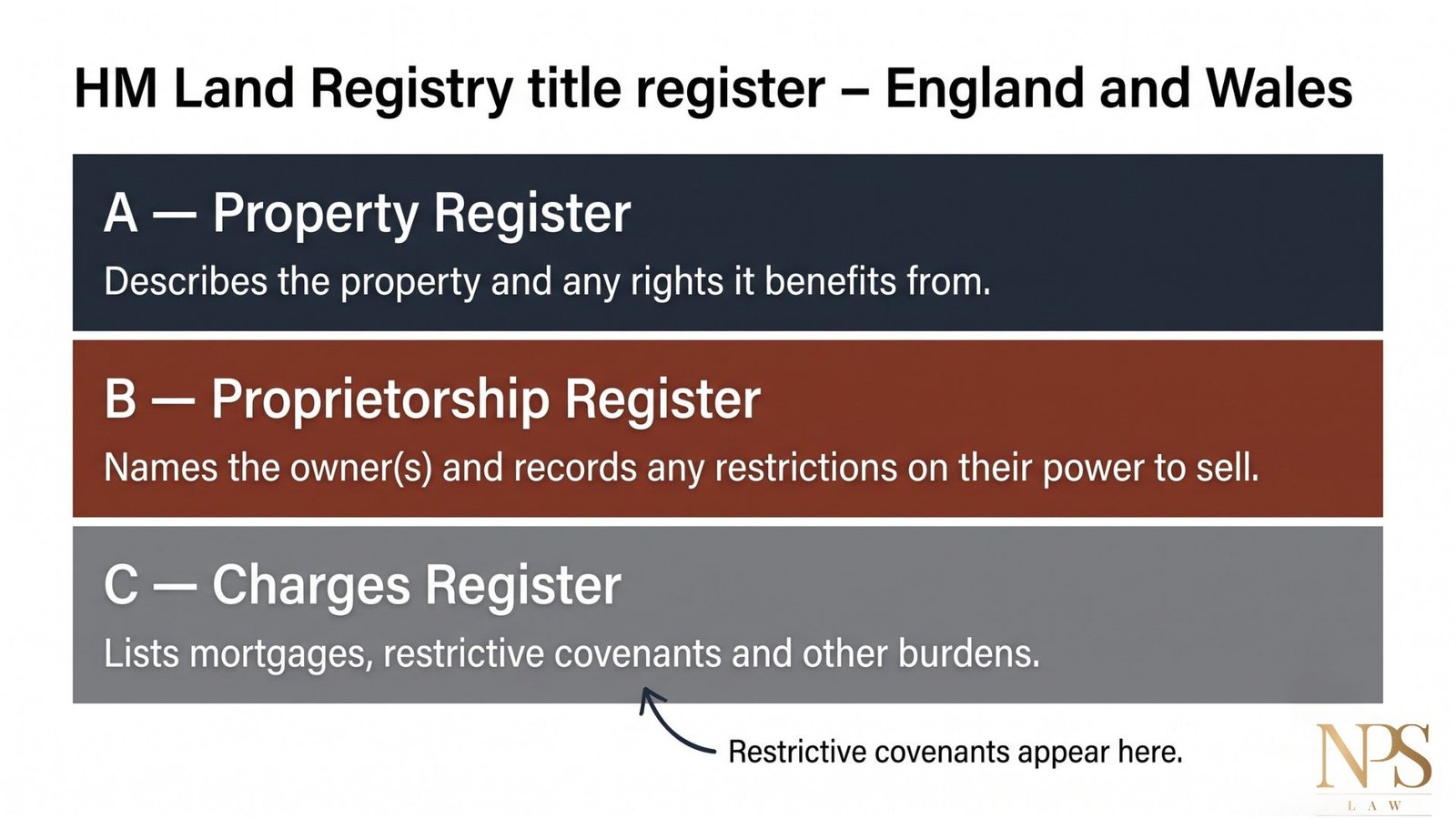
For registered land, which now covers the vast majority of property in England and Wales, restrictive covenants are protected by being noted on the charges register (the C section) of the title register. A buyer who searches the title register before completing will see the covenant noted there. The rule is that they are bound by it whether or not they have actually read it, provided it appears on the register.
For unregistered land, the position depends on when the covenant was created. Covenants created before 1926 are governed by the doctrine of notice: a buyer is bound if they had actual, constructive or imputed notice of the restriction. Covenants created from 1926 onwards must be registered as a Class D(ii) Land Charge under the Land Charges Act 1972. If not so registered, a purchaser for value takes free of the covenant regardless of any actual knowledge they had at the time of purchase (s4(6) LCA 1972). Knowledge alone does not make an unregistered post-1925 covenant binding.
For registered land, the position is governed by LRA 2002 s29. A purchaser for value takes free of any interest not protected by an entry on the register, a registered charge or an overriding interest. Constructive notice plays no role in registered land: priority is determined by the register alone.
→ Related: Average Conveyancing Fees UK 2026: What Buyers and Sellers Should Expect
SUMMARY
Breaching a restrictive covenant can have serious legal consequences. The beneficiary of the covenant has the right to seek a court order requiring you to undo the breach and, in some circumstances, may be entitled to financial compensation. The risk does not disappear simply because the work has been completed or because the breach was unintentional.
Many breaches are not deliberate. An owner adds a conservatory without checking whether a covenant prevents further building. A buyer inherits a property where a previous owner ran a business in breach of a residential use covenant. In both cases, the legal exposure is real. The existence of a breach and the decision to enforce it are separate questions, and not every beneficiary will act. But the risk of one that does is not theoretical.
The primary remedy available to a beneficiary when a restrictive covenant is breached is an injunction. A mandatory injunction can require the person in breach to undo whatever has been done: take down an extension, remove a converted outbuilding, restore altered boundaries. Courts are not automatically sympathetic to arguments that the cost of compliance is disproportionate. In cases where the breach is flagrant or deliberate, the court may order remediation even where the financial cost is high.
Injunctions are more likely to be granted where the application is made promptly after the breach is discovered, where the breach causes genuine harm or annoyance to the beneficiary and where the work has not yet been substantially completed. Once major works are finished, a court may be more inclined to award damages in lieu rather than require demolition. But this is not guaranteed, and the risk of a demolition order is real enough that solicitors always flag it as a possibility before any work covered by a covenant begins.
In some cases, a court will award damages instead of granting an injunction. This is more likely where the breach has already been completed, where the impact on the beneficiary is modest or where ordering demolition would be disproportionate to the benefit gained by restoring compliance.
The level of damages in restrictive covenant cases is assessed using the principles established in Wrotham Park Estate Co v Parkside Homes [1974], which recognised that damages could be calculated by reference to the sum of money the court considers the parties would notionally have agreed as the price for releasing the covenant. This can result in a substantial award even where the beneficiary has suffered no measurable financial loss, because the court is compensating for the value of the right that was taken without consent.
⚠ Common Pitfall
Indemnity insurance is available for an existing breach of a restrictive covenant, including one committed years ago. What makes insurance unavailable is not the breach itself but contact with the beneficiary: approaching anyone who holds the benefit invalidates any existing policy and prevents a new one from being issued. Planning applications are public record and carry the same risk, because a neighbour’s objection on covenant grounds counts as the beneficiary becoming aware. Arrange insurance before any planning application is submitted and before approaching anyone for consent. Once contact has been made, the insurance window may be closed.
Where a breach has already occurred before legal advice is sought, the priority is to assess whether the beneficiary is aware, whether they are likely to act and what remedies remain available. NPS Law can advise on the practical risk level and the options for regularising the position.
SUMMARY
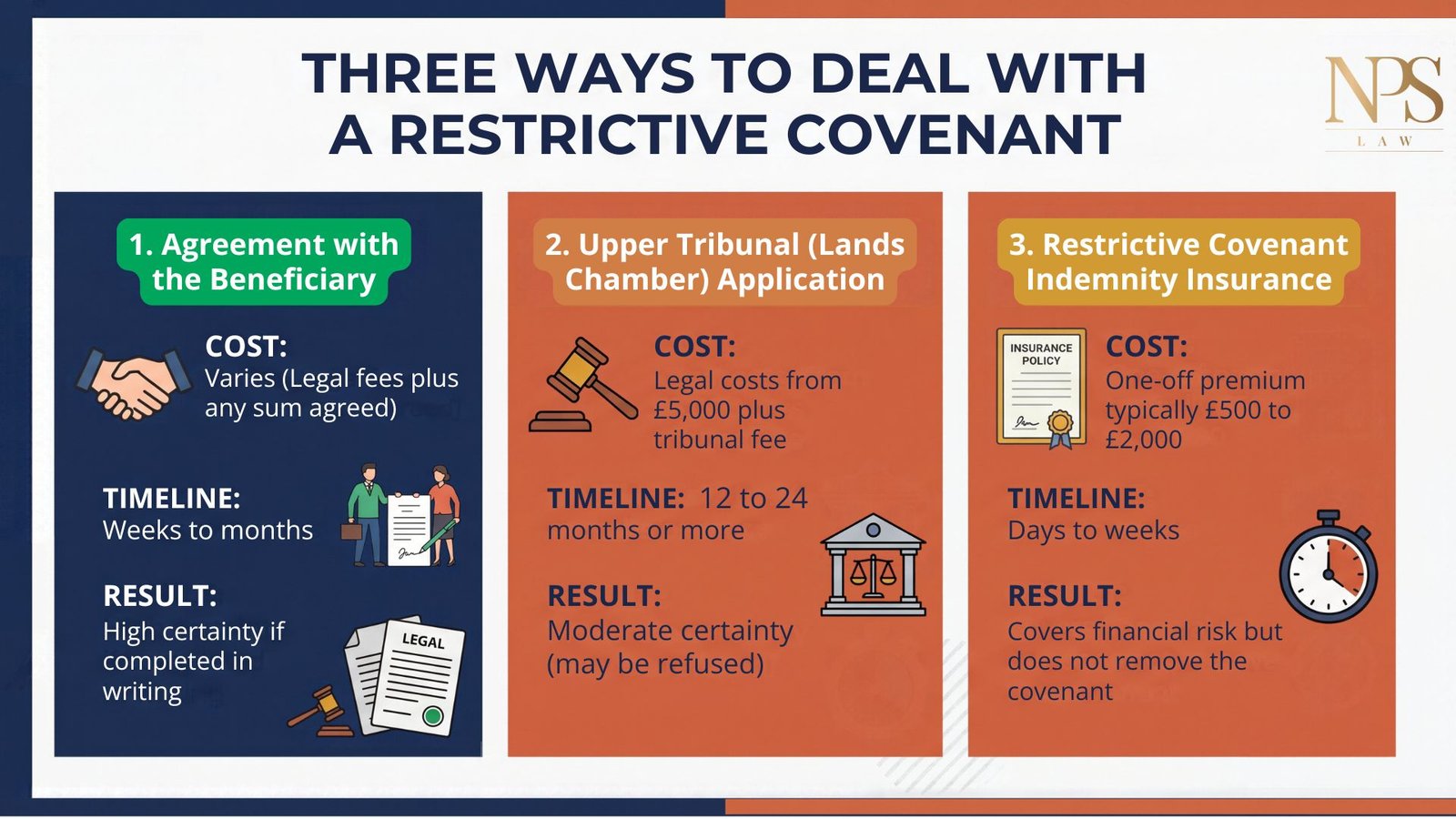
A restrictive covenant does not disappear with time. It can, however, be addressed in one of three ways: negotiating with the beneficiary to obtain a formal release or modification, applying to the Upper Tribunal (Lands Chamber) for discharge or modification under statute, or obtaining restrictive covenant indemnity insurance to manage the financial risk of enforcement. Each approach has different costs, timelines and outcomes.
The right approach depends on the nature of the covenant, how old it is, who holds the benefit, what you want to do with the property and how quickly you need to proceed. In many cases, particularly where the transaction is time-sensitive, insurance is the most practical short-term solution while leaving the covenant technically in place.
Where the beneficiary of a covenant can be identified and is willing to engage, a negotiated release or formal modification is the cleanest outcome. A deed of release or modification, properly executed and registered at HM Land Registry, conclusively disposes of the restriction. It provides complete certainty for the current transaction and all future dealings with the property.
The challenge is that the beneficiary is not obliged to agree, and may demand a substantial payment in return for releasing a valuable right. Where the property sits within a residential estate built under a building scheme, each plot owner may hold the benefit of covenants imposed on every other plot (Elliston v Reacher [1908]). Agreement from one neighbour is not sufficient: a full release requires consent from every current beneficiary on the estate, which can make negotiation impractical.
Negotiations can also be slow. Some beneficiaries are companies that have been dissolved or individuals who are difficult to trace. Even where contact is possible, the process of agreeing terms, drafting a deed and completing registration can take several months, which is rarely compatible with a transaction under offer.
Under section 84 of the Law of Property Act 1925, an owner of burdened land can apply to the Upper Tribunal (Lands Chamber) for the modification or discharge of a restrictive covenant. The Tribunal has discretion to make an order where one or more statutory grounds are established, the most commonly relied upon being that the restriction is obsolete due to changes in the character of the neighbourhood, that it impedes reasonable use of the land without securing practical benefits of substantial value or advantage to those entitled to benefit, or that the beneficiary has agreed.
Tribunal applications are not straightforward. They require a formal application, detailed evidence of the grounds relied upon and a willingness to defend the position if the beneficiary opposes. Proceedings typically take twelve to twenty-four months or longer. Legal costs can be significant. The outcome is not guaranteed: the Tribunal can refuse an application even where the covenant appears outdated. This route is more commonly used where a negotiated release is impossible and the stakes justify the time and expense involved.
Three decisions from 2020 to 2025 are particularly relevant for anyone considering a Tribunal application or a purchase involving a potential breach.
In Alexander Devine Children’s Cancer Trust v Housing Solutions Ltd [2020] UKSC 45, the Supreme Court refused to discharge a covenant where the developer had knowingly built in breach of it. The Tribunal’s discretion takes into account the conduct of the applicant, not just the technical grounds, and a cynical or deliberate breach will count against an application.
Lackey v Pearce [2024] UKUT 189 and Garton v Wheatcroft [2025] UKUT 253 both involved applications to build in residential gardens. Both were refused despite the existence of planning permission. The Tribunal’s position is consistent: planning permission and covenant law are separate regimes, and resolving one does not resolve the other.
The counterpoint is Ball v Fulton [2025] UKUT 135, where the Tribunal discharged a covenant on the basis that it had become personal to the original covenantee and did not bind successors. Discharge is available where the right circumstances can be established, but the analysis is always fact-specific.
Where neither negotiation nor a Tribunal application is practical in the timescale of a transaction, restrictive covenant indemnity insurance provides a workable alternative. The policy indemnifies the buyer and their mortgage lender against the financial consequences of the beneficiary seeking to enforce the covenant. The premium is typically paid as a one-off sum and the policy runs with the property, protecting future owners as well.
Insurance does not remove the covenant or resolve the legal position. It manages the financial risk. If the insured party builds an extension in breach of a covenant and the beneficiary obtains an injunction requiring demolition, the policy will cover the cost of complying with the order and any damages awarded. The covenant itself remains on the title. Most policies cover the cost of defending a claim, reduction in market value and the cost of settling with the beneficiary. Lost profits and financing costs are typically excluded.
Insurers will not issue a policy if the beneficiary is known to be aware of the breach, which is why the approach must be considered before any approach is made to the beneficiary.
| Approach | Typical Cost | Timescale | What It Achieves |
|---|---|---|---|
| Beneficiary agreement | Legal fees plus any agreed sum | Weeks to months | Complete removal of the covenant if registered |
| Upper Tribunal application | A setting-down fee of £999 to the Tribunal applies before legal and expert witness costs, which in contested cases regularly exceed £5,000 in total. | 12 to 24 months or more | Discharge or modification if grounds are met |
| Indemnity insurance | One-off premium: varies (straightforward residential cases from a few hundred pounds; complex cases significantly more) | Days to weeks | Financial protection without removing the covenant |
The three approaches are not mutually exclusive. Insurance can be taken out immediately to enable a transaction to proceed, while a longer-term negotiation or Tribunal application is pursued afterwards. A solicitor advising on a specific covenant will assess which combination of approaches is appropriate given the facts.
→ Related: Transfer of Equity: Costs, Process and When You Need a Solicitor
SUMMARY
Identifying restrictive covenants is a standard part of the conveyancing process. Your solicitor reviews the title documents, searches the Land Registry entries and raises specific enquiries to establish what covenants exist, who holds the benefit and whether any existing or planned activity constitutes a breach. This review is not optional.
Conveyancing solicitors receive and review the title register and associated documents as a matter of course on every residential purchase. The section of the title register most relevant to restrictive covenants is the charges register, referred to as the C register. Any restrictive covenants created after the title was first registered will typically appear here, described in the original wording from the transfer or conveyance in which they were imposed.
The Land Registry title register is divided into three parts: the property register (A), the proprietorship register (B) and the charges register (C). Restrictive covenants are listed in the C register, often with a reference to the document in which they were originally set out. That document, usually a transfer or a conveyance, is obtained separately and must be read in full to understand the scope of each restriction.
Once the covenant is identified, your solicitor will assess several things: what the covenant actually prohibits, who originally imposed it and who now holds the benefit, whether the legal conditions for the covenant to run with the land are satisfied and whether anything you plan to do with the property would constitute a breach. Any relevant findings are reported to you and, where a mortgage lender is involved, to the lender as well. If a breach is identified or a potential breach is foreseeable, your solicitor will advise on the appropriate next steps before exchange.
Not every restrictive covenant that affects a property will appear in the title register. Covenants created before the land was first registered at HM Land Registry may not have been carried forward into the register when first registration occurred. These are sometimes called off-register covenants, and they are a genuine source of risk in conveyancing transactions.
The mechanism for discovering off-register covenants is reviewing the original title deeds rather than the Land Registry entry. In unregistered land transactions and in older registered titles where the first registration was done without full conversion of the pre-registration history, these deeds are the only source of the covenant information. A thorough conveyancing solicitor will request and review any available prior title documentation and will raise enquiries with the seller about the existence of restrictions not apparent from the register.
⚠ Common Pitfall
A clear Charges Register does not mean no restrictive covenants exist. A common entry reads: “A Conveyance dated [date] contains covenants, but no copy was supplied on first registration.” The restriction exists; its content is unknown until the original deed is recovered. Where the deed cannot be located, indemnity insurance is the standard response. For registered land, constructive notice does not fill the gap: under LRA 2002 s29, a purchaser for value takes free of any interest not entered on the register.
Where a potential off-register covenant is identified or suspected, the options are to seek further documentation, raise detailed enquiries with the seller or, where the risk cannot be fully resolved, to obtain restrictive covenant indemnity insurance to cover the possibility of an unknown covenant being enforced.
SUMMARY
Restrictive covenants arise at every stage of the property ownership journey: when buying, when planning works, when selling and when disputes arise. NPS Law advises on all of these situations as part of our residential conveyancing service, with fixed fees agreed before instruction and a free initial consultation at no charge.
The most common point at which clients encounter restrictive covenant issues is during the purchase of a property. Our conveyancing solicitors review the full title documentation as standard, identify any relevant covenants and advise on their implications before you are committed. If a problem is identified, we will explain the options and help you decide how to proceed before exchange of contracts.
If you are planning an extension, a change of use or any other works that may be affected by a restrictive covenant, speak to a solicitor before you begin. The cost of early advice is a fraction of the cost of dealing with an enforcement action once work has started. NPS Law offers a free initial consultation with no obligation. Contact our team to discuss your situation.
→ Related: Residential Conveyancing with NPS Law
The questions below address the most common queries from buyers, owners and sellers dealing with restrictive covenants on residential property in England and Wales.
It depends on what the covenant says. Some covenants prohibit any further building without consent from the beneficiary. Others apply only to building in a specific location or exceeding a certain footprint. Before any planning application or building work begins, your solicitor should review the covenant to establish whether the proposed works would be a breach. If they would, you will need to obtain the beneficiary’s consent, apply to the Upper Tribunal for modification or arrange restrictive covenant indemnity insurance before proceeding.
The starting point is the charges register (C register) of your HM Land Registry title register. This is available to download online for a small fee. Any registered restrictive covenants will be noted there, with a reference to the document in which they appear. However, older covenants created before first registration may not appear in the register. A conveyancing solicitor reviewing your title documents will check both sources and report on anything relevant.
Possibly. A covenant requiring residential use only, or prohibiting trade or business being carried on at the property, may extend to working from home depending on how the court would interpret the specific wording. Much depends on the nature of the work: a professional using a home office without clients visiting is in a very different position from someone running a business that generates regular deliveries, visitors or vehicle movements. If your title includes a residential use covenant and you plan to work from home or run a business from the property, take legal advice on the specific wording before you begin.
NPS Law provides a written fixed-fee quote before instruction for all restrictive covenant advice, whether as part of a conveyancing transaction or as a standalone consultation. The fee reflects the complexity of the covenant, the number of documents to review and the nature of the advice required. There is no hourly billing. Contact us for a free initial consultation and we will explain what is involved and what it will cost before you commit to anything.
We report the covenant to you in writing as part of our standard title report, explaining its scope, who holds the benefit and whether anything you plan to do could constitute a breach. If a problem is identified, we will set out the available options: approaching the beneficiary, applying for indemnity insurance, applying to the Upper Tribunal or adjusting your plans to avoid a breach. We will not exchange contracts on a property with an unresolved restrictive covenant issue without your informed consent to the position and the risk.
A restrictive covenant on a property is not automatically a problem. Most are manageable. Some turn out to be unenforceable. Others can be insured against for a modest one-off premium. The key is understanding exactly what you are dealing with before you exchange contracts, apply for planning permission or begin any works.
The worst outcomes in restrictive covenant cases share a common cause: someone assumed the restriction did not apply, did not check or decided to proceed without advice and hope for the best. The person who builds an extension in breach of a covenant they never read, or who runs a business from home without checking the title, is not in a better position than someone who investigated and found a problem. They are in a worse one, because they have fewer options and less time to resolve it.
NPS Law reviews restrictive covenants as part of every residential conveyancing instruction. If a covenant is flagged on a property you are buying, we will explain what it means and what you can do about it. If you are planning works or a change of use and want to check your position before you start, contact our team for a free initial consultation. The earlier the question is asked, the more options are available.
Ready to speak to NPS Law about a restrictive covenant?
NPS Law advises buyers, sellers and property owners on restrictive covenants as part of our residential conveyancing service. Fixed fees, free initial consultation and no completion, no fee protection on every instruction.
Disclaimer: This article is for general informational purposes only and does not constitute formal legal advice. The law described applies to England and Wales unless otherwise stated. For specific legal matters, please consult with a qualified solicitor.
★ 4.8 / 5.0 from 520 client reviews on ReviewSolicitors (including Google reviews)

©️ Copyright 2026 NPS Law is a trading name for NPS Law LLP. Solicitors of England and Wales. Authorised and Regulated by the Solicitors Regulation Authority. SRA Number 570169. A list of all Partners is available on the SRA directory for this firm. website designed by origin-media