
★ 4.8 / 5.0 from 520 client reviews on ReviewSolicitors (including Google reviews)
You chose freehold. No landlord, no ground rent, no annual permission to make changes to your own home. That was the point. Then the conveyancing report arrived and your solicitor mentioned an estate rent charge. The development comes with an annual obligation. There is a management company. And if you do not pay, things can escalate quickly.
Estate rentcharges are found on new build freehold estates across England and Wales, and they are better understood before exchange than after. This guide explains what an estate rent charge is, how it differs from other types of rentcharge, why Section 121 of the Law of Property Act 1925 makes it a title issue rather than just a billing one, what the law currently says and what has not yet changed, and what to confirm before you commit. This article applies to property in England and Wales only.
SUMMARY
An estate rent charge is a legal obligation requiring the owner of a freehold property to make periodic payments to a designated recipient, usually a management company or the original developer. It is attached to the land itself, not to any individual, and transfers automatically when the property is sold. It is distinct from ground rent, which applies to leasehold properties, and from the old-style rentcharges created before modern housing legislation.
Freehold ownership is often described as outright ownership with no ongoing obligations to a third party. In practice, many freehold properties on modern managed estates carry an estate rent charge that runs against the title. The buyer takes on the obligation whether or not they are aware of it at the point of purchase, which is why identifying it during conveyancing matters.
When a developer builds a residential estate with shared areas, roads, lighting, open spaces or communal facilities, those areas need to be maintained. On a leasehold estate, maintenance costs are collected through service charges. On a freehold estate, the mechanism is often an estate rentcharge.
The rentcharge is created in the transfer deed when a plot is sold. It specifies the annual amount, the recipient and the review mechanism, if any. The recipient is usually a management company established by the developer, though this can change over time if the management function is transferred. The charge continues for as long as the rentcharge exists, which for an estate rent charge means indefinitely, because this category is excluded from the 2037 expiry under the Rentcharges Act 1977.
The annual amount on a typical modern estate ranges from a few hundred pounds to over a thousand, depending on the size of the shared areas and the scope of the management company’s responsibilities. Unlike leasehold service charges, estate rentcharges are not regulated under the same statutory framework, and the mechanisms for challenging increases or querying costs are more limited.
| Annual amount | Typically £200 to over £1,000 per year, depending on estate size and scope of maintenance |
| Duration | Indefinite - estate rentcharges are excluded from the 2037 expiry under the Rentcharges Act 1977 |
| Transfer on sale | Passes automatically with the property on every future sale without requiring a new agreement |
“Fleecehold” is an informal term used to describe freehold properties where the buyer pays ongoing management charges without the protections that leasehold law gives to service charge payers. The word combines “freehold” with the suggestion of being “fleeced”. It has gained currency in the press and in consumer campaigns because the experience it describes is a real one.
The pattern that attracts the term typically involves a developer selling freehold houses on an estate with a management company that retains control of shared spaces and charges for their upkeep. Charges may increase year on year without detailed justification. The management function may be sold to a third-party company that the residents had no say in choosing. Challenges to the level of charges are possible but involve more effort and expense than the equivalent process for leasehold service charges, where statutory rights exist.
Understanding whether a property carries a fleecehold-type estate rentcharge, and on what terms, is a practical priority rather than a theoretical concern. The Section 121 enforcement mechanism described later in this article turns a billing irritation into a title risk.
→ Related: Leasehold vs Freehold: What’s the Difference and Which Should You Buy?
SUMMARY
The word “rentcharge” covers several legally distinct obligations. Confusing estate rentcharges with older regulated rentcharges leads to misunderstanding which legal protections apply, whether the 2037 expiry date is relevant and what the 2024 Act actually changed. The table below sets out the key differences.
The distinction matters in practice because the 2024 Act protections, the 2037 expiry and the Section 121 enforcement right all apply differently depending on which type of rentcharge is involved. A property with an old regulated rentcharge and a property with a modern estate rentcharge are in different legal positions, even though both involve annual payments attached to the title.
| Type | What It Is | Expires 2037? | LFRA 2024 Protections? | Section 121 Risk? |
|---|---|---|---|---|
| Regulated rentcharge | Pre-1977 rentcharge created as part of a historical land transaction, not for estate management purposes | Yes (Rentcharges Act 1977) | Yes, from 24 July 2024 | Largely removed by 1977 Act provisions |
| Estate rentcharge (fixed) | Annual fixed charge created on a modern residential estate to fund shared maintenance | No (explicitly excluded) | No | Yes, under current law |
| Estate rentcharge (variable) | Annual charge linked to actual maintenance costs, reviewed periodically | No (explicitly excluded) | No | Yes, under current law |
Regulated rentcharges were typically created before the Rentcharges Act 1977 came into force. They were used in historical land transactions as a way of retaining a stream of income from land that had been sold, rather than to fund estate management. Most have no connection to the upkeep of shared facilities.
The Rentcharges Act 1977 provided that all existing rentcharges would be extinguished on 22 July 2037 and that no new regulated rentcharges could be created after the Act came into force. The Leasehold and Freehold Reform Act 2024 then added additional protections for holders of regulated rentcharges, including restrictions on how the Section 121 enforcement right could be used against them. These protections came into force on 24 July 2024.
Estate rentcharges are a different creature. They are created after 1977, so they are permitted under the Rentcharges Act, and they are created specifically for estate management purposes rather than as a historical income stream. The 1977 Act’s 2037 extinction provision does not apply to them: parliament carved them out because abolishing them would remove the legal mechanism that funds estate upkeep on thousands of freehold developments.
Fixed estate rentcharges specify a set annual sum in the transfer deed. Variable estate rentcharges link the annual charge to the actual costs incurred by the management company, with the buyer obliged to pay their proportionate share. Variable charges are less predictable and can increase if maintenance costs rise or if the management company’s scope of activity expands. Neither type benefits from the LFRA 2024 protections that were introduced for regulated rentcharges.
SUMMARY
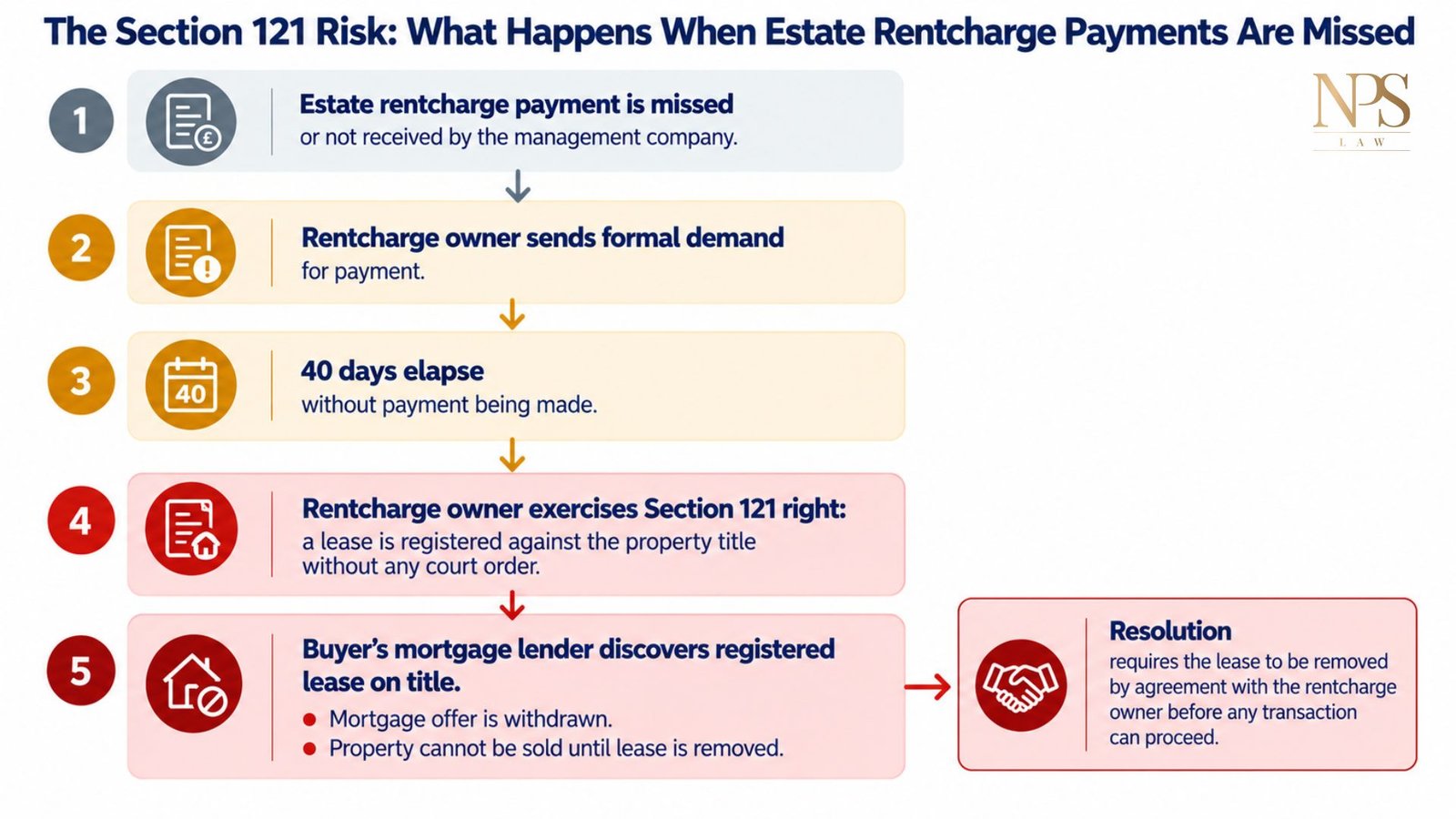
The reason estate rentcharges demand careful attention in conveyancing is Section 121 of the Law of Property Act 1925. This provision gives the rentcharge owner the right to create a lease over the property if payments fall into arrears, without going to court. Once such a lease is registered, the title is no longer clean and no mortgage lender will proceed until it is removed.
On first reading, a modest annual payment for estate maintenance does not sound like a title risk. The Section 121 right changes that calculation entirely. The severity of the consequence, a registered lease that blocks any mortgage or sale, is out of proportion to the size of the debt that triggers it. That disproportionality is exactly why the Law Commission has recommended reform and why draft legislation proposes abolition. As at October 2026, however, the right remains in force.
Section 121 of the Law of Property Act 1925 provides two remedies to a rentcharge owner whose payments are at least 40 days in arrears. The first is the right to enter the land and take the income from it. The second, and more serious for residential property owners, is the right to grant a lease of the property for a term of up to one thousand years.
The lease is created by deed and can be registered at HM Land Registry without any court order and without the knowledge of the property owner. There is no judicial oversight and no minimum debt threshold: a payment of £50 that is 41 days late is technically sufficient to trigger the right, though in practice most management companies do not exercise it immediately. The 40-day period begins from the date the payment was due, not from the date a formal demand was issued.
When a solicitor searches the title register on a property purchase or remortgage, they will find any lease created under Section 121. A registered lease of this kind is not an overriding interest: it will appear on the register and it makes the title unacceptable to a mortgage lender. The lender’s concern is that the lease holder, in this case the rentcharge owner, has a legal interest in the property that takes priority. No mainstream lender will proceed until the lease is removed.
Removing the lease requires the co-operation of the rentcharge owner. In most cases this means paying the outstanding arrears, any interest and the management company’s costs of granting and removing the lease. The process takes time and the costs can substantially exceed the original missed payment. Where a Section 121 lease has been created on a property that is already under offer, the transaction stalls until the position is resolved.
Beyond the Section 121 enforcement risk, freehold owners on managed estates have fewer statutory protections than leaseholders when it comes to challenging the level or justification of management charges. A leaseholder who disputes a service charge can apply to the First-tier Tribunal (Property Chamber) under the Landlord and Tenant Act 1985. No equivalent right exists for freehold owners paying estate rentcharges.
This asymmetry is one of the drivers behind the term “fleecehold”. Management companies can increase charges, change the scope of services and pass on cost increases with limited formal accountability to the owners paying the charges.
The transfer deeds and estate management agreements may contain dispute resolution provisions, but these vary considerably and are often difficult to invoke in practice. Before buying on a managed freehold estate, understanding what the management company can charge for and how increases are governed is at least as important as knowing the current annual figure.
⚠ Common Pitfall
A Section 121 lease can be created even when the property owner did not receive the payment demand. Management companies sometimes change, contact details are updated and payments that were being made by standing order to an old account go unrecorded. A payment history with your bank does not prove that the current rentcharge owner received the money. Confirm the current payee and payment reference whenever you take on a property with an estate rentcharge, and keep records of every payment made.
SUMMARY
Two pieces of legislation are relevant to estate rentcharges in 2026: the Leasehold and Freehold Reform Act 2024, which came into force in July 2024, and the Commonhold and Leasehold Reform Bill, published in draft form in January 2026. These are separate instruments affecting different things. The table below sets out what has and has not changed.
Coverage of estate rentcharge reform in the press and on property websites has frequently conflated the two pieces of legislation. The result is that some articles describe estate rentcharges as already protected by the 2024 Act, or Section 121 as already abolished. Neither is accurate as at October 2026.
| Measure | What It Covers | Status as at October 2026 |
|---|---|---|
| LFRA 2024: regulated rentcharge protection | Restrictions on use of Section 121 against regulated rentcharge payers | Enacted: in force from 24 July 2024 |
| LFRA 2024: estate rentcharge changes | No direct changes to estate rentcharge rules | Not covered by LFRA 2024 |
| 2026 draft bill: abolition of Section 121 and Section 122 | Would remove the right to create a lease on arrears for all rentcharge types including estate rentcharges | Not yet law: draft bill only. Parliamentary approval required. |
| 2026 draft bill: management company accountability | Would introduce requirements on estate management companies similar to leasehold service charge controls | Not yet law: draft bill only |
| Rentcharges Act 1977: 2037 expiry | Extinction of regulated rentcharges. Estate rentcharges are excluded. | Already law. Applies to regulated rentcharges only. |
The Leasehold and Freehold Reform Act 2024 is a wide-ranging piece of legislation with provisions covering leasehold reform, enfranchisement and, relevant here, additional protections for holders of regulated rentcharges.
From 24 July 2024, certain pre-conditions must be met before a regulated rentcharge owner can exercise Section 121 rights, providing a degree of protection for owners of older properties affected by historical rentcharges.
Estate rentcharges are not regulated rentcharges. The 2024 Act does not amend the Section 121 rights available to estate rentcharge owners. A buyer purchasing a new build freehold house on a managed estate in 2026 faces exactly the same Section 121 exposure as a buyer who purchased a similar property in 2019. The 2024 Act did not change that position.
The Commonhold and Leasehold Reform Bill, published in draft form in January 2026, includes proposals to abolish Section 121 and Section 122 of the Law of Property Act 1925 in their entirety.
This would remove the right to create a lease over a property for non-payment of any rentcharge, including estate rentcharges. The draft bill also proposes a statutory framework for estate management companies, giving freehold homeowners on managed estates similar rights to those that leaseholders have to challenge service charges.
As at October 2026, the bill is in draft form and has not been introduced to Parliament. A formal parliamentary bill was expected to follow the draft in autumn 2026, though no confirmed date has been announced. The current law continues to apply until any new legislation is enacted and brought into force. Purchasing a property with an estate rent charge on the assumption that Section 121 will be abolished before completion is not a safe basis for any transaction.
→ Related: What Is a Flying Freehold? Risks, Mortgages and Solutions for Buyers
SUMMARY
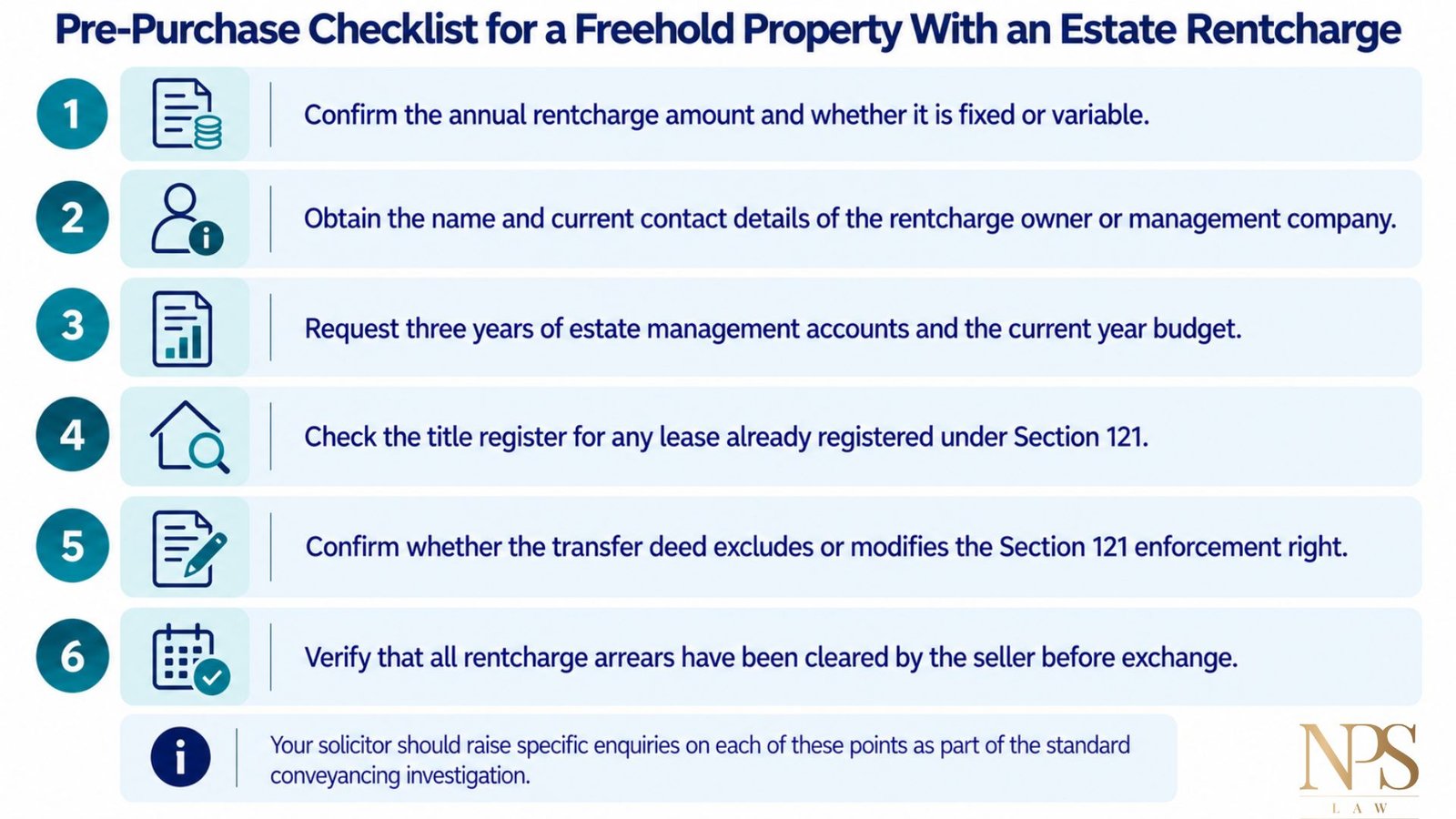
Identifying and investigating an estate rent charge is part of standard residential conveyancing on a freehold property. But the enquiries need to be specific. A title register that mentions a rentcharge without any detail about the management company, the current payee or the history of charges is not sufficient information to assess the risk. The checklist below covers the points that matter before exchange.
A conveyancing solicitor will identify a rentcharge from the title register or the transfer deed. What happens next depends on the enquiries raised and the information obtained in response. Not all of the items below will be volunteered by the seller’s solicitor without being asked. Instructing a solicitor who asks specifically about these points before exchange avoids the risk of finding out about problems after the transaction completes.
The title register will typically note the existence of an estate rentcharge in the charges register, often with a reference to the original transfer deed. The transfer deed itself sets out the terms: the annual amount, the recipient, the review mechanism and any provisions modifying or excluding the Section 121 enforcement right.
Not all transfer deeds modify Section 121. Some developers include provisions that restrict the circumstances in which Section 121 can be exercised or require additional notice before the right can be triggered. Others do not. Identifying what, if any, protections are in the deed is a task for a solicitor reviewing the document, not a question that can be answered from the Land Registry register alone.
The management company responsible for collecting the rentcharge and maintaining the shared areas may or may not be the same entity that was named in the original transfer deed. Management functions are sometimes sold or transferred after a development is complete, which means the current payee may differ from the name in the deed. Confirming the current management company’s identity, contact details and payment instructions before completion is a practical step that prevents the missed-payment risk described earlier.
Beyond identity, a buyer should obtain three years of estate management accounts where these are available. This gives a picture of how charges have changed over time, whether expenditure matches stated purposes and whether there are any outstanding works planned that could affect the charge level in future. On a newly built development where three years of accounts do not yet exist, asking for the current year budget and the developer’s stated maintenance obligations is the next best option.
A Section 121 lease can be registered against a title before you buy the property. If a previous owner missed payments or if the management company exercised the Section 121 right for any reason, the resulting lease will appear on the charges register of the title. A solicitor conducting a standard title investigation will identify it, but it is worth specifically asking whether any such lease has been noted and whether the seller has confirmed it has been removed or was never created.
Where a Section 121 lease is discovered on the title of a property under offer, the seller’s solicitor must arrange for it to be removed before exchange. This requires the seller to pay any arrears and obtain a deed of release from the rentcharge owner. The process takes time and can delay completion. Discovering a Section 121 lease on the day of exchange is a situation that a thorough pre-exchange investigation should prevent.
⚠ Common Pitfall
A title register that does not mention a rentcharge does not guarantee that no estate rentcharge exists. On some large developments, the rentcharge obligation arises from the transfer deed rather than from a separate registered entry, and not all transfer deeds are uploaded to the Land Registry online system. Where a property is on a managed freehold estate with shared facilities, the solicitor should ask specifically about estate rentcharges even if none appears on the face of the register.
SUMMARY
An estate rent charge can in principle be extinguished, either by statutory redemption under the Rentcharges Act 1977 or by agreement with the rentcharge owner. Neither route is available in every case and both require legal input. Where neither is practical, the position can sometimes be managed by modifying the enforcement terms rather than removing the charge entirely.
The desire to remove an estate rentcharge typically arises in one of three situations: a buyer wants to buy out the obligation before completing a purchase, an existing owner wants to simplify their title before selling, or a Section 121 lease has been created and needs to be resolved. The right approach depends on which of these applies and on the attitude of the rentcharge owner.
The Rentcharges Act 1977 gives any landowner burdened by a rentcharge the right to apply to the Secretary of State for a redemption certificate. The process involves paying a lump sum calculated using a statutory formula, after which the rentcharge is extinguished and a redemption certificate is issued. The certificate is then used to remove the rentcharge from the title at HM Land Registry.
The process involves five steps:
The statutory redemption right applies to estate rentcharges as well as regulated rentcharges. The lump sum is calculated by HMRC using a government-set formula based on the annual rentcharge amount and prevailing interest rates, and the process involves submitting a redemption application with the required fee.
Redemption is a permanent solution: once completed and registered, the land is free of the obligation. One caveat is that redeeming the rentcharge extinguishes the payment but does not resolve who maintains the shared areas going forward. On a large estate, that practical question needs to be addressed alongside the legal process.
Where statutory redemption is not the preferred route, a rentcharge owner may agree to release the obligation by deed for a negotiated sum. This approach can be quicker and more flexible than the statutory route, particularly where the rentcharge owner is an active management company willing to engage. The agreed terms are set out in a deed of release, which is then registered at HM Land Registry.
Not all rentcharge owners are willing to negotiate. A management company that depends on the annual income from multiple properties on an estate has a financial interest in maintaining the charge. Some will agree to a release for a one-off payment; others will decline. Where the management function has been taken over by a residents’ management company that the homeowners themselves control, the negotiation may be more straightforward, since the owners and the management company are effectively the same people.
Three situations commonly make redemption or release difficult:
Where the rentcharge owner cannot be traced or will not engage, neither statutory redemption nor a negotiated release is available in the short term. Indemnity insurance can cover the financial consequences in these circumstances: for example, a previously unidentified Section 121 lease coming to light, or the owner reappearing to claim arrears. The insurance does not remove the rentcharge, and approaching the owner before obtaining cover invalidates the policy.
Where a Section 121 lease has already been created and the owner is unresponsive, the position is more serious. The lease must be removed before a mortgage lender will proceed, and if the owner cannot be located to execute a deed of release, a court application may be necessary. This is why confirming the identity and contact details of the management company before purchase is not a formality.
→ Related: Problems With Escalating Ground Rent: Your Options in 2026
SUMMARY
Estate rentcharges appear on a growing number of freehold properties across England and Wales as managed estate developments have become more common. NPS Law investigates rentcharge obligations and Section 121 risk as part of every freehold conveyancing instruction. Where a rentcharge is found, we report it clearly and advise on what steps, if any, are needed before exchange.
We do not treat the presence of an estate rentcharge as a reason to delay a transaction without cause. Many properties with estate rentcharges can be purchased without difficulty once the relevant checks have been carried out and the terms are understood. Our role is to make sure those checks happen before exchange, not after.
If you have been told that a property you are buying has an estate rent charge, or if you are selling a property on a managed freehold estate and want to understand what buyers’ solicitors will ask about, contact NPS Law for a free initial consultation.
→ Related: New Build Conveyancing: What to Expect and Why You Need a Specialist
→ Related: Average Conveyancing Fees UK 2026: What Buyers and Sellers Should Expect
The questions below cover the most common queries from buyers and sellers encountering estate rentcharges on freehold properties in England and Wales.
A service charge is paid by a leaseholder to a landlord under the terms of a lease. An estate rent charge is paid by a freehold owner under a charge registered against the title of the land. The practical effect can feel similar: both involve annual payments for the upkeep of shared areas.
The legal framework is different. Leaseholders have statutory rights under the Landlord and Tenant Act 1985 to challenge the reasonableness of service charges and to apply to a tribunal. Freehold owners paying estate rentcharges do not currently have the same rights, though the 2026 draft bill proposes to address this.
In most cases, yes. An estate rentcharge does not in itself prevent a mortgage lender from lending. What a lender will want to confirm is that the rentcharge terms are properly set out in the title, that there are no arrears, that no Section 121 lease has been registered against the property and that the annual charge is at a level that does not materially affect the property’s saleability.
Your solicitor will report on all of these points as part of the conveyancing process. If a Section 121 lease is found on the title, the mortgage cannot proceed until it is removed.
Not imminently. The Commonhold and Leasehold Reform Bill published in draft form in January 2026 proposes material changes, including the abolition of the Section 121 enforcement right and the introduction of a statutory framework for estate management companies. However, the draft bill had not been introduced to Parliament as at October 2026.
Estate rentcharges themselves are not proposed for abolition in the draft bill: the charges would continue, but the most severe enforcement consequence would be removed if the legislation is enacted. Existing rentcharges would remain on the titles of affected properties unless individually redeemed.
We review the title register and the transfer deed as part of our standard investigation. Where an estate rent charge is identified, we raise specific enquiries with the seller’s solicitor covering the current management company identity, payment history, arrears position and any existing Section 121 leases.
We also review the deed terms to check whether the Section 121 right has been modified or excluded. Our findings are reported to you and to your mortgage lender before we advise on readiness to exchange.
NPS Law provides a fixed fee for all residential conveyancing instructions, agreed in writing before we begin. A property with an estate rentcharge does not automatically attract a higher fee: in most cases the additional checks are part of our standard investigation.
Where additional work is required, such as advising on redemption or investigating a Section 121 lease, we will quote separately for that element before proceeding. Contact us for a free initial consultation and we will confirm the fee before you instruct us.
An estate rent charge on a freehold property is not an automatic problem. Hundreds of thousands of freehold properties across England and Wales carry estate rentcharges and are bought, sold and mortgaged without difficulty every year. The conditions for that to work are clear: the charge must be identified, the terms must be understood, the management company must be confirmed as the current payee and no Section 121 lease must be outstanding on the title.
The failure mode is not the rentcharge itself but the absence of proper investigation. A buyer who does not know the identity of the management company cannot confirm that their payments are reaching the right recipient. A conveyancing process that notes a rentcharge without asking the specific questions about arrears and enforcement history leaves the buyer exposed. The Section 121 right remains in force and it is triggered by facts, not intentions.
NPS Law treats estate rentcharge investigation as a substantive part of freehold conveyancing, not a box to check. If you are buying a freehold property on a managed estate, or if an estate rent charge has appeared in a title report and you want to understand what it means, contact our team for a free initial consultation before you proceed.
Buying a Freehold Property With a Rentcharge? Talk to NPS Law First.
NPS Law investigates estate rentcharges and Section 121 risk as part of every freehold conveyancing instruction. Fixed fees, free initial consultation and no completion, no fee protection on every purchase.
Disclaimer: This article is for general informational purposes only and does not constitute formal legal advice. The law described applies to England and Wales unless otherwise stated. Legislative proposals described as draft bills are not yet law. For specific legal matters, please consult with a qualified solicitor.
©️ Copyright 2026 NPS Law is a trading name for NPS Law LLP. Solicitors of England and Wales. Authorised and Regulated by the Solicitors Regulation Authority. SRA Number 570169. A list of all Partners is available on the SRA directory for this firm. website designed by origin-media