

★ 4.8 / 5.0 from 520 client reviews on ReviewSolicitors (including Google reviews)
Flying freehold” has a habit of appearing in conveyancing reports without explanation. It sounds technical, it is rarely clear why it has been flagged, and most buyers find themselves reading the same paragraph twice. The concept is not new: flying freeholds have existed in English and Welsh property law for centuries, produced by the way buildings were expanded and altered before modern planning controls existed. Understanding what the term means for the specific property you are buying is what matters.
This guide covers everything a buyer or seller needs to know. What a flying freehold is, where they typically occur, why they create legal complications around repairs and mortgages, and what practical steps can be taken before exchange of contracts. If your solicitor has flagged one, the aim of this article is to help you understand what is at stake.
SUMMARY
A flying freehold is a section of a freehold property that overhangs, bridges over or sits above land owned by a different person. The owner holds it as part of their freehold title, but because it physically extends over someone else’s land, questions arise about who is responsible for maintaining it, who has the right to access it for repairs and what happens when the neighbouring property changes hands.
The term comes from the idea of part of the property “flying” above land belonging to another party. In English and Welsh property law, freehold ownership normally includes the land below a property and the air space above it within reasonable limits. A flying freehold breaks this vertical stack: the structure exists above land that belongs to someone else, creating a horizontal boundary rather than the straightforward vertical one that applies to most homes.
In legal terms, a flying freehold arises when a registered freehold title includes a part of the building that is not supported by, or does not sit above, land included in that title. It appears on the title plan as a registered area, but the physical structure relies on land belonging to a neighbouring title for its support or passage.
Most flying freeholds are the result of historical building practices rather than deliberate legal design. In the nineteenth and early twentieth centuries, houses were extended, altered and sometimes merged without the legal documentation that would accompany the same work today. A room added above a passage, or an upper floor expanded over a neighbour’s ground floor, created what we now call a flying freehold. The structure went up; the paperwork did not follow.
A standard freehold gives the owner complete, unencumbered ownership of the land and everything above and below it within the registered title. There is no third party with a structural interest in the property, and maintenance decisions are entirely the owner’s to make.
A flying freehold changes this. The overhanging part of the property depends on the neighbouring structure for physical support. The owner of the flying freehold needs to be able to access the neighbouring land to carry out repairs. And any obligation to maintain the supporting structure falls on the neighbour, which is where the legal difficulty arises: positive covenants, including obligations to carry out maintenance, do not automatically bind future freehold owners in England and Wales under the rule affirmed in Rhone v Stephens [1994] 2 AC 310. A verbal agreement with the current neighbour about maintenance is not enforceable against whoever buys their house next year.
→ Related: Leasehold vs Freehold: What’s the Difference and Which Should You Buy?
SUMMARY
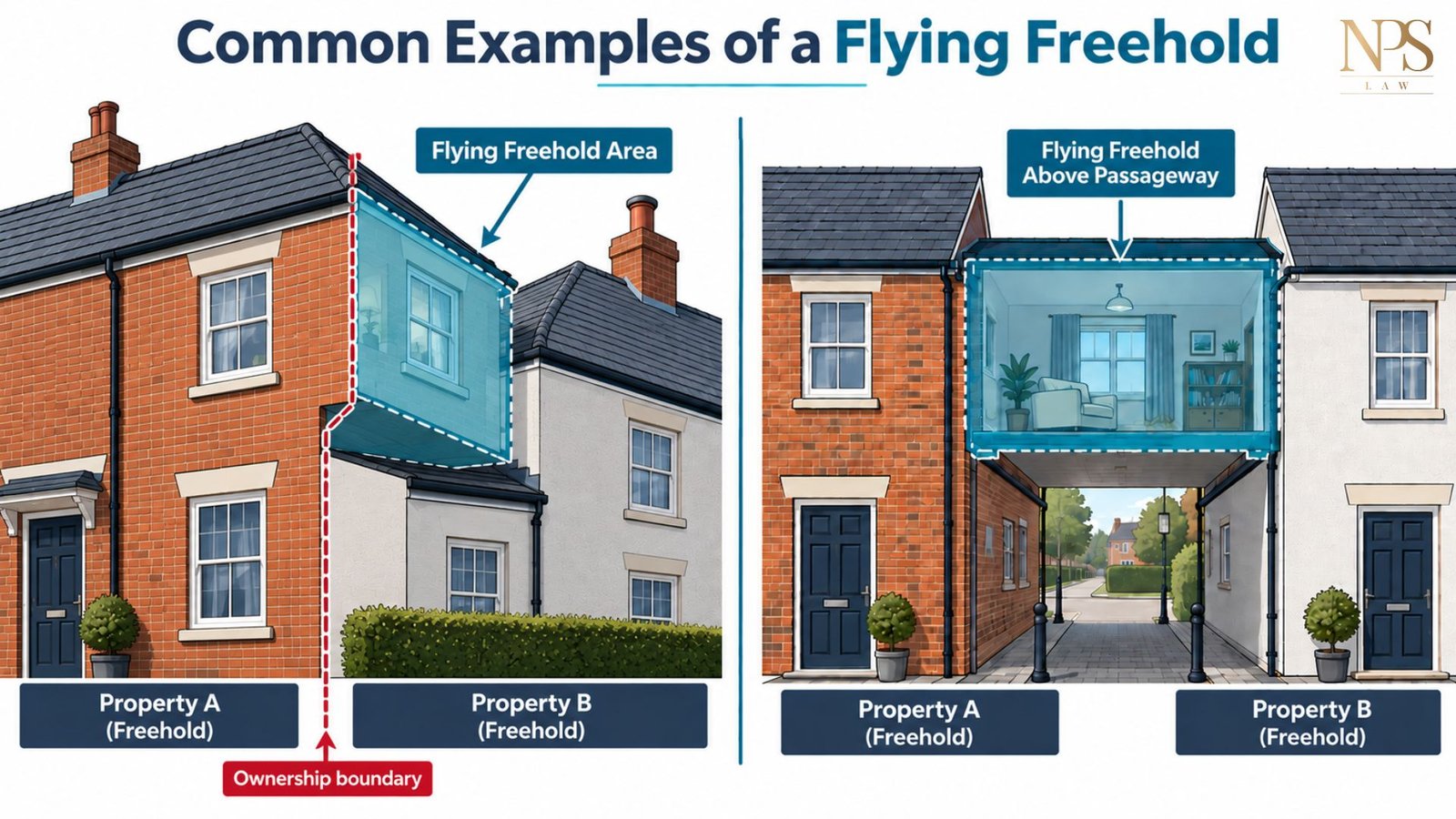
Flying freeholds appear most often in older terraced and semi-detached housing, particularly in urban areas where buildings were extended and altered before modern planning controls. The two most common configurations are rooms that overhang a neighbour’s property and rooms built above a shared or public passageway.
Flying freeholds are not rare in England and Wales. They are particularly common in Victorian and Edwardian terraces, in older town centres and in converted buildings where the original layout has been altered over time. The physical configuration varies, but the legal issues that arise are broadly similar across all of them.
The most frequently encountered flying freehold in residential conveyancing involves an upper-floor room that projects beyond the outer wall of the house and overhangs part of the ground floor of the neighbouring property. This is particularly common where terraced houses were extended upward without the lower-level extension being mirrored next door, or where original back-to-back building lines produced unequal structures.
In these cases, the ceiling of the neighbour’s ground floor is also the floor of the overhanging room. Any structural work on that floor, or on the wall that supports it, may require access to the neighbouring property. The obligation to maintain the supporting structure, if not documented in the title, falls into a legal grey area as soon as either property changes hands.
A second common configuration involves a room or corridor built above a shared passageway or public archway. In older terraced streets, it was common for houses to be built with a covered passage running through the ground floor to provide access to rear gardens and rear lanes. Where the first floor of the house extends across that passage, the property above the passageway constitutes a flying freehold.
The same issue arises with properties built above archways, under bridges or above covered access routes that are not included in the property’s own title. The occupier of the space above does not own the land below the arch or passage, yet the structure of their property relies on it for physical support.
SUMMARY
The difficulty with flying freeholds is not the physical configuration itself but the legal gap it creates. English and Welsh property law does not automatically require a new freehold owner to honour the positive obligations agreed by their predecessor. This means that repair and maintenance arrangements that worked perfectly well between two long-standing neighbours can become unenforceable the moment either property is sold.
When both neighbouring properties are owned by people who have lived there for decades and have an informal understanding about maintenance, a flying freehold may cause no practical difficulty at all. The problem surfaces when a property is sold, when a structural issue arises that requires one party to act, or when a mortgage lender asks questions about the title during a purchase application.
The central legal issue is the rule that positive covenants do not run with freehold land in England and Wales. This principle, confirmed by the House of Lords in Rhone v Stephens [1994] 2 AC 310, means that an obligation imposed on a landowner to carry out a positive act, such as maintaining a wall, repairing a roof or keeping a supporting structure in good condition, cannot be enforced against that landowner’s successors in title.
In a flying freehold, the practical consequence is this: if the neighbour agreed informally to keep the ground-floor wall that supports the overhanging room in good repair, that agreement binds them personally. When they sell, the new owner takes the property without inheriting the obligation. If the supporting structure then falls into disrepair, the owner of the flying freehold has limited legal recourse to compel the neighbour to fix it.
⚠ Common Pitfall
A written agreement with a current neighbour about maintaining a flying freehold is not automatically binding on the next owner of their property. Positive covenants do not run with freehold land in England and Wales under the rule in Rhone v Stephens [1994]. Before buying a flying freehold property, check whether the obligations have been formalised in a Mutual Deed of Covenant that is registered at HM Land Registry. An informal agreement or letter between neighbours has no legal weight once the neighbouring property is sold.
The Halsall v Brizell [1957] principle does allow some positive obligations to bind successors where the successor takes the benefit of an arrangement, but this exception is narrow and cannot be relied upon as a substitute for properly documented mutual obligations.
A property with a flying freehold needs three things from the neighbouring land: physical support for the overhanging structure, the right to access the neighbouring property when repairs are needed and, depending on the configuration, access to light through windows on the overhanging portion. If any of these rights has not been expressly granted in the title documentation, their existence may depend on implied rights or long use, both of which are harder to rely on and harder to prove to a mortgage lender.
Express grants of rights of support, access and light can be included in a deed or noted on the title register. Where they exist and are registered, a buyer and their lender can see exactly what rights are in place. Where they are absent or ambiguous, the conveyancing process will identify the gap and the buyer will need to decide how to proceed before exchange.
A flying freehold that is properly documented, with mutual obligations in a registered deed and clear rights of support and access, is unlikely to cause significant problems on resale. Most solicitors and lenders will accept it once they can see that the paperwork is in order.
The difficulty arises when the documentation is incomplete or absent. A buyer’s solicitor will raise the issue. If the title cannot be improved before exchange, the buyer’s lender may reduce the loan amount, require indemnity insurance or withdraw the mortgage offer entirely. This can slow a sale or, in some cases, prevent it from completing. Sellers who know a flying freehold exists on their title are better placed if they address the documentation before listing the property.
SUMMARY
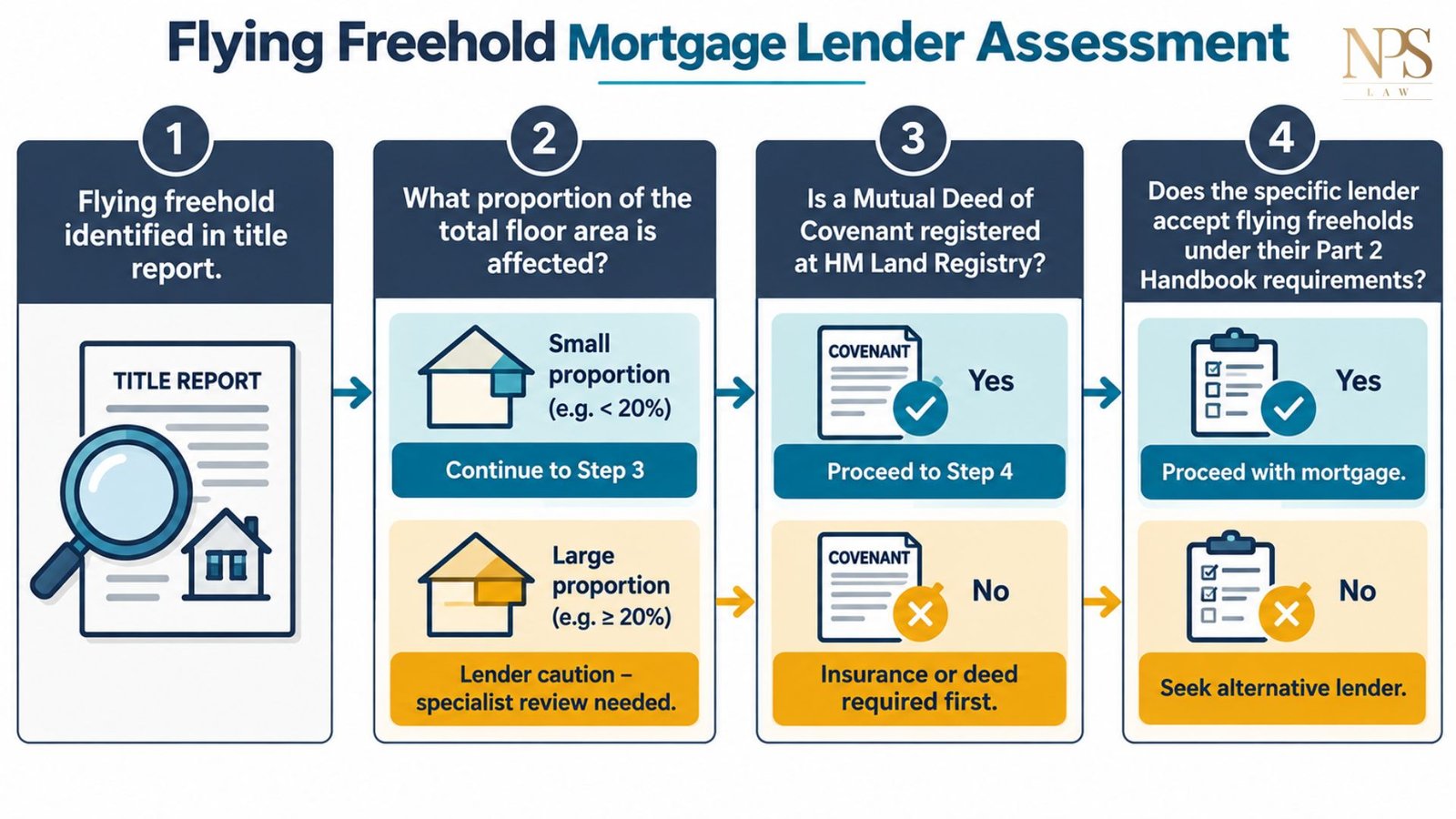
A mortgage on a flying freehold is available from many lenders but not all. The key variables are the proportion of the floor area affected, whether a Mutual Deed of Covenant is registered and whether the specific lender’s requirements under the UK Finance Mortgage Lenders’ Handbook are met. Checking lender-specific requirements before making a full application avoids wasted time and fees.
“Flying freehold” does not automatically mean a mortgage is impossible. Many mainstream lenders will accept a flying freehold where the affected area is relatively small, the rights of support and access are documented and mutual obligations are set out in a registered deed. The difficulty is that lender requirements vary significantly, and a lender who accepts one flying freehold title may decline another where the documentation is less complete.
When a flying freehold appears in a title report, a lender’s valuer and solicitor will consider several factors. The proportion of the total floor area that constitutes the flying freehold element is usually the first consideration: a small overhanging corridor is assessed differently from a situation where the entire first floor sits above the neighbouring property. The existence of a registered Mutual Deed of Covenant, express grants of support and access rights in the title deeds, and the age and condition of the structure all feed into the lender’s risk assessment.
Some lenders set out specific thresholds, for example accepting flying freeholds where the overhanging area does not exceed a certain percentage of the total property floor area. Others apply a case-by-case judgement. Where a lender declines, it is not necessarily a permanent barrier: a different lender with a wider acceptance policy, or the addition of a registered deed, may resolve the position.
The UK Finance Mortgage Lenders’ Handbook is the definitive reference for lender-specific conveyancing requirements. Part 1 sets out instructions common to all participating lenders. Part 2 contains the individual requirements of each lender and is where flying freehold policies are found. The Handbook is freely accessible online and a solicitor acting on a purchase will check the relevant Part 2 entry as part of the standard conveyancing process.
Where a buyer has a mortgage offer in principle from a specific lender, it is worth asking their solicitor to check Part 2 of the Handbook for that lender before committing further. An agreement in principle does not guarantee that the lender will accept the title: that assessment happens during the full application when the solicitor’s title report is reviewed.
⚠ Common Pitfall
An agreement in principle from a mortgage lender does not take account of the title. Flying freehold issues are identified during the full conveyancing process, after the application has been submitted and fees paid. Where a solicitor identifies a flying freehold element early in the transaction, checking the target lender’s Part 2 requirements before the full mortgage application is submitted can avoid a declined offer and the delay and cost that follows.
SUMMARY
Three practical measures address the legal gaps that flying freeholds create. A Mutual Deed of Covenant makes obligations registrable and enforceable against future owners. Express grants of support and access rights put the necessary permissions in writing. Indemnity insurance covers the financial risk where documentation cannot be put in place before exchange.
The right combination of measures depends on the specific title, the neighbouring owner’s co-operation and the requirements of the buyer’s mortgage lender. A solicitor acting on the purchase will identify which gaps exist and advise on which solutions are appropriate for that transaction.
| Problem | Legal Risk | Recommended Solution |
|---|---|---|
| Maintenance obligation not binding on future neighbours | New neighbour takes property free of repair duty | Mutual Deed of Covenant registered at HM Land Registry |
| No express right of support from neighbouring structure | Structural reliance on neighbouring land not legally protected | Include express grant of support right in registered deed |
| No right of access for repairs | Cannot enter neighbouring land when repairs are needed | Include express access right in registered deed or easement |
| Mortgage lender declines | Buyer cannot complete with chosen lender | Check Lenders' Handbook Part 2 early; seek lender who accepts |
| Documentation incomplete but transaction urgent | Financial exposure if enforcement action later arises | Indemnity insurance to cover financial risk of claim |
A Mutual Deed of Covenant is an agreement between the owners of two neighbouring properties that sets out each party’s obligations in relation to the shared structural elements. Unlike a simple letter or informal arrangement, it can be registered against both titles at HM Land Registry. Once registered, it binds not just the parties who sign it but also their successors in title, addressing the core problem that positive covenants do not otherwise run with freehold land.
Negotiating a deed requires the co-operation of the neighbouring owner, which is not always forthcoming. Where the neighbour agrees, a solicitor will draft the deed, both parties will execute it and it will be submitted for registration. This is the cleanest solution because it improves the title rather than simply insuring against the risks that remain. The cost of preparing and registering the deed is a one-off expense that benefits any future owner of either property.
Where rights of support, access for repairs and light are not expressly set out in the title, they may exist as implied rights arising from the original sale of the properties or as rights acquired through long use under the Prescription Act 1832. However, implied and prescriptive rights are harder to evidence and harder to present to a mortgage lender than rights expressly granted in a registered document.
Where the title is being improved as part of a purchase transaction, adding express grants of these rights to the mutual deed, or obtaining a separate deed of grant from the neighbouring owner, is preferable to relying on implied or prescriptive rights. A solicitor will advise on which rights need to be documented based on what the title currently shows.
Where the neighbouring owner will not engage, or where the transaction is proceeding quickly and documentation cannot be put in place before exchange, indemnity insurance is the standard practical solution. A policy covers the buyer and their mortgage lender against the financial consequences of a claim arising from the flying freehold: the cost of defending a claim, any damages awarded and, in some cases, the cost of remedial works.
Insurance does not fix the underlying title issue. The flying freehold remains undocumented. What the policy does is transfer the financial risk from the buyer to the insurer. Most mainstream lenders will accept an indemnity insurance policy as a condition of lending rather than requiring the title to be fully resolved before completion. The premium is typically a one-off payment and the policy runs with the property, covering future owners as well as the current buyer.
→ Related: Estate Rentcharges Explained: What Freehold Buyers Need to Know
SUMMARY
Selling a flying freehold property is achievable. The title will be reviewed by the buyer’s solicitor and lender, and any gaps in the documentation will be raised as enquiries. A seller who has prepared the title in advance, or who can arrange indemnity insurance quickly, is in a much stronger position than one who encounters the issue for the first time when a sale is already under way.
Flying freeholds are not deal-breakers for most buyers and lenders. They are a complication that requires active management. The seller’s solicitor will disclose the flying freehold through the title documentation as a matter of course; it is not something that can or should be concealed.
The flying freehold will appear in the title register or the title plan and will be identified by the buyer’s solicitor as part of their standard title investigation. Sellers are also required to answer pre-contract enquiries on the TA6 Property Information Form honestly. Any knowledge of the flying freehold, of past disputes with neighbours about the structure or of maintenance issues should be disclosed accurately.
Concealment of known problems is not a viable approach and carries serious legal risk. The conveyancing process will identify the flying freehold regardless.
The most effective preparation is to instruct a solicitor before the property goes on the market and to ask them to review the title for flying freehold documentation. If a Mutual Deed of Covenant is registered and rights of support and access are clearly documented, a solicitor can confirm this early in the buyer’s investigation and the issue is unlikely to cause significant delay.
Where the documentation is incomplete, the seller has two options: approach the neighbour to put a deed in place before sale, or arrange indemnity insurance to be held on behalf of the buyer. The first option takes longer but produces a better title. The second is quicker and is often the practical choice when a sale is already agreed. NPS Law can advise on both routes and on which is more appropriate for a specific title.
→ Related: How Long Does Conveyancing Take? 2026 UK Guide
→ Related: What Does a Conveyancer Do? Solicitor vs Licensed Conveyancer Explained
SUMMARY
Flying freehold issues arise in both purchase and sale transactions and require the same attention as any other title defect: identification, assessment and a practical resolution before exchange. NPS Law handles flying freehold titles as part of our residential conveyancing service, with a fixed fee agreed before instruction and a free initial consultation.
When a flying freehold appears on a title we are reviewing, we assess what documentation is in place, what gaps exist and what the buyer’s mortgage lender requires. We then explain the options clearly and, where action is needed, manage the process of putting documentation in place or arranging insurance.
If you have been told a property has a flying freehold and are not sure whether it will affect your mortgage or your purchase timeline, contact NPS Law for a free initial consultation. We will review the title, explain the position and confirm what, if anything, needs to be resolved before you commit to exchange.
→ Related: Average Conveyancing Fees UK 2026: What Buyers and Sellers Should Expect
The questions below address the most common queries from buyers and sellers encountering flying freehold properties in England and Wales.
It depends on the documentation. A flying freehold with a registered Mutual Deed of Covenant and clear rights of support and access is unlikely to prevent a sale or a mortgage. One where the title is silent on these points requires action before exchange: either putting documentation in place with the neighbour or arranging indemnity insurance. The issue is manageable in most cases, but it needs to be identified and addressed rather than ignored.
The physical configuration cannot be changed without significant structural work. The legal risk, however, can be substantially reduced by registering a Mutual Deed of Covenant that makes maintenance and access obligations binding on future owners of both properties.
This does not remove the flying freehold from the title plan but it does address the core legal gap. Indemnity insurance covers the financial risk where a full deed cannot be put in place.
It can. Buildings insurance for a flying freehold property needs to cover the overhanging structure, including any damage caused to or by the overhanging element. Insurers should be informed of the flying freehold when a policy is taken out.
Where a claim arises from the structure between the two properties, the question of which insurer is liable and in what proportion may be complex. A solicitor can advise on whether the title documentation allocates insurance responsibility between the neighbouring owners.
NPS Law provides a fixed, itemised quote before instruction for all residential conveyancing matters, including those involving flying freehold titles. The fee reflects the complexity of the title review and any additional work required, such as drafting a Mutual Deed of Covenant or arranging indemnity insurance.
There is no hourly billing. Contact us for a free initial consultation and we will confirm what is involved and what it will cost before you instruct us.
We check the title register and title plan to identify the extent of the flying freehold element, review any existing deeds or agreements relating to maintenance and access, confirm whether rights of support, access and light are expressly granted or need to be established, and check the buyer’s mortgage lender’s requirements under Part 2 of the UK Finance Mortgage Lenders’ Handbook. We then advise on what action is needed, if any, before exchange of contracts.
A flying freehold is not a reason to walk away from a property you want to buy. It is a feature of the title that requires specific investigation and, in some cases, specific action before exchange. Where the documentation is in place, most lenders will proceed and the transaction runs normally. Where it is not, the gap needs to be closed, either by working with the neighbour to put a registered deed in place or by arranging indemnity insurance to cover the risk.
Sellers are in a stronger position when the flying freehold is identified and addressed before a buyer is found. Waiting until the buyer’s solicitor raises it as a requisition mid-transaction creates avoidable delay and, in a competitive market, the risk that the buyer loses patience and moves on.
NPS Law reviews flying freehold titles as part of our standard residential conveyancing service. If you are buying or selling a property with a flying freehold element, or if the phrase has appeared in a report and you are not sure what it means for your transaction, contact our team for a free initial consultation before you make any commitments.
Get Expert Advice on Flying Freeholds From NPS Law
NPS Law reviews flying freehold titles as part of every residential conveyancing instruction. Fixed fees agreed before instruction, free initial consultation and no completion, no fee protection on every purchase.
Disclaimer: This article is for general informational purposes only and does not constitute formal legal advice. The law described applies to England and Wales unless otherwise stated. For specific legal matters, please consult with a qualified solicitor.


©️ Copyright 2026 NPS Law is a trading name for NPS Law LLP. Solicitors of England and Wales. Authorised and Regulated by the Solicitors Regulation Authority. SRA Number 570169. A list of all Partners is available on the SRA directory for this firm. website designed by origin-media