

★ 4.8 / 5.0 from 520 client reviews on ReviewSolicitors (including Google reviews)
Most property buyers know the phrase “exchange of contracts” long before they understand what it actually means. It comes up at the end of the conveyancing process, often accompanied by the instruction to have buildings insurance in place and funds ready. Then it happens, and everything feels different, though it can be hard to say exactly why.
This guide explains what exchange means in legal terms, what changes the moment it happens and what your obligations become from that point forward. It covers the deposit, what happens if either party fails to complete after exchange, how exchange works across a chain of transactions and what you need to have in place before your solicitor can proceed. This article applies to property transactions in England and Wales only.
SUMMARY
Exchange of contracts is the legal step that transforms a property transaction from an intention into a binding obligation. It is the point at which both buyer and seller commit to the transaction and become legally liable if they do not proceed. Until exchange, either party can withdraw without legal consequence, though costs already incurred may be lost.
The phrase “exchange” comes from the original practice of physically swapping signed contract documents: the buyer’s solicitor held the seller’s signed copy and the seller’s solicitor held the buyer’s signed copy. In modern practice, exchange usually happens by telephone, but the legal effect is the same. Two identical contracts are in existence, each signed by one party, and the moment both solicitors confirm they hold the signed copy, exchange is complete.
Before exchange, the agreement between a buyer and seller is not a contract in the legal sense. It is a set of negotiations and understandings that neither party is obliged to honour. A seller can accept a higher offer and a buyer can withdraw, and while this may be frustrating, it is not unlawful.
Exchange creates a legally binding contract. From that moment, both parties are under a duty to complete on the agreed date and on the terms set out in the contract. Any breach of that duty opens the defaulting party to legal remedies, including the loss of the deposit, claims for damages and, in some circumstances, a court order for specific performance requiring them to complete.
Exchange and completion are two distinct events that often happen weeks apart. Exchange is when the contract is created. Completion is when money changes hands, keys are released and the buyer takes ownership. The gap between the two, typically one to four weeks but sometimes longer, is the period in which final preparations are made.
The distinction matters because many of the obligations that people associate with buying a property, including buildings insurance, stamp duty planning and the physical move, are triggered by exchange, not completion. Getting these wrong by confusing the two dates is a common and avoidable mistake.
SUMMARY
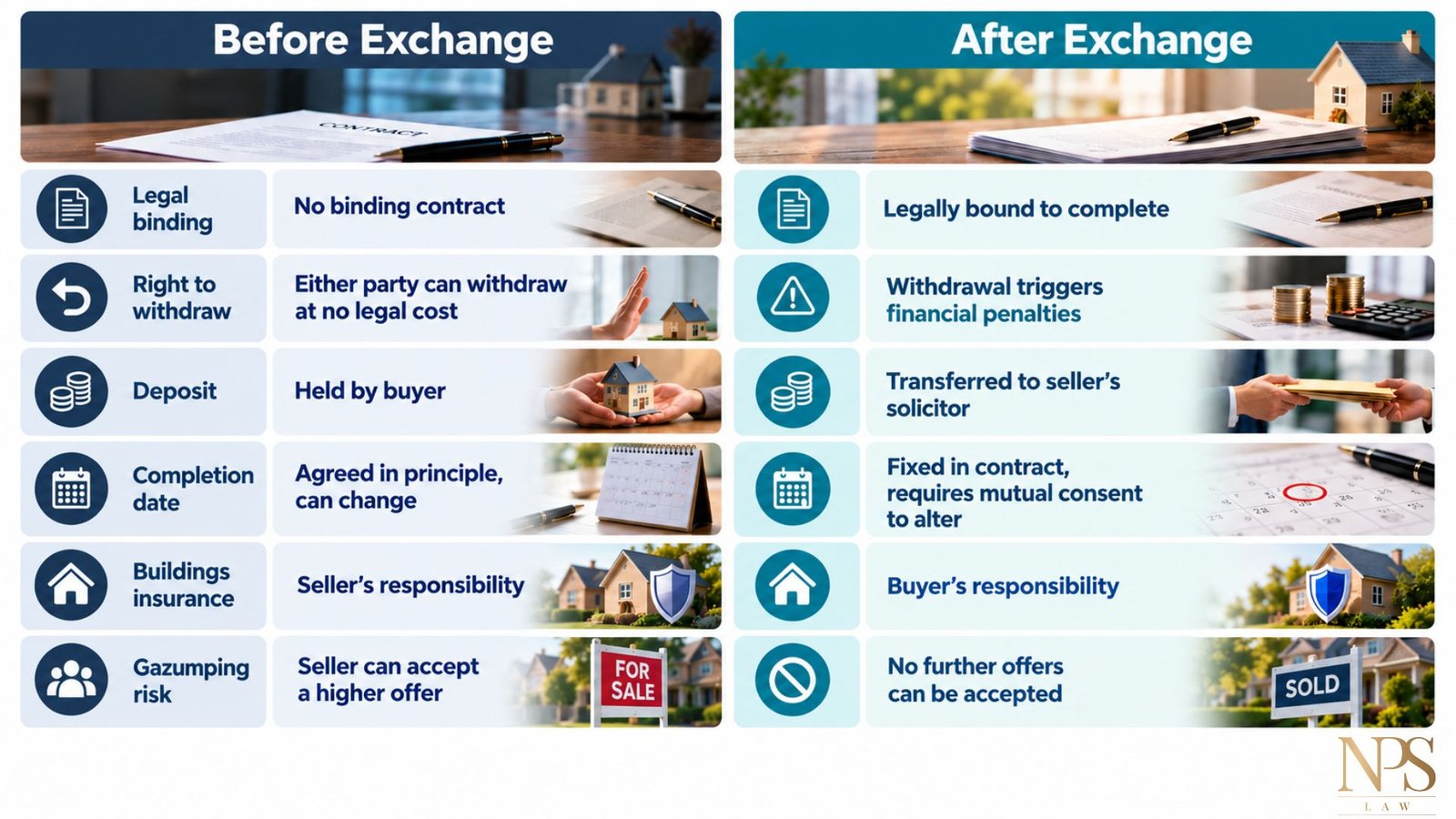
Six things change at the moment of exchange. Some are obvious, others catch buyers and sellers by surprise. The table above sets out the most important. The sections below explain the three with the greatest practical impact in more detail.
Exchange is often described as a single event, but it triggers a cascade of legal and practical changes simultaneously. Each of the six changes in the table above has consequences that play out between exchange and completion. Understanding them before exchange day, rather than after, is what allows buyers and sellers to prepare properly.
After exchange, both buyer and seller are bound by the terms of the contract. The purchase price is fixed. The completion date is fixed. The property must be delivered in the condition agreed at exchange, subject to any specific provisions in the contract. Neither party can unilaterally change these terms.
The standard residential contract used in England and Wales is based on the Law Society’s Standard Conditions of Sale. It sets out what happens in most foreseeable scenarios, including late completion, damage to the property between exchange and completion, and the procedures for serving a notice to complete if one party does not perform. Your solicitor will have gone through the contract with you before exchange, but if any term is unclear, ask before you sign.
Once exchange has happened, the completion date in the contract is the date on which the transaction must complete. It is not a target or an expectation. It is a contractual obligation. Missing the completion date without the agreement of the other party is a breach of contract.
In practice, completion dates can be moved after exchange if both parties agree. This is relatively common when there are practical complications such as mortgage delays or difficulties with the physical move. The key is that both sides must consent: one party cannot simply decide to delay. If completion is delayed without consent, the party responsible for the delay faces compensation obligations under the contract.
Under the Standard Conditions of Sale used in most residential transactions in England and Wales, the risk in the property passes to the buyer at exchange, not at completion. This means that if the property is damaged by fire, flood or any other event between exchange and completion, the loss falls on the buyer even though they do not yet own it.
The practical consequence is straightforward: buildings insurance should be in place from exchange day. Many buyers arrange cover to start from exchange, even if they do not intend to move in until completion. If the property is a leasehold flat where the freeholder insures the building, confirm the cover is in place and request evidence before exchange. Leaving insurance until completion day is a risk that is not worth taking.
→ Related: What Is Conveyancing? The Complete UK Guide for Buyers and Sellers
SUMMARY
The deposit on exchange is not a reservation fee or a booking amount. It is a contractual payment that the seller is entitled to keep if the buyer fails to complete. The standard amount is 10 per cent of the purchase price, though reduced deposits are sometimes agreed. Understanding what happens to the deposit, and under what circumstances it can be recovered, matters as much as knowing the amount.
The deposit is paid on exchange by the buyer’s solicitor to the seller’s solicitor. In most cases it moves electronically on the day of exchange. It is not paid to the seller directly and it does not sit in the seller’s bank account while the transaction completes. Where it is held and what it can be used for depends on the terms agreed in the contract.
The Law Society standard conditions call for a 10 per cent deposit on exchange. This is the default position and applies unless the contract specifies otherwise. On a purchase of £400,000, the standard deposit would be £40,000.
Reduced deposits below 10 per cent are sometimes negotiated, particularly where a buyer has a mortgage covering more than 90 per cent of the purchase price and does not have the full 10 per cent in cash. A seller does not have to agree to a reduced deposit, and doing so does increase their exposure if the buyer fails to complete, since a smaller sum would be available to offset their losses. Where a reduced deposit is agreed, this must be recorded in the contract before exchange.
On exchange, the buyer’s solicitor transfers the deposit to the seller’s solicitor. The seller’s solicitor holds it in one of two capacities: as agent for the seller, or as stakeholder. The distinction matters.
If held as agent, the seller can in principle instruct their solicitor to release the deposit to them immediately after exchange. If held as stakeholder, the deposit cannot be released to the seller until completion. In most residential transactions the deposit is held as stakeholder, which protects the buyer in the event the seller fails to complete: the deposit remains available for return rather than having already been spent. If you are in any doubt about the basis on which the deposit is being held, ask your solicitor before exchange.
→ Related: Solicitor Fees for Buying or Selling a House in the UK 2026
SUMMARY
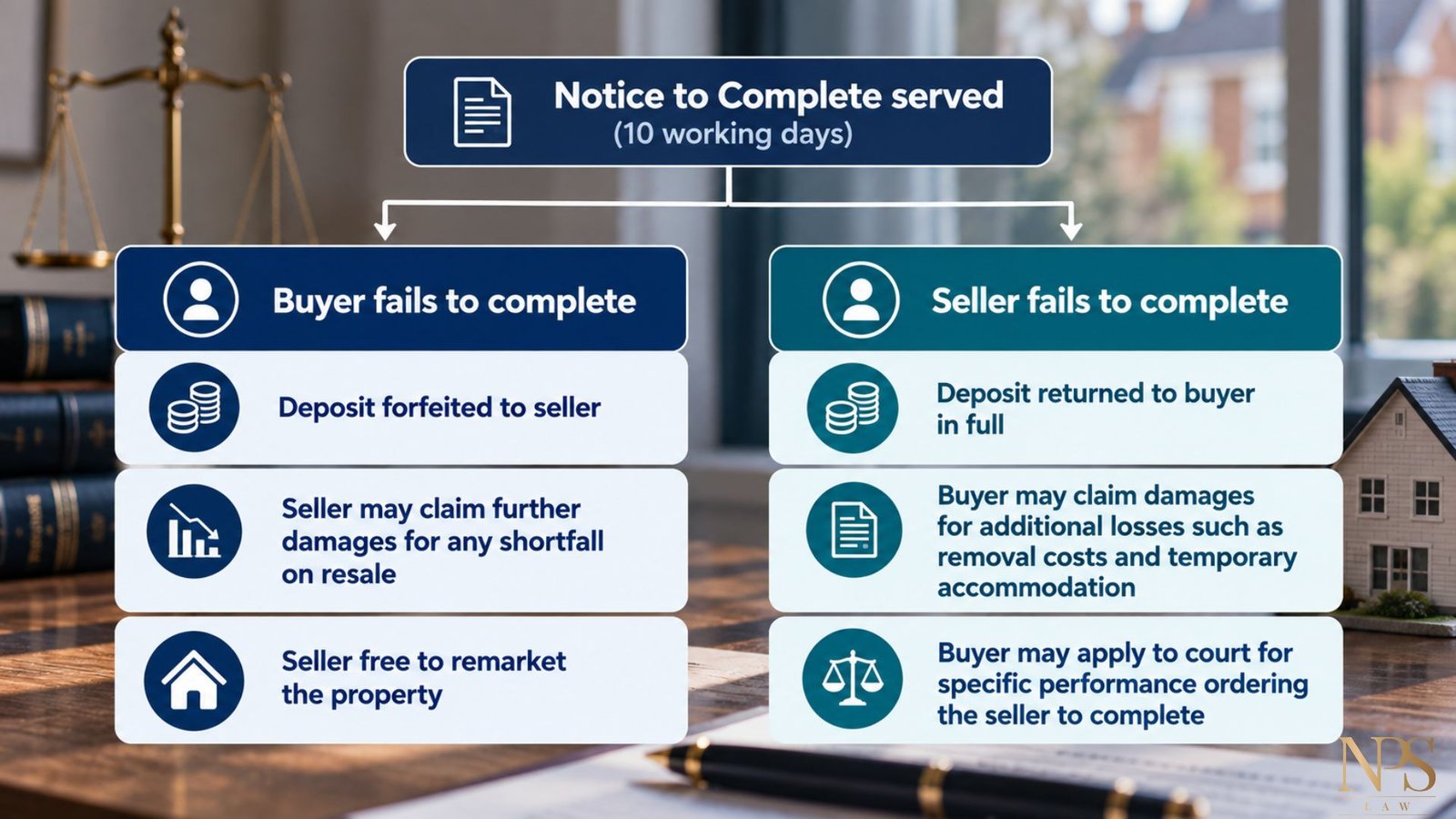
Withdrawing from a property transaction after exchange is a serious legal event with serious financial consequences. The consequences are different depending on whether the buyer or the seller defaults. In both cases, the process begins with a Notice to Complete, which sets a formal deadline before the remedies under the contract become available.
The right to pull out of a property transaction without penalty ends at exchange. After that point, the contract governs what happens and the remedies are set out in its terms. Understanding those remedies is useful, not because most transactions fail after exchange, but because knowing what is at stake helps both parties make informed decisions if difficulties arise.
A Notice to Complete is a formal legal notice served by one party on the other when the defaulting party has failed to complete on the contractual date. It is not issued immediately on the missed completion date: in practice, a short delay is common and solicitors will often communicate before resorting to formal notices. However, if completion does not happen and the parties cannot agree an extension, the aggrieved party can serve a Notice to Complete.
Under the Standard Conditions of Sale, a Notice to Complete gives the recipient 10 working days to complete. If completion does not happen within that window, the party who served the notice becomes entitled to terminate the contract and pursue the remedies described below. The notice is a formal legal step and must be served correctly through solicitors. It cannot be served informally.
If the buyer fails to complete within the Notice to Complete period, the seller can rescind the contract. On rescission, the buyer loses their deposit entirely. The seller is then free to resell the property to someone else.
If the seller’s eventual resale price is lower than the original agreed price, the seller may also bring a claim against the original buyer for the difference, together with any additional costs incurred in the process of remarketing and reselling. The deposit loss is the minimum consequence; the actual financial exposure can be higher where the market has moved or where the resale takes time. A buyer facing completion difficulties should contact their solicitor immediately, before the completion date is missed and before any notice is served.
If the seller fails to complete after a Notice to Complete has been served by the buyer, the buyer can rescind the contract and demand the return of their deposit in full. The seller cannot retain the deposit if they are the party at fault.
The buyer may also bring a claim for damages to cover additional costs caused by the seller’s failure, such as removal costs wasted, temporary accommodation and mortgage arrangement fees. In some circumstances a buyer may apply to the court for an order of specific performance, which compels the seller to complete the sale rather than simply pay compensation. Specific performance is an equitable remedy and is not guaranteed, but courts have awarded it in residential property cases where damages would not adequately compensate the buyer.
⚠ Common Pitfall
If you are facing difficulties completing after exchange, do not wait until the completion date passes to contact your solicitor. The Notice to Complete period of 10 working days sounds material, but in practice it moves quickly. Acting before the deadline is missed keeps more options available, including negotiating an agreed extension with the other party. Waiting until after the notice is served dramatically narrows what can be done.
SUMMARY
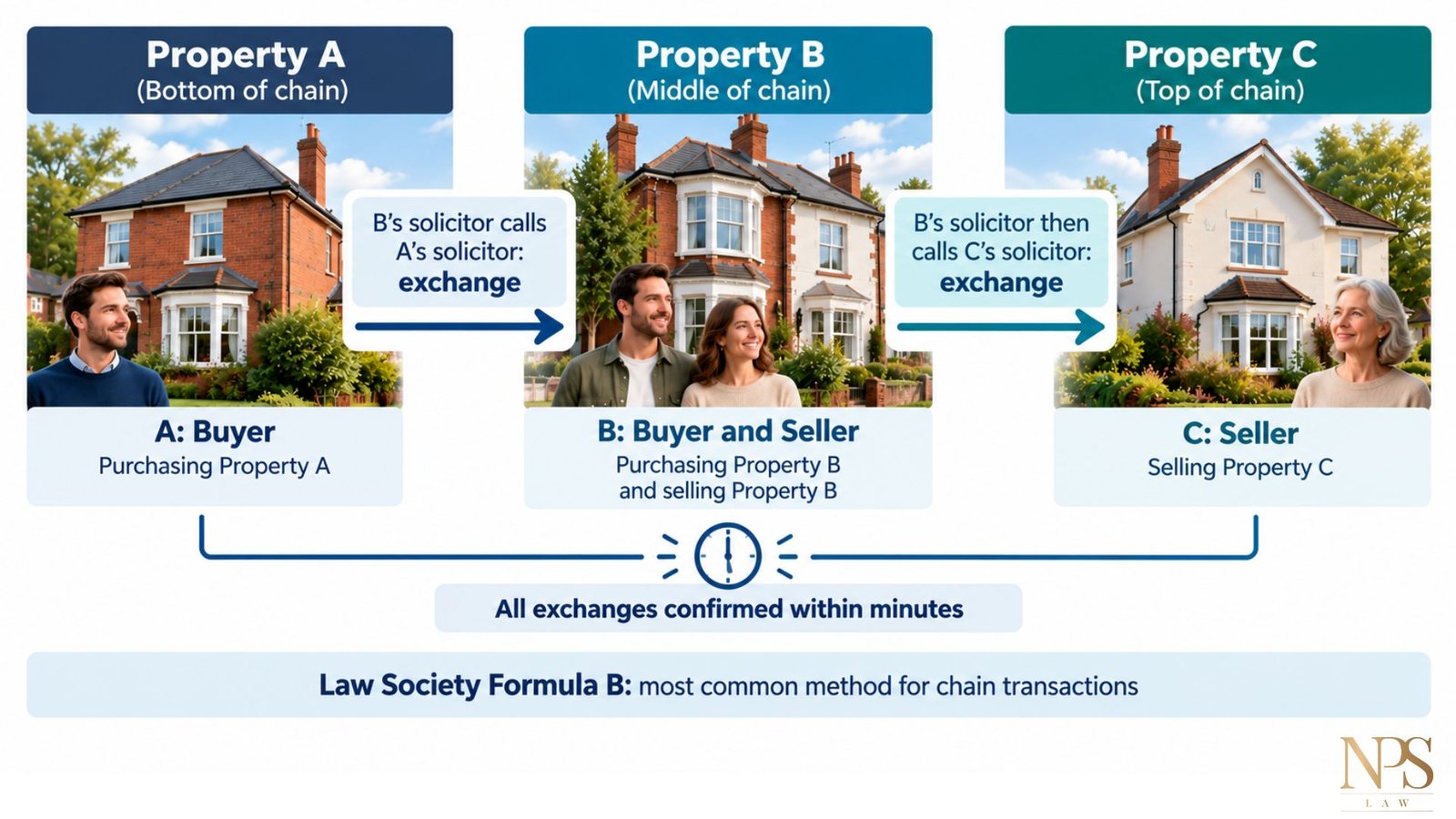
Most residential property transactions in England and Wales are part of a chain. A chain means that one transaction depends on another: the buyer cannot complete their purchase until their property is sold, and the person buying that property cannot complete until theirs is sold, and so on. Exchange across the chain must happen on the same day for all transactions to proceed.
A chain of three or four properties is common. Longer chains exist, and each additional link adds complexity and risk. Every property in the chain must be ready to exchange on the same day, with the same completion date, for the process to work. This means that all parties, solicitors, buyers, sellers, lenders and estate agents, must be aligned simultaneously.
Exchange in a chain is carried out by telephone using one of three Law Society formulae. Formula B is the most commonly used in chain transactions. Under Formula B, the solicitor who is acting for both a buyer and a seller in different parts of the chain takes on a personal undertaking to exchange with the other solicitor within a specified period, usually the same business day.
The undertaking is personal to the solicitor, not just their firm, which is why this system works: each solicitor in the chain is personally committed to completing their part of the exchange. The calls happen in sequence, starting from one end of the chain and working to the other. When the final call is confirmed, exchange across the entire chain is simultaneously complete. The solicitors then follow up in writing to confirm the exchange.
The practical challenge of chain exchange is co-ordination. Every solicitor in the chain must confirm that their client is ready, their documents are in order and their funds are available before the telephone sequence can begin. If one property is not ready, the entire chain waits.
On the day of exchange, your solicitor will be in communication with the other solicitors in the chain and will keep you informed as the position becomes clear. Exchange days can be slow to start and then move quickly at the end. It is common for exchange to be confirmed later in the afternoon than anticipated, which is why firm commitments such as booking removal vans or giving notice at a rented property should not be made on the basis of exchange happening at a specific time.
A chain collapse before exchange means that one party in the chain has withdrawn from their transaction. Because exchange has not happened, there is no legal breach and no deposit is lost. The financial loss is limited to costs already incurred: solicitor fees, survey fees, search fees and any other disbursements paid up to that point. These can amount to several thousand pounds and are not recoverable from the party who withdrew.
Chain collapse is one of the most common and frustrating events in residential property transactions. It cannot be prevented entirely, but the risk can be managed. Keeping the transaction moving quickly, maintaining communication between all parties through the estate agent and solicitors, and having a clear picture of the weakest link in the chain are the most effective tools available. If a chain has a known vulnerability, such as a buyer at one end who has not yet sold their own property, that is worth addressing early rather than discovering it on the day exchange was expected.
⚠ Common Pitfall
Do not make irreversible commitments based on an expected exchange date. Booking a removal company, handing in notice on a rental property, booking time off work or arranging storage are all reasonable steps in preparation, but they should be treated as provisional until exchange is actually confirmed. An exchange date that slips by even a few days can make these arrangements difficult or expensive to unwind.
SUMMARY
The period between exchange and completion is typically one to four weeks. During this time, both parties have obligations to fulfil and both solicitors continue working on the practical and legal steps needed to hand over the property. For buyers this includes finalising mortgage funds, confirming insurance and preparing for the physical move.
Exchange marks the end of the negotiation phase and the beginning of the preparation phase. The uncertainty about whether the transaction will proceed is over. What remains is executing the practical steps needed to make completion happen smoothly on the agreed date.
Your solicitor will send a formal report on title and a completion statement setting out the exact funds required on completion day. This statement includes the balance of the purchase price after the deposit, stamp duty and any adjustments for prepaid service charges or ground rent if the property is leasehold. Read it carefully and ask about anything you do not recognise.
Your mortgage lender will need to be notified to draw down funds in time for completion day. Most lenders require several working days’ notice. Your solicitor will make this request on your behalf, but confirm the timing with them. On the day before completion, your solicitor should confirm that the completion funds are in their client account and ready to transfer. If there is any doubt about this, raise it early.
Stamp Duty Land Tax is payable on completion, not on exchange. Your solicitor will handle the submission of the SDLT return and the payment to HMRC, funded from the completion monies you provide. The legal deadline for both the return and the payment is 14 days from the completion date.
Missing the 14-day deadline results in automatic financial penalties and interest on the amount due, regardless of the reason for the delay. In practice, most solicitors submit the return on the day of completion or the following day. If you are completing on a property where SDLT is material, confirm with your solicitor that the return is being submitted promptly and ask for confirmation when it has been filed.
→ Related: What Is Stamp Duty and How Much Will You Pay in 2026?
The most common problem arising between exchange and completion is a delay to the buyer’s mortgage funds. Lenders occasionally request additional information or extend their processing times close to the completion date. If your solicitor alerts you to a potential delay, act quickly: contact your lender directly, provide any outstanding information and keep your solicitor informed at every stage.
If the property is damaged between exchange and completion, the position depends on the insurance arrangements and the terms of the contract. Notify your solicitor and your insurer immediately. The damage may affect whether completion can proceed on the agreed date, and the contract will set out the mechanism for dealing with this scenario. Do not wait and hope the situation resolves itself: early legal advice is almost always cheaper than dealing with the consequences of inaction.
→ Related: How to Buy a House in the UK: Step-by-Step Process 2026
SUMMARY
Exchange should not be a surprise. Your solicitor will confirm when they are ready to exchange, and you should be able to confirm that everything on your side is in order before that call is made. The checklist below covers the most important items. If any of these are not in place, exchange should not proceed until they are.
The discipline of treating exchange as a formal checkpoint, rather than something that happens when the solicitors are ready, puts the buyer and seller in a stronger position. Raising a concern the day before exchange is far easier to address than raising it on exchange day itself.
If any of these items is outstanding, ask your solicitor for a clear timeline for resolution before you confirm readiness to exchange. Exchanging with a known unresolved issue is possible but carries risk: the obligation to complete exists regardless of what happens after exchange.
Buyers sometimes feel pressure to exchange quickly, particularly in competitive markets or from estate agents managing a chain. This pressure is real, but proceeding to exchange before all of the above items are in place transfers risk to you rather than managing it. Your solicitor’s role is to advise you on readiness. If they confirm they are ready, the items on your side of this checklist are your responsibility to verify.
SUMMARY
Exchange is the highest-stakes moment in a property transaction. NPS Law handles the legal steps leading to exchange, manages the chain co-ordination process and confirms your readiness before proceeding. Our residential conveyancing team has experience with straightforward and complex transactions, including chain break-down and re-building.
Our role in the exchange process is not just to confirm when documents are ready. We review the full title, advise on any issues identified in searches or enquiries, confirm your mortgage offer terms, manage communications with other solicitors in the chain and give you a clear picture of any outstanding risk before we ask whether you are ready to exchange.
If you are approaching exchange on a property purchase or sale and want to be confident that everything is in order, contact NPS Law for a free initial consultation. We will tell you where things stand, what is still needed and what to expect on exchange day.
→ Related: Average Conveyancing Fees UK 2026: What Buyers and Sellers Should Expect
The questions below address the most common queries from buyers and sellers approaching exchange of contracts on property transactions in England and Wales.
Yes, simultaneous exchange and completion is possible and does happen, particularly in auction transactions and in some chain-free sales. It removes the period of risk between exchange and completion but requires both parties and their solicitors to be fully prepared and for all funds to be available on the same day.
It is less common in chain transactions because of the additional co-ordination required across multiple parties. If you are considering same-day exchange and completion, discuss it with your solicitor early in the process.
In England and Wales, the gap between exchange and completion is typically between one and four weeks. Two weeks is a common target in straightforward transactions. Longer gaps of four to six weeks are agreed where a seller needs more time to vacate or where a buyer needs additional time for a large mortgage drawdown.
There is no legal maximum, though very long gaps between exchange and completion can create practical complications around insurance and the risk of market movement.
No. Once exchange has happened, the seller is legally bound by the contract. Accepting or agreeing to a higher offer from another buyer would be a breach of contract.
Gazumping, where a seller accepts a higher offer from a different buyer during the period before exchange, is not unlawful in England and Wales and unfortunately does occur. One of the key practical effects of exchange is that it ends this risk entirely.
NPS Law handles the entire exchange process. We investigate the title, review all searches and enquiries, confirm your mortgage offer, check the contract terms and advise on readiness before exchange.
On exchange day, we carry out the telephone exchange using the Law Society formula, confirm with you when exchange is complete and immediately begin the post-exchange steps including mortgage drawdown instruction and SDLT preparation. You will be kept informed throughout and will not be asked to exchange until we are satisfied that everything is in order.
A mortgage offer can in principle be withdrawn after exchange in certain circumstances, though this is uncommon. If a lender withdraws an offer after exchange, the buyer remains legally bound to complete on the contractual date.
If they cannot do so without the mortgage funds, they face the consequences described in the section on failing to complete: deposit loss and potential claims for further damages. The practical priority is to contact your solicitor immediately if you have any reason to believe your mortgage offer may be at risk, and to do this before exchange rather than after.
Exchange of contracts is the moment a property transaction becomes real in legal terms. Everything before it is negotiation. Everything after it is obligation. The practical and financial consequences of exchange are material, and understanding them before the day arrives is what allows buyers and sellers to act confidently rather than reactively.
The most common exchange-related problems, missed insurance, inadequate deposit funds, buildings that are damaged between exchange and completion, chain collapses that were foreseeable, are almost always avoidable with preparation. The checklist in this guide sets out the items that should be in place before exchange is confirmed. Working through it with your solicitor in the week before exchange is a worthwhile use of time.
NPS Law handles the exchange process on behalf of buyers and sellers across England and Wales. If you are approaching exchange and want confidence that everything is in order, speak to our residential conveyancing team for a free initial consultation.
Ready to Exchange With Confidence? Talk to NPS Law First.
NPS Law manages the exchange process on your behalf, from final checks to chain co-ordination and completion day. Fixed fees, free initial consultation and no completion, no fee protection on every instruction.
Disclaimer: This article is for general informational purposes only and does not constitute formal legal advice. The law described applies to England and Wales unless otherwise stated. For specific legal matters, please consult with a qualified solicitor.

©️ Copyright 2026 NPS Law is a trading name for NPS Law LLP. Solicitors of England and Wales. Authorised and Regulated by the Solicitors Regulation Authority. SRA Number 570169. A list of all Partners is available on the SRA directory for this firm. website designed by origin-media