
Buying a house in the UK is one of the most significant financial decisions most people will make. The process is more predictable than it feels once you understand each stage, but it involves legal obligations, cash requirements and decisions that have lasting consequences if they go wrong.
This guide covers the full nine-stage home-buying process for England and Wales, what each stage involves, how long it takes, what it costs, and what experienced buyers know that first-time buyers often do not.
Summary
Buying a home in England or Wales follows nine sequential stages, from arranging finances to registering ownership. The process typically takes three to six months from offer acceptance to completion, though chains and leasehold complications can extend this significantly.
Buying a house involves two parallel tracks running at the same time: the financial track (arranging a mortgage and saving the deposit) and the legal track (the conveyancing process your solicitor manages). Both tracks need to be in order before you can exchange contracts and commit legally.
This guide covers England and Wales only. Scotland uses a different conveyancing system with binding offers and its own Land and Buildings Transaction Tax. NPS Law advises on transactions in England and Wales.
Two factors shape your experience more than any other: your life stage, and where in England or Wales you are buying. Both affect how long the process takes, what it costs, and which legal steps matter most for your specific transaction.
Summary
The nine stages are: arrange finances, find a property and make an offer, instruct a conveyancing solicitor, obtain a mortgage and valuation, commission searches and a survey, complete legal enquiries, exchange contracts, complete the purchase, and register ownership with HM Land Registry. Each stage has its own timeline and legal requirements.
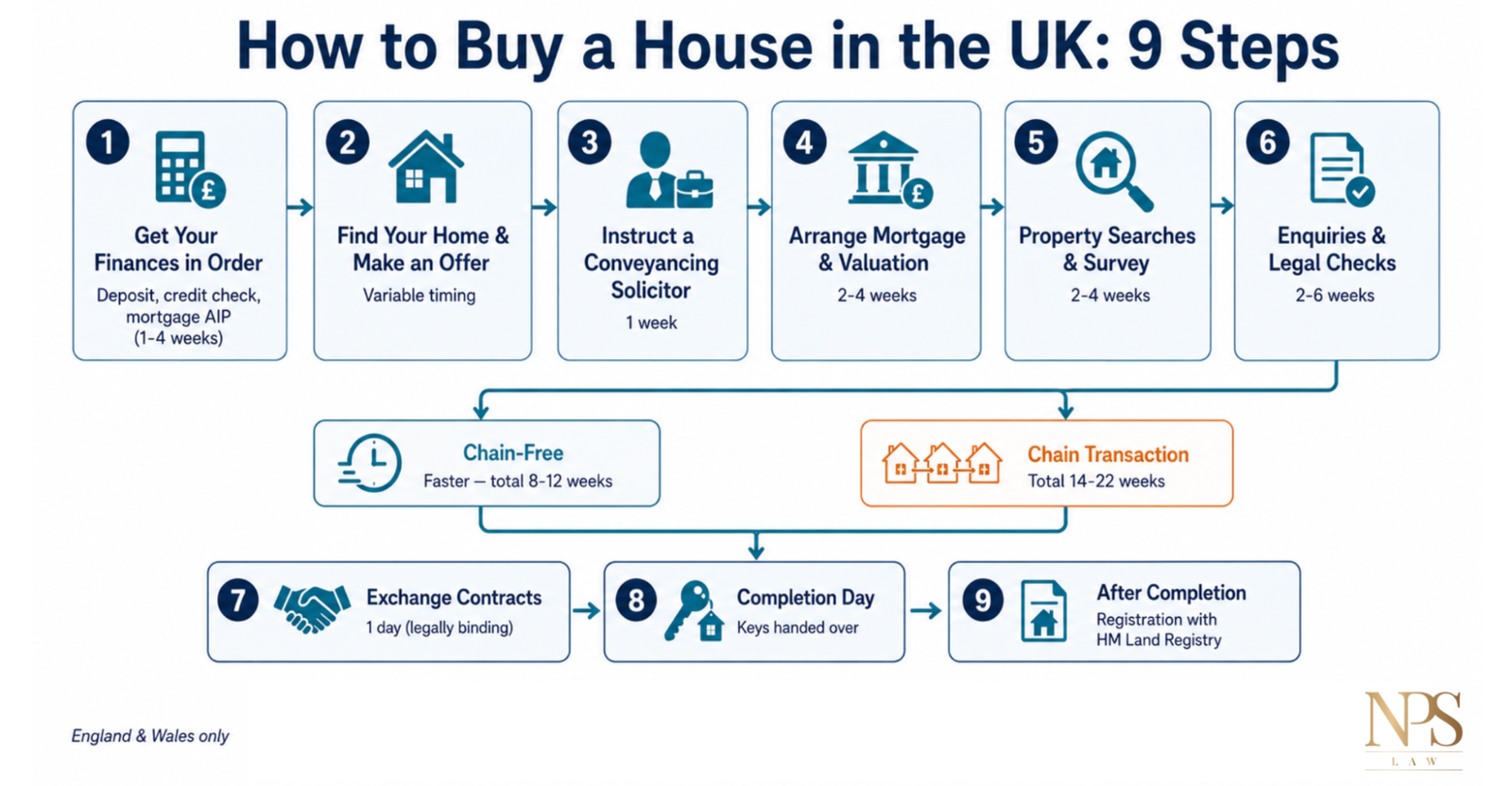
Before viewing any property, establish your maximum budget, save your deposit, check your credit file and get a mortgage Agreement in Principle (AIP). Doing this before you start searching avoids the situation where you find a property you cannot finance.
This stage has no fixed timeline. Once you find a property, submit your offer in writing through the estate agent. Most offers are made verbally first and confirmed in writing. No contract exists at this point and either party can withdraw without legal consequence.
Instruct a solicitor as soon as your offer is accepted. Doing this early, before searches are ordered, means your legal file is open and your solicitor can begin work immediately when the search results arrive. Waiting until the mortgage offer is in place adds unnecessary weeks to the timeline.
Need a conveyancing solicitor? See: NPS Law Residential Conveyancing
Submit your full mortgage application with supporting documents. Your lender instructs a valuation survey to confirm the property is worth the loan amount. This is not a structural survey and does not flag defects. A lender valuation confirming value does not mean the property has no problems.
Your solicitor orders local authority, environmental and water drainage searches. You arrange a separate structural survey if you want an independent assessment of the property’s condition. The survey is optional but advisable, particularly for older properties.
Common survey types and their uses:
| Survey Type | Best For | Typical Cost |
|---|---|---|
| Condition Report (Level 1) | New-build or recently built homes | £300-£450 |
| HomeBuyer Report (Level 2) | Conventional properties in reasonable condition | £450 to £700 |
| Building Survey (Level 3) | Older, unusual or significantly altered properties | £700 to £1,500 |
Your solicitor reviews the search results, survey and title documents and raises formal enquiries to the seller’s solicitors. This is where the underlying legal quality of the transaction is established. Enquiries about planning permissions, boundaries, service charges and lease terms are all addressed at this stage.
Once all enquiries are resolved, both parties sign identical contracts and your solicitor transfers the deposit, typically 10 per cent of the purchase price, to the seller. The transaction is now legally binding and the completion date is fixed. Neither party can withdraw without significant financial penalties.
⚠ Common Pitfall
Exchange of contracts is legally binding. If you withdraw after exchange, you lose your deposit, typically 10 per cent of the purchase price. Never exchange until your survey results are satisfactory, your solicitor has resolved all enquiries and your mortgage offer is unconditional. Once exchanged, you are committed.
On completion day, the remaining purchase funds transfer to the seller’s solicitors and you collect the keys. The property is legally yours. Your solicitor handles the final steps: paying any Stamp Duty or Land Transaction Tax due within 14 days, and registering your ownership with HM Land Registry.
Your solicitor pays any Stamp Duty Land Tax or Land Transaction Tax due within 14 days of completion, registers you as the new owner with HM Land Registry and sends the title documents to your mortgage lender. Once Land Registry registration is complete, you are legally recorded as the owner.
Summary
First-time buyers, home movers and later-life buyers face different financial and legal considerations. First-time buyers may qualify for Stamp Duty relief; home movers must coordinate a simultaneous sale and purchase; later-life buyers should consider the implications of equity release or inherited funds on timing and title.
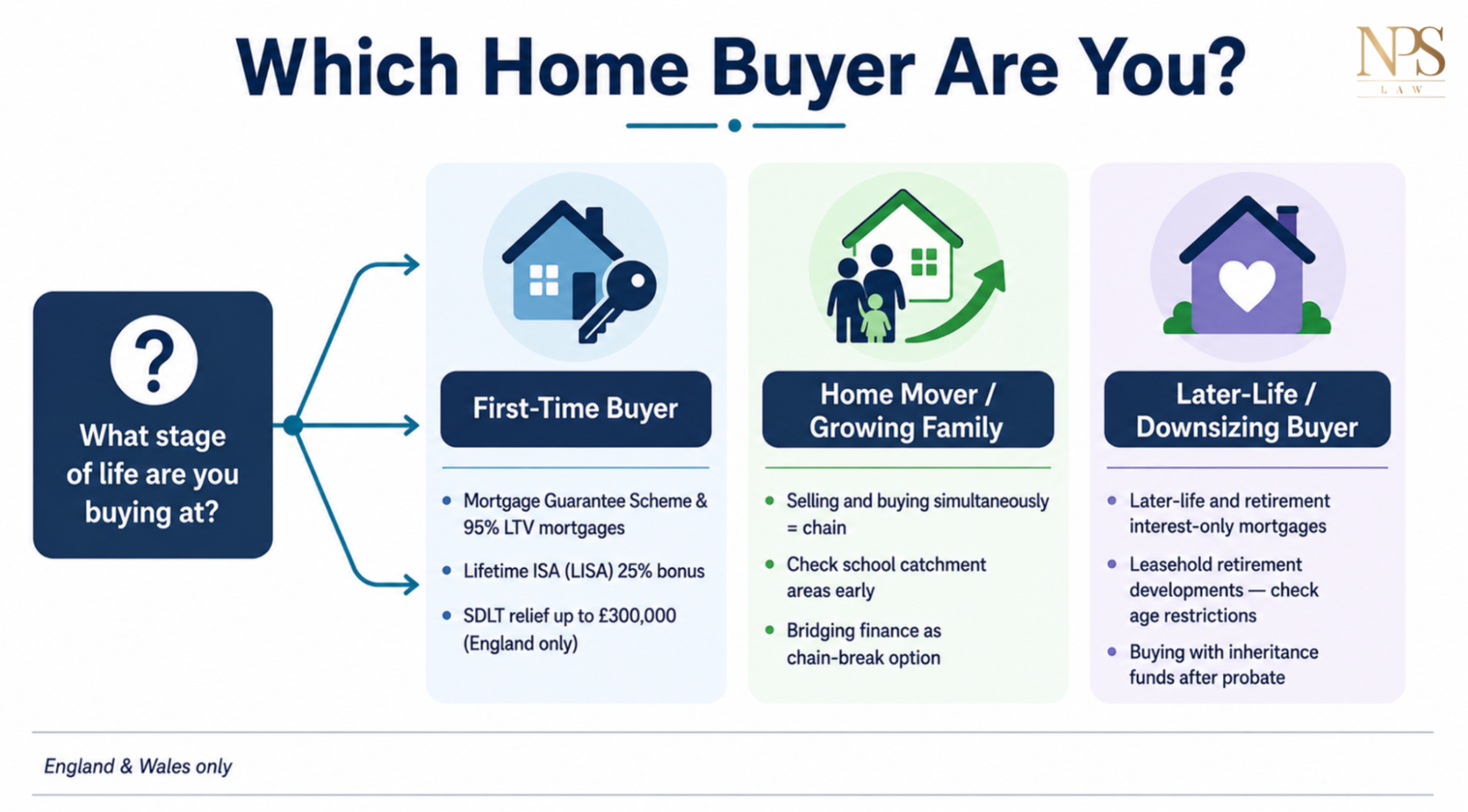
The main obstacles for first-time buyers are deposit savings and mortgage affordability. Government schemes can help:
Selling and buying simultaneously places you in a property chain. A buyer further down the chain withdrawing can collapse transactions across all parties. Build contingency into your timeline and confirm the chain length with your estate agent before committing.
Buyers aged 55 and over face different questions around mortgage products, retirement income and, in some cases, the use of inherited funds.
If you are buying using funds from an inheritance, see our guide to the probate process in the UK.
Summary
Property tax systems differ across the UK. England charges Stamp Duty Land Tax; Wales charges Land Transaction Tax with different thresholds and no first-time buyer relief. Local authority search turnaround times and typical chain lengths also vary significantly by area. NPS Law advises on transactions in England and Wales only.
England uses Stamp Duty Land Tax (SDLT) administered by HMRC. Wales uses Land Transaction Tax (LTT) administered by the Welsh Revenue Authority. The two systems have different rate structures and different thresholds.
| England (SDLT) | Wales (LTT) | |
|---|---|---|
| Standard nil-rate threshold | £125,000 | £225,000 |
| First-time buyer nil-rate | 0% up to £300,000 | No first-time buyer relief |
| First-time buyer purchase limit | Up to £500,000 | Not applicable |
| Administering body | HMRC | Welsh Revenue Authority |
Local authority search turnaround is one of the least visible but most impactful regional variables. In some areas searches return in five to ten working days; in others they take six to eight weeks. Ask your solicitor for current turnaround times for the specific local authority before exchange.
Reference:
Summary
The most costly mistakes in the home-buying process involve underestimating the total cash required at completion, delaying solicitor instruction, skipping an independent survey, and misunderstanding the legal significance of exchange of contracts.
⚠ Common Pitfall
Many buyers calculate their maximum budget as deposit plus mortgage and forget that Stamp Duty, solicitor fees, search costs and a survey must all be paid in cash at completion. A first-time buyer purchasing at £290,000 in England typically needs an additional £2,000 to £3,000 on top of their deposit for these costs alone. Calculate your full cash requirement before making an offer.
Not instructing a solicitor immediately after offer acceptance
Your solicitor cannot begin ordering searches until formally instructed. Waiting until the mortgage offer arrives typically adds two to four weeks to the transaction for no benefit.
Relying on the lender’s valuation instead of commissioning an independent survey
A mortgage valuation confirms the property is worth the loan amount. It does not flag damp, subsidence, roof condition or structural defects. Skipping an independent survey to save £500 can result in costs of many thousands after completion.
Not confirming freehold or leasehold tenure before making an offer
Leasehold properties involve additional legal complexity: service charges, ground rents on older leases, EWS1 fire safety certificates for buildings over 11 metres, and potentially a short remaining lease that affects mortgage eligibility. Confirm tenure before you fall in love with a property.
Summary
A conveyancing solicitor manages all legal aspects of your purchase from instruction to completion, including searches, enquiries, the Stamp Duty return and Land Registry registration. The key factors to evaluate are: whether the firm is on your mortgage lender’s approved panel, whether fees are fixed from the outset, and how progress is communicated.
Get a fixed-fee quote from NPS Law: Contact NPS Law today
Summary
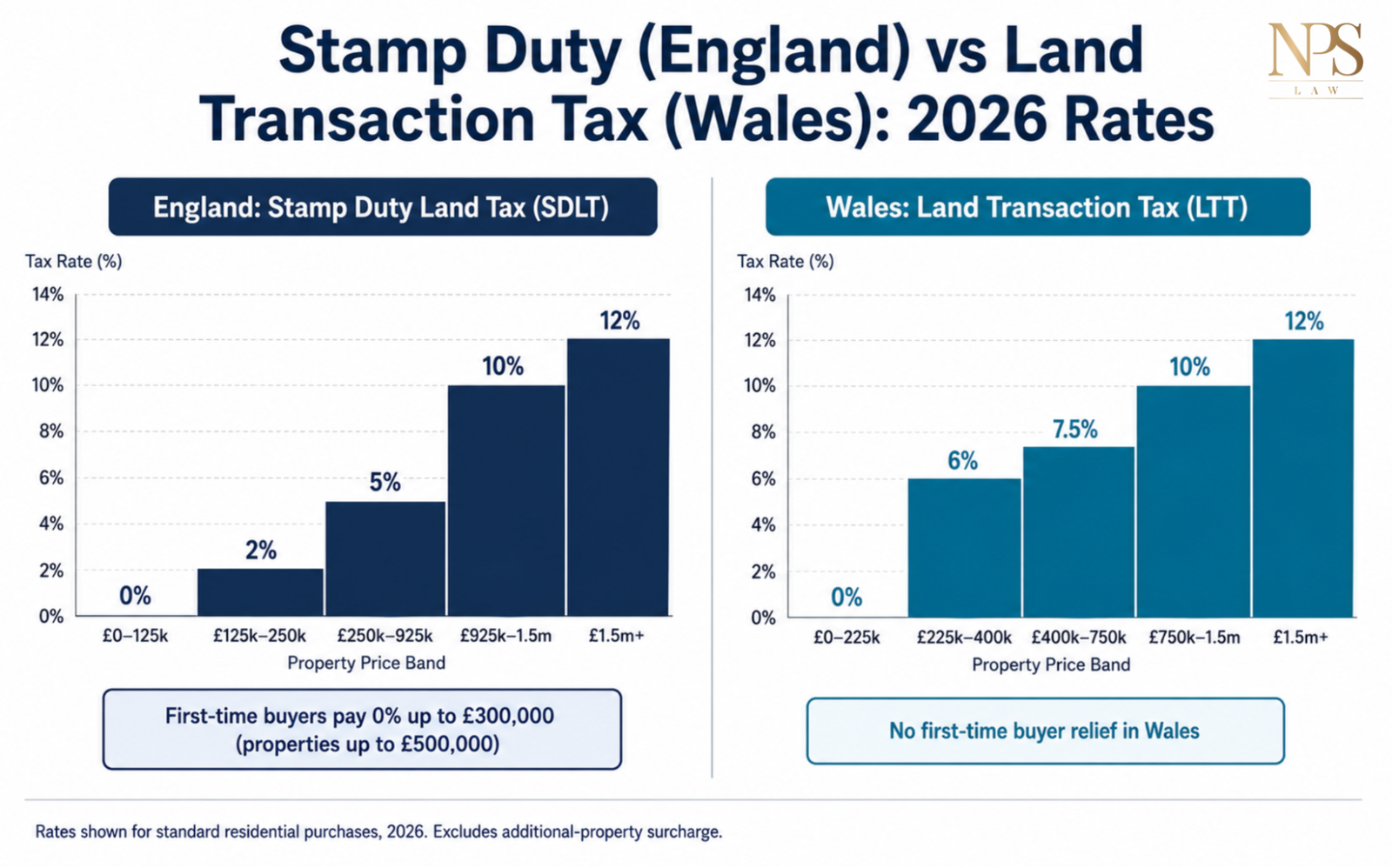
Stamp Duty Land Tax in England is calculated on a banded basis. The standard nil-rate threshold is £125,000; first-time buyers pay nothing on the first £300,000 of purchases up to £500,000. Wales uses Land Transaction Tax with different bands and no first-time buyer relief. No changes to either rate structure have been announced for 2026/27.
England: Stamp Duty Land Tax (SDLT)
| Price Band | Standard Rate | First-Time Buyer Rate |
|---|---|---|
| Up to £125,000 | 0% | 0% (up to £300,000) |
| £125,001 - £250,000 | 2% | 0% (up to £300,000) |
| £250,001 to £925,000 | 5% | 5% (on portion above £300,000) |
| £925,001 to £1,500,000 | 10% | 10% |
| Over £1,500,000 | 12% | 12% |
First-time buyer relief is only available on purchases up to £500,000. If the agreed price exceeds that threshold, standard rates apply on the entire purchase price.
⚠ Common Pitfall
At £500,001, a first-time buyer loses all first-time buyer relief and pays standard rates on the full purchase price. A £499,999 offer produces a Stamp Duty bill of £10,000. A £500,001 offer produces a bill of £15,000: a £5,000 difference on a £2 price gap. Always check whether negotiating below £500,000 is feasible before finalising an offer above this threshold.
Wales: Land Transaction Tax (LTT)
| Price Band | Rate (No First-Time Buyer Relief) |
|---|---|
| Up to £225,000 | 0% |
| £225,001 - £400,000 | 6% |
| £400,001 - £750,000 | 7.5% |
| £750,001 - £1,500,000 | 10% |
| Over £1,500,000 | 12% |
Wales does not offer first-time buyer relief under the LTT regime. The nil-rate threshold is higher at £225,000, but rates above that are steeper than England’s SDLT. Buyers purchasing in Wales should confirm LTT liability with their solicitor before exchange.
Buying an additional property? See: Stamp Duty on Second Homes and Buy-to-Let Properties
Reference:
GOV.UK: Stamp Duty Land Tax: residential property rates
Welsh Revenue Authority: Land Transaction Tax rates and bands
A chain-free purchase typically takes 8 to 12 weeks from offer to completion. A purchase involving a chain of three or more parties typically takes 16 to 24 weeks. Leasehold properties with management companies can take longer still, particularly if the managing agent is slow to return enquiries. For a UK-wide overview of timescales, see our guide to how long conveyancing takes.
Exchange of contracts is the point at which the transaction becomes legally binding. Both parties sign identical contracts and the buyer pays the deposit. Completion is typically one to four weeks later, when the remaining funds transfer and ownership legally passes.
First-time buyers in England pay 0 per cent Stamp Duty on the first £300,000 and 5 per cent on the portion between £300,001 and £500,000. The relief disappears entirely above £500,000. Wales does not offer an equivalent first-time buyer relief under Land Transaction Tax.
The mortgage lender’s valuation only confirms the property is worth the loan amount. It does not assess structural condition. An independent survey identifies defects before you commit legally. Skipping it to save a few hundred pounds risks much larger repair costs after completion.
NPS Law provides a fixed, itemised quote before instruction. The fee covers all stages from instruction to Land Registry registration, including the Stamp Duty return filed within 14 days of completion. We operate on a no completion, no fee basis: if your purchase does not proceed for reasons outside your control, our professional legal fees are not charged.
If a purchase collapses before exchange, NPS Law’s no completion, no fee policy applies and our professional legal fees are not charged. Third-party costs already incurred: search fees, survey costs: remain payable. After exchange, withdrawal triggers contractual penalties and the buyer typically loses the deposit. Your solicitor will explain the exact position before exchange takes place.
Summary
The home-buying process follows a predictable sequence. The decisions that matter most are made early: how much you can realistically borrow and spend, which solicitor you instruct, and whether the survey results justify proceeding. Getting these right at the start reduces the risk of delays and unexpected costs later.
The nine stages above apply to almost every purchase in England and Wales. Your personal timeline depends on your life stage, where you are buying and whether you are part of a chain. Understanding where delays most commonly occur, at the local authority search stage, the enquiries stage and in longer chains, allows you to prepare rather than react.
If you are ready to start your purchase or want a fixed-fee conveyancing quote with no completion, no fee protection, contact NPS Law today. Our team handles residential conveyancing across England and Wales from offices in Solihull, Middlesbrough and London.
Ready to start your property purchase with NPS Law?
NPS Law handles residential conveyancing across England and Wales from offices in Solihull, Middlesbrough and London. Fixed-fee quotes, no completion, no fee protection on every instruction.
Disclaimer: This article is for general informational purposes only and does not constitute formal legal advice. For specific legal matters, please consult with a qualified solicitor.
All references verified July 2026.
GOV.UK: Stamp Duty Land Tax residential property rates
Welsh Revenue Authority: Land Transaction Tax rates and bands

©️ Copyright 2026 NPS Law is a trading name for NPS Law LLP. Solicitors of England and Wales. Authorised and Regulated by the Solicitors Regulation Authority. SRA Number 570169. A list of all Partners is available on the SRA directory for this firm. website designed by origin-media