
Are you planning to buy or sell a property in Birmingham but feeling overwhelmed by the legal paperwork? In a city as large and varied as Birmingham from city centre leasehold apartments to Edgbaston family homes the legal risks can look very different depending on where you are buying.
Many buyers and sellers struggle with unclear timelines, unpredictable costs, and risks that generic guides simply do not cover.
This guide removes the guesswork by breaking down the exact legal steps, uncovering Birmingham-specific risks that most solicitors’ guides overlook, and showing you how to secure a smooth, stress-free move in the West Midlands.
SUMMARY: Property conveyancing in Birmingham is the legal process of transferring home ownership from seller to buyer, typically taking 8–16 weeks and costing £1,150–£2,100 in legal fees and disbursements before Stamp Duty.
Property conveyancing is the legal process of transferring property ownership from a seller to a buyer. Birmingham’s property market encompasses everything from Victorian terraces in Moseley to leasehold apartments in the city centre, and each comes with a distinct legal profile.
The solicitor you instruct determines how much of that complexity you are exposed to, and how much is identified and resolved before it becomes your problem.
Birmingham is the United Kingdom’s second largest city, home to more than 1.1 million residents within the city boundary and over 4 million across the wider West Midlands metropolitan area.
The property market reflects that scale and diversity: the average sold price was £236,000 in April 2026 according to the ONS and HM Land Registry’s UK House Price Index, but prices vary sharply by postcode:
| Postcode | Areas | Typical Price Range |
|---|---|---|
| B1 / B2 | City Centre, Southside (mainly leasehold flats) | £140,000 – £210,000 |
| B15 | Edgbaston, Ladywood | £380,000 – £450,000 |
| B13 / B14 | Moseley, Kings Heath, Billesley | £250,000 – £320,000 |
| B74 / B72 | Sutton Coldfield, Four Oaks | £350,000 – £500,000+ |
Getting the legal groundwork right from the outset matters particularly in Birmingham, where the variables are greater than in most UK markets. An unresolved search result near the HS2 corridor, a missing EWS1 certificate on a city centre flat, or a delayed CON29 return from Birmingham City Council can each hold up a transaction that appeared straightforward at the outset.
Professional legal oversight is what stands between you and those risks.
Reference:
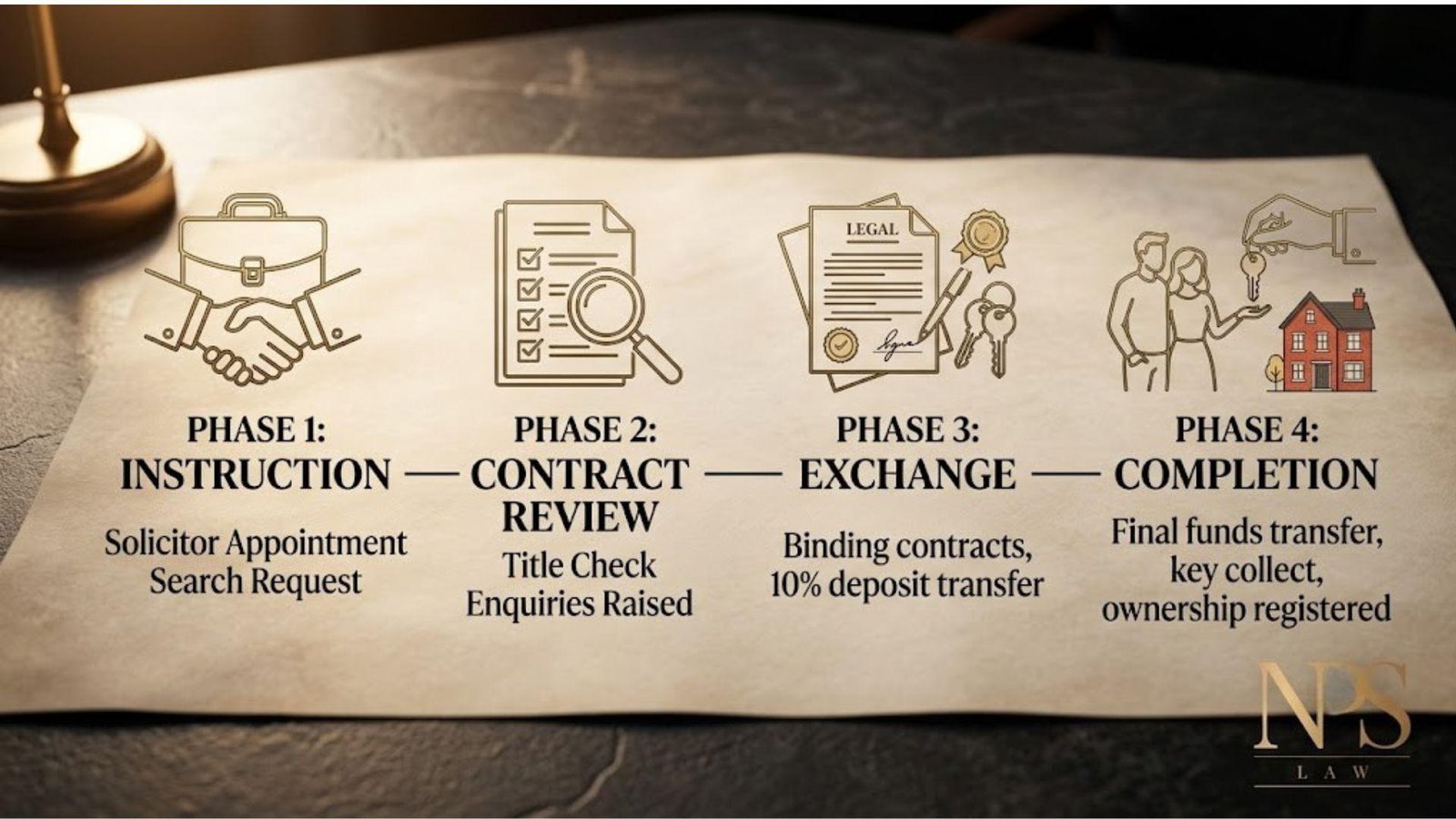
SUMMARY: Residential conveyancing in Birmingham moves through four distinct phases: instruction and searches, contract review, exchange of contracts, and completion.
Here is how the process works from the moment an offer is accepted until you receive the keys.
Your solicitor begins work as soon as you instruct them. Before you commit financially, they will commission a series of standard property searches covering local authority records, environmental data, and water infrastructure to identify any issues that could affect the value or legal status of the property.
The official Local Land Charges search for Birmingham is submitted through the national HM Land Registry portal, while Birmingham City Council continues to answer the more detailed CON29 enquiries directly. This investigation checks official records to secure your purchase.
Key Council Search Checkpoints:
Alongside council records, your legal team will arrange three further essential property searches:
Completing these vital checks ensures you fully understand the physical and legal condition of your future home before moving forward.
Reference:
Birmingham City Council Local Land Charge Searches
When the draft contract arrives from the seller’s solicitors, your conveyancer reviews it in full. They examine the title deeds, verify the ownership history, and raise formal written questions known as enquiries to resolve any ambiguities.
Most of this work takes place out of sight, but it is where the foundations of a secure transaction are laid.
Your legal team will actively raise specific questions (officially known as enquiries) with the seller’s side. This process is crucial to clear up any ambiguities regarding:
In a city the size of Birmingham, property chains frequently involve multiple simultaneous transactions, and this is the stage at which they most commonly stall.
A solicitor who responds promptly to enquiries and keeps all parties updated can prevent a single delay from unravelling the entire chain, particularly in competitive postcodes where other buyers may be waiting in the wings.
Leasehold vs freehold in Birmingham:
Birmingham’s housing stock is more diverse than most West Midlands towns. Suburban freehold homes dominate in Edgbaston, Moseley, and Sutton Coldfield, while city centre apartments and Jewellery Quarter conversions are predominantly leasehold.
For a leasehold purchase, your solicitor needs extra time to request and review the management pack, checking:
EWS1 fire safety certificates:
If you are buying a flat in a building over 11 metres in height, which applies to the majority of city centre apartment blocks in Birmingham, your solicitor will check whether an EWS1 (External Wall System) fire safety certificate is in place.
Introduced following the Grenfell Tower fire, EWS1 is required by most mortgage lenders before they will lend on high-rise properties. Without it, completing a purchase can be extremely difficult. Your solicitor will flag this during the enquiries stage.
Buying new-build in Birmingham:
If you are buying off-plan or a newly built home in a development such as the Eastside or Digbeth regeneration zone, your solicitor will also check:
Exchange of contracts is the point at which the transaction becomes binding on both parties. Solicitors confirm the exchange by telephone, with each side holding a signed copy of the same contract. The buyer pays the deposit at this stage, which is normally 10 per cent of the agreed purchase price.
After exchange, withdrawing from the transaction carries serious financial consequences for whichever party walks away. For buyers who have worked through Birmingham’s competitive market to reach this stage, it is the moment the property is secured and the completion date is set.
On completion day, the balance of the purchase price is transferred electronically to the seller’s solicitors, and the buyer collects the keys. The handover itself is usually straightforward, but your solicitor must complete a number of legally required steps before the matter can be closed.
Following completion, your legal team will handle the final mandatory steps:
HM Land Registry’s official YouTube channel publishes a short explainer covering how the conveyancing process and land registration interact, including what happens after completion day. This video outlines the timeline and documentation required for registering ownership.
Reference:
HM Land Registry How conveyancing and land registration interact (YouTube)
SUMMARY: Conveyancing costs in Birmingham typically total £1,150–£2,100 before Stamp Duty, split into three categories: legal fees, disbursements, and tax.
Conveyancing costs are split into three distinct categories: Legal Fees, Disbursements, and Taxes. The table below details what you can expect to pay and when.
| Cost Category | Item Description | Typical Estimated Cost | Payment Timing |
|---|---|---|---|
| Legal Fees | Solicitor professional service fee | £850 – £1,500 + VAT | Small deposit upfront; balance paid on completion |
| Disbursements | Birmingham City Council CON29, water, and environmental searches | £250 – £300 | Paid upfront when instructing the solicitor |
| Disbursements | HM Land Registry registration fee | £45 – £300 | Paid on completion day |
| Taxes | Stamp Duty Land Tax | Dependent on property price and buyer status | Paid on completion day |
NPS Law provides a fixed, itemised quote at the outset of every instruction. There are no estimate ranges and no unexpected additions at completion. Because we recognise that Birmingham transactions can fall through for reasons outside your control, all residential conveyancing is handled on a no completion, no fee basis: if the transaction does not proceed, our legal fees are not payable.
Stamp Duty is charged in bands, so the real bill is usually lower than it first looks. Under the rates in force since April 2025, Birmingham’s lower average price means many buyers, especially first-time buyers, owe considerably less than they expect.
| Purchase Price | Standard Buyer | First-Time Buyer |
|---|---|---|
| £200,000 | £1,500 | £0 |
| £236,000 (Birmingham average) | £2,220 | £0 |
| £400,000 | £10,000 | £5,000 |
First-time buyer relief applies up to £500,000, giving 0% on the first £300,000 and 5% on the portion above it. At Birmingham’s average price of £236,000, first-time buyers pay nothing at all in Stamp Duty. According to GOV.UK’s official guidance, this relief is not available once the purchase price exceeds £500,000, even by a small amount. This is a cliff edge, not a gradual taper.
Reference:
SUMMARY: Two risks unique to Birmingham. The HS2 Curzon Street construction zone and Birmingham City Council’s Section 114 financial constraints and these require extra due diligence that most generic conveyancing guides do not address.
Birmingham’s property market moves quickly, but two local factors introduce legal complications that you will not encounter in most other West Midlands transactions. Understanding them before you instruct a solicitor can prevent costly surprises.
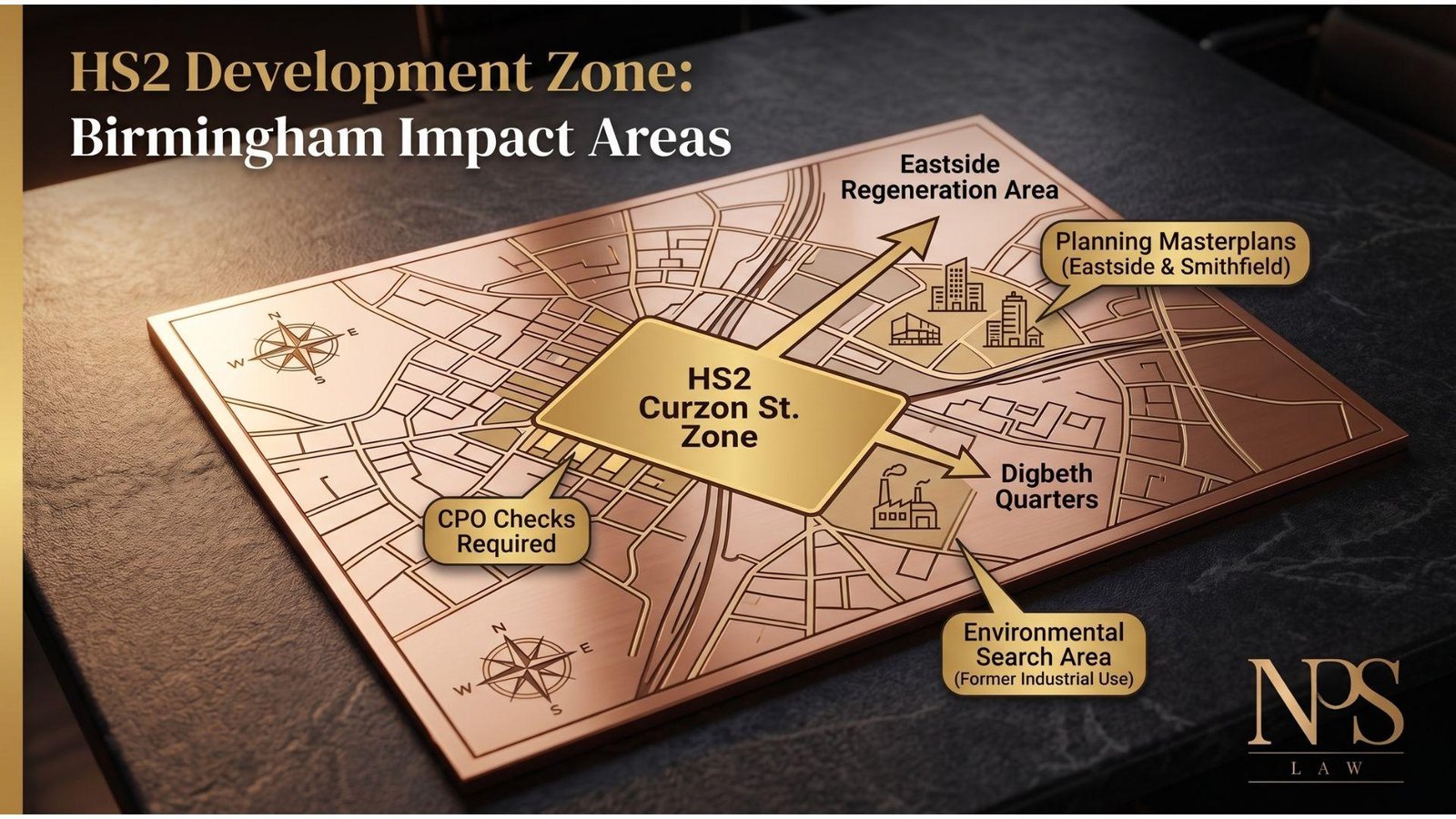
HS2’s Birmingham terminus at Curzon Street is under active construction in the Eastside and Digbeth quarters, covering approximately 141 hectares of the city centre.
If you are buying in or near this zone, your solicitor’s searches will need to investigate:
For new-build purchases in the regeneration zone, always confirm with your solicitor how completed searches from the local authority interact with any infrastructure protection zones before exchanging contracts.
Reference:
Birmingham City Council Birmingham Curzon HS2 Masterplan
In September 2023, Birmingham City Council issued two Section 114 notices, the local government equivalent of a financial emergency,, following equal pay liabilities and a significant budget gap.
The council has been operating under government commissioner oversight since then, with the 2026/27 budget expected to be the first balanced without asset sales.
What this means practically for conveyancing buyers in Birmingham:
This is not a reason to avoid buying in Birmingham, it is a reason to instruct a solicitor who monitors Birmingham City Council’s current CON29 turnaround times and plans accordingly. NPS Law tracks local authority search turnaround times across the West Midlands as standard practice.
Reference:
SUMMARY: Commercial conveyancing in Birmingham covers higher-stakes transactions, from Colmore Row office leases to Jewellery Quarter properties, requiring extra scrutiny of repair liabilities, use class restrictions, and in the Quarter, Listed Building Consent.
Commercial conveyancing differs significantly from residential transactions. It involves higher financial stakes and more complex legal obligations, such as ongoing repair liabilities and permitted use classes. See our broader guide on commercial conveyancing in the UK for the fundamentals, or read on for how this applies specifically in Birmingham.
Colmore Row, at the heart of Birmingham’s B3 postcode, is the city’s prime commercial address, home to major law firms, financial institutions, and professional services companies within walking distance of New Street and Snow Hill stations. If your business is acquiring office space here, the legal focus shifts to scrutinising commercial leases. Your solicitor will check for:
The Jewellery Quarter (B18 and B19) is one of Birmingham’s most distinctive commercial and residential areas, containing more than 200 listed buildings within a designated Conservation Area, one of the most significant Conservation Areas in the West Midlands. This creates a layer of legal complexity not found elsewhere in Birmingham:
Reference:
SUMMARY: NPS Law is a West Midlands conveyancing firm, based at 1 Cranmore Drive in Shirley, Solihull, serving Birmingham and the surrounding region, rated 4.4/5 on Trustpilot and 4.8/5 on ReviewSolicitors firm-wide.
Finding a solicitor who communicates clearly and acts quickly is the key to a stress-free move. Based at 1 Cranmore Drive in Shirley, Solihull, just south of the Birmingham city boundary,. NPS Law handles residential and commercial transactions across the B1 to B74 postcode range and the wider West Midlands. That local knowledge, combined with nationwide expertise, means your transaction is never a postcode away from proper attention.
Our core ethos is Redefining Legal Services:
The most common complaint in the conveyancing industry is poor communication. At NPS Law, we prioritise responsiveness:
As of 5 July 2026, NPS Law holds a 4.4 out of 5 rating from 87 reviews on Trustpilot, an independent review platform, reflecting our commitment to exceptional service across the team. Recent feedback highlights that dedication:
As of 5 July 2026, NPS Law also holds a 4.8 out of 5 rating from 153 reviews on ReviewSolicitors firm-wide. One client there described Junaid as follows:
“particularly excellent, always responsive, professional and proactive in keeping things moving.”
, ReviewSolicitors client review of Junaid
The same reviewer added that Salma, Hamza and Yusuf Tariq also helped make the process far less stressful.
Reference:
SUMMARY: Successfully completing a property transaction in Birmingham comes down to three things: understanding the four-phase process, budgeting accurately for fees and Stamp Duty, and choosing a solicitor who knows Birmingham’s specific search environment and leasehold landscape.
Buying or selling a property in Birmingham is a major financial milestone, but with the right solicitor, it does not have to be stressful. Whether you are a first-time buyer taking advantage of Birmingham’s affordability, an investor targeting the Jewellery Quarter or Digbeth regeneration zone, or a family moving into Edgbaston or Sutton Coldfield, the fundamentals remain the same: understand the process, budget accurately, and choose a legal team who knows Birmingham.
If you are planning a property transaction in Birmingham or the West Midlands, contact NPS Law today for a free, transparent quote and experience conveyancing as it should be. If you are remortgaging or adding a partner to the title rather than buying outright, our guide to transfer of equity covers that related process.
A chain-free transaction can complete in 8–10 weeks. Longer chains or leasehold management-pack delays commonly push this to 12–16 weeks. Properties near the HS2 Curzon Street zone or subject to Birmingham City Council search delays may require additional time, and your solicitor should plan for this from the outset.
Three risks stand out. First, whether an EWS1 fire safety certificate is in place, required by most lenders for buildings over 11 metres. Second, the service charge history: check the last three years for large one-off charges that signal poorly managed communal areas. Third, the remaining lease length: below 80 years, many lenders will not lend, and the cost of extending the lease must be factored into your offer.
EWS1 (External Wall System) is a fire safety assessment introduced following the Grenfell Tower fire. It is required by most mortgage lenders for residential buildings over 11 metres in height. Most city centre apartment blocks in Birmingham fall into this category. Without a current EWS1 certificate, many lenders will refuse to lend, making the purchase effectively unmortgageable. Your solicitor will identify this requirement during the enquiries stage and advise on next steps.
Not legally, but local knowledge of Birmingham City Council’s search turnaround times, the specific complexities of Jewellery Quarter transactions, and the HS2 construction zone helps avoid delays that a remote firm might miss. A solicitor familiar with the Birmingham search environment will know when to recommend a personal search and when to apply for indemnity insurance.
At Birmingham’s average price of £236,000, first-time buyers pay £0 in Stamp Duty. The first-time buyer relief gives 0% on the first £300,000, which covers the vast majority of Birmingham transactions. Only purchases between £300,001 and £500,000 attract any SDLT for first-time buyers, at 5% on the amount above £300,000.
Disclaimer: This article is for general informational purposes only and does not constitute formal legal advice. For specific legal matters, please consult with a qualified solicitor.

©️ Copyright 2026 NPS Law is a trading name for NPS Law LLP. Solicitors of England and Wales. Authorised and Regulated by the Solicitors Regulation Authority. SRA Number 570169. A list of all Partners is available on the SRA directory for this firm. website designed by origin-media