
Is a property purchase or sale in Middlesbrough on your horizon? Whether you are purchasing a terrace in Acklam, a flat in the town centre or a detached home in Marton, the legal process of conveyancing involves more than most buyers expect. In a town shaped by industrial heritage and active regeneration, local knowledge is not optional.
This guide explains the conveyancing process step by step, sets out what buyers and sellers in Middlesbrough need to know about local property searches, Right to Buy restrictions and the Teesworks Freeport zone, and gives you realistic figures for costs and Stamp Duty at Middlesbrough price points.
SUMMARY
Property conveyancing in Middlesbrough is the legal process of transferring home ownership from seller to buyer, typically taking 8 to 16 weeks and costing £1,000 to £1,800 in legal fees and disbursements before Stamp Duty.
Conveyancing is the legal mechanism by which ownership of a property transfers from one party to another. Without it, a sale or purchase has no legal force. For buyers in Middlesbrough, securing a solicitor who understands the local search environment is especially important because the town’s industrial past creates specific due diligence requirements that do not arise in most other UK property markets.
Middlesbrough is a post-industrial town in the Tees Valley, one of the largest local economies in the North East of England. The property market is characterised by relatively low average prices compared with the national average, a high proportion of terrace housing, and pockets of significant regeneration activity. According to the ONS and HM Land Registry’s UK House Price Index, the average sold price in Middlesbrough was approximately £150,000 in early 2026, though prices vary considerably by postcode.
The table below shows typical price ranges across the main residential areas.
| Postcode | Areas | Typical Price Range |
|---|---|---|
| TS1 / TS2 | Middlesbrough Town Centre (mainly flats and apartments) | £80,000 to £130,000 |
| TS4 / TS5 | Linthorpe, Acklam, Berwick Hills | £120,000 to £200,000 |
| TS7 | Marton, Nunthorpe | £200,000 to £320,000 |
| TS6 | Grangetown, South Bank (near Teesworks) | £60,000 to £110,000 |
Because properties in the TS6 area sit near active industrial and regeneration land, and because a significant proportion of Middlesbrough’s housing stock was originally built as council housing, local legal expertise matters more here than in most comparable towns. Our residential conveyancing team handles transactions across all of these postcodes.
Reference:
GOV.UK – Buying or selling your home
ONS / HM Land Registry – UK House Price Index, Middlesbrough
SUMMARY
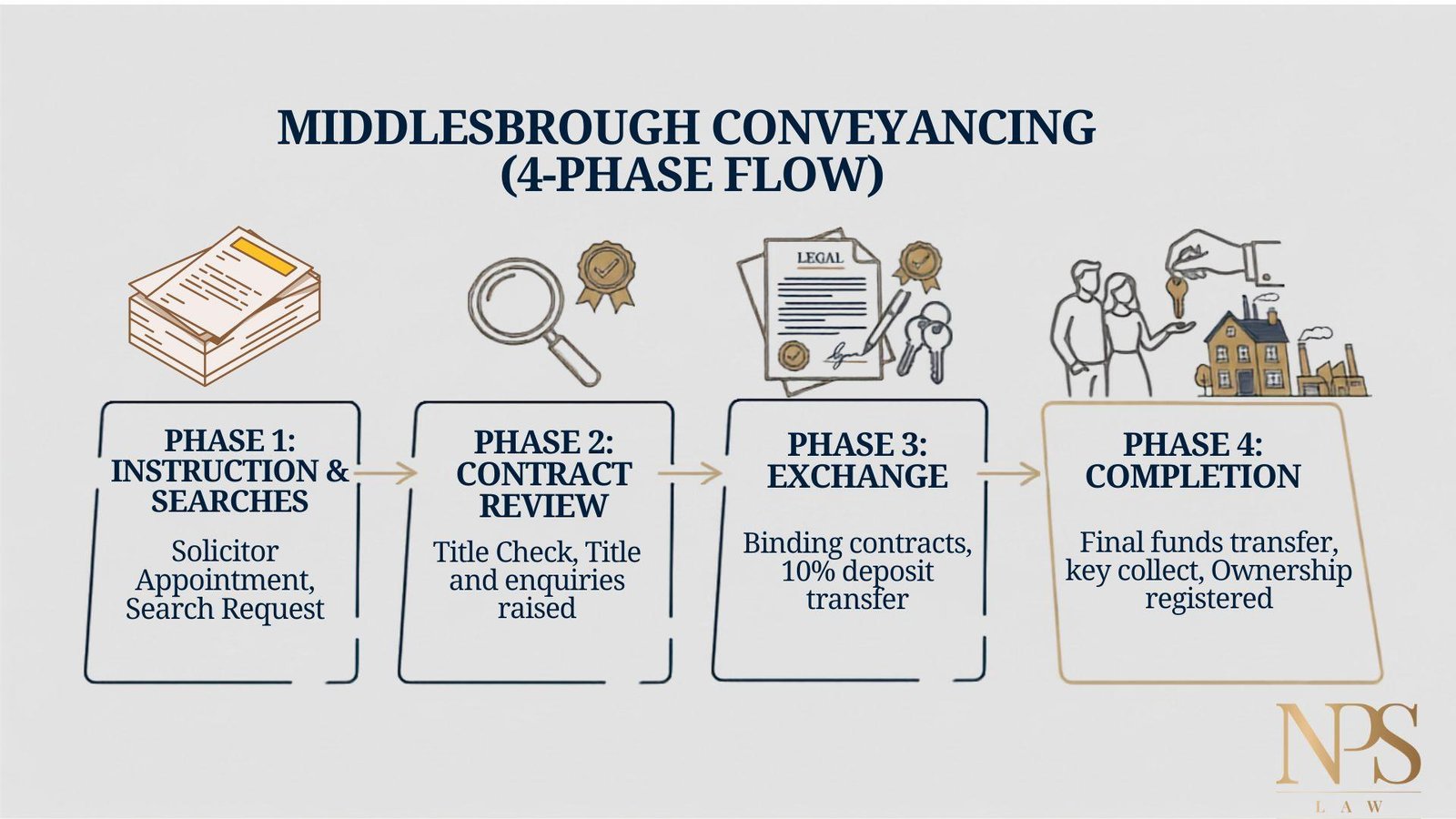
Residential conveyancing in Middlesbrough moves through four distinct phases: instruction and searches, contract review, exchange of contracts, and completion. In Middlesbrough, Phase 1 involves additional searches that are rarely needed in other parts of England.
Here is how the process works from the moment an offer is accepted to the day you receive the keys.
The conveyancing process formally begins when you instruct your solicitor. Your solicitor will then commission a set of property searches to uncover any risks or restrictions that could affect the property before you commit financially.
The standard set of searches for a Middlesbrough property covers four areas, though additional searches are often warranted given the local environment.
Standard searches:
Additional searches commonly needed in Middlesbrough:
These additional searches add a modest cost but can reveal issues that affect mortgage lending, insurance premiums and resale value. Identifying them before exchange is far less costly than discovering them afterwards.
Reference:
Middlesbrough Council – Local Land Charges and CON29 searches
The Coal Authority – Coal mining risk assessment service
When the seller’s solicitors provide the draft contract, your solicitor reviews every legal detail and raises formal questions, known as enquiries, to resolve any ambiguities. This is where the underlying legal quality of the transaction is established.
The enquiries will cover boundaries, fixtures and fittings, and any warranties or guarantees on work done to the property. In Middlesbrough, three additional topics arise more frequently than in other markets.
Right to Buy properties:
Middlesbrough has a higher than average proportion of former council housing that has been sold under the Right to Buy scheme. These properties carry restrictive covenants in the title deeds that impose conditions on resale. The most significant of these is the council’s right of first refusal: if the property is sold within five years of the original Right to Buy purchase, the council may have the right to repurchase it at a discounted price. Your solicitor will identify these restrictions in the title deeds and explain their practical implications before you exchange.
Leasehold flats and EWS1 certificates:
City centre apartment blocks in TS1 and TS2 are predominantly leasehold. For buildings over 11 metres in height, an EWS1 (External Wall System) fire safety certificate is required by most mortgage lenders before they will approve a loan. Without a valid EWS1 in place, many lenders will refuse to lend, making the property effectively unmortgageable. Your solicitor will identify this requirement during the enquiries stage.
New builds in regeneration zones:
Buyers purchasing new-build properties near the Teesworks zone or the Middlehaven regeneration area should expect additional scrutiny of the developer’s contract terms, completion date flexibility and any infrastructure charges that may apply.
⚠ Common Pitfall
Right to Buy properties look straightforward on the surface, but the restrictive covenants and council right of first refusal are buried in the title deeds. Buyers who skip a full title check before exchange sometimes discover restrictions that significantly limit their ability to sell or let the property. Always instruct a solicitor to review the full title register before you commit.
Exchange of contracts is the point at which the transaction becomes legally binding. Both buyer and seller sign identical copies of the contract, and the solicitors exchange them formally by telephone. The buyer pays the deposit at this stage, typically 10 per cent of the purchase price.
After exchange, neither party can withdraw without facing significant financial consequences. For buyers in Middlesbrough, this is the moment the property is secured and the completion date is fixed.
On completion day, the balance of the purchase price transfers to the seller’s solicitors and the buyer collects the keys. The transaction is complete, but your solicitor still has mandatory steps to carry out.
Following completion, your legal team handles the final required steps:
HM Land Registry’s official channel explains how the land registration process works after a residential purchase completes, including the documents required and typical timescales. This is the process your solicitor carries out on your behalf.
Reference:
HM Land Registry – guidance for property registration
HM Land Registry – conveyancing explainer (YouTube)
SUMMARY
Conveyancing costs in Middlesbrough typically total £1,000 to £1,800 before Stamp Duty, split across legal fees, disbursements and tax. At Middlesbrough’s average price levels, most first-time buyers pay zero Stamp Duty, and standard buyers face one of the lowest SDLT bills of any UK town.
The table below sets out the main cost categories and when each falls due.
| Cost Category | Item | Typical Estimate | Payment Timing |
|---|---|---|---|
| Legal Fees | Solicitor professional service fee | £750 to £1,200 + VAT | Deposit on instruction; balance at completion |
| Disbursements | Middlesbrough Council CON29, water, environmental searches | £200 to £280 | Paid upfront on instruction |
| Disbursements | Additional: coal mining or contaminated land search | £30 to £80 | Paid upfront if required |
| Disbursements | HM Land Registry registration fee | £20 to £270 | Paid at completion |
| Tax | Stamp Duty Land Tax | Often zero at Middlesbrough prices | Paid at completion |
NPS Law provides a fixed, itemised quote before you instruct. For residential transactions, we operate on a no completion, no fee basis: if the transaction falls through for reasons outside your control, our professional legal fees are not charged.
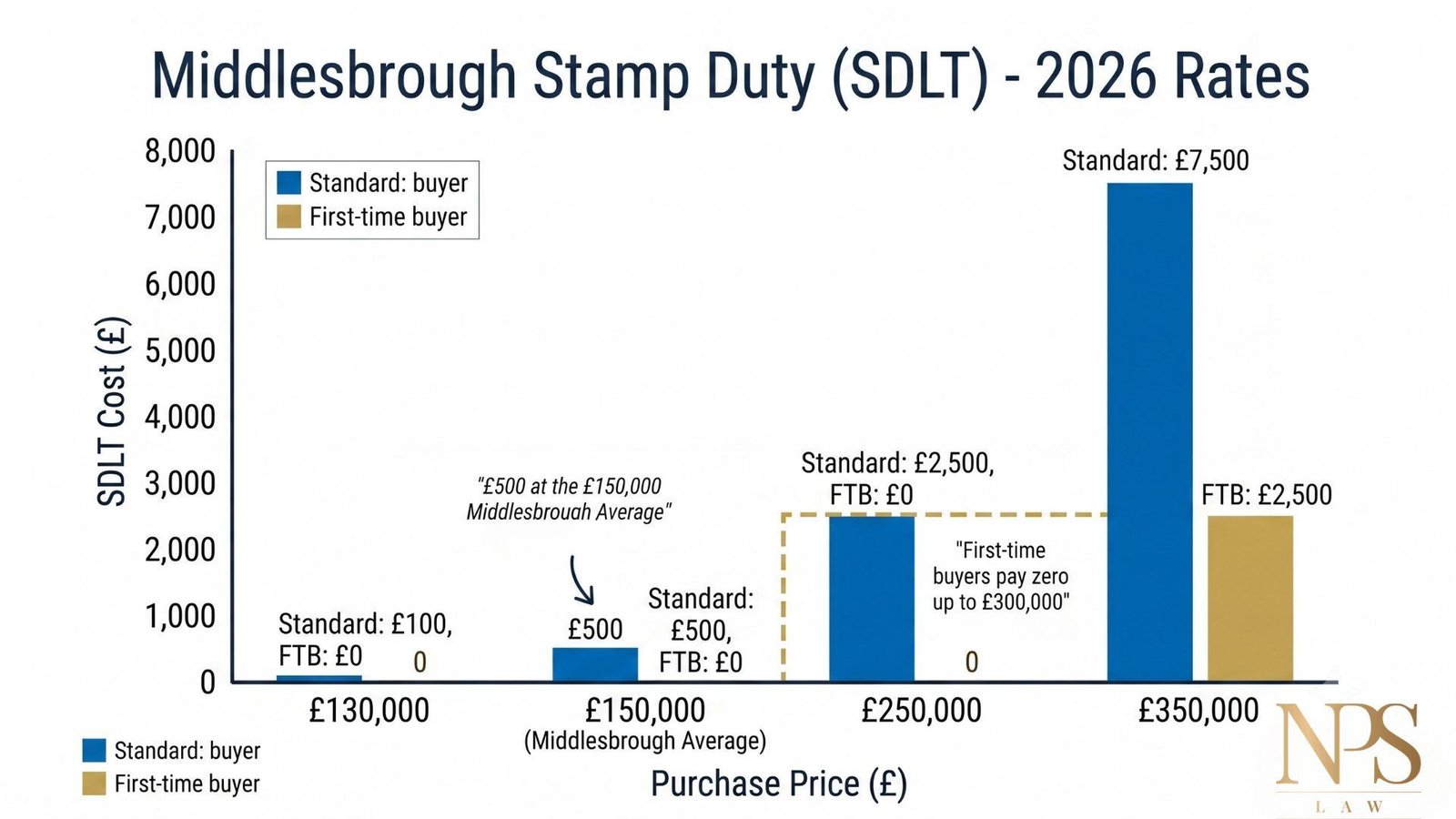
Stamp Duty is calculated in bands, and at Middlesbrough’s typical price levels, the bills are among the lowest in England. Under the rates in force from April 2025:
| Purchase Price | Standard Buyer | First-Time Buyer |
|---|---|---|
| £130,000 | £100 | £0 |
| £150,000 (Middlesbrough average) | £500 | £0 |
| £250,000 | £2,500 | £0 |
| £350,000 (Marton / Nunthorpe) | £7,500 | £2,500 |
First-time buyer relief gives 0 per cent on the first £300,000 of any purchase up to £500,000. At £150,000, this means a first-time buyer in Middlesbrough pays nothing at all. Even a standard buyer purchasing at the town average pays just £500. According to GOV.UK’s official guidance, the relief is not available once the purchase price exceeds £500,000, making this an effective benefit that covers the entire Middlesbrough market for almost all buyers.
If you are purchasing an additional property or buy-to-let investment in Middlesbrough, the 5 per cent surcharge applies on top. See our guide to Stamp Duty on second homes and buy-to-let properties.
Reference: GOV.UK – Stamp Duty Land Tax: residential property rates
→ Related: What Is Stamp Duty and How Much Will You Pay in 2026?
SUMMARY
Three risks are specific to the Middlesbrough property market and receive little coverage in generic conveyancing guides: the Teesworks Freeport construction zone, former industrial land contamination, and the legal restrictions on Right to Buy properties. Each requires active due diligence from your solicitor.
Generic conveyancing guides cover the standard risks. The following section covers what those guides miss and what matters most in this specific market.
New to conveyancing? See: NPS Law Residential Conveyancing
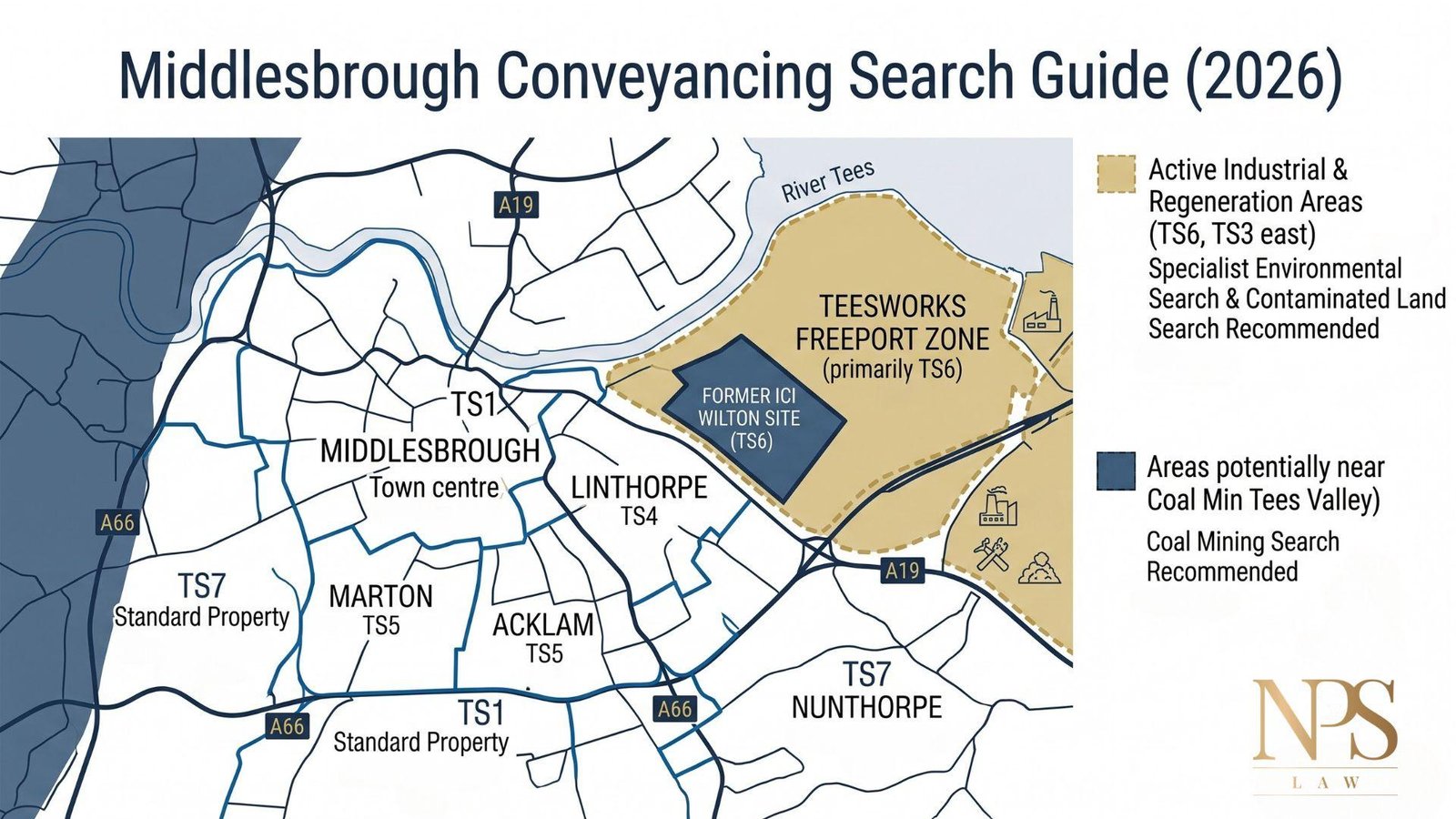
Teesworks is the UK’s largest Freeport, covering approximately 4,500 acres of the former Redcar steelworks site on the south bank of the River Tees, primarily within the TS6 postcode. It is one of the largest regeneration projects in Europe, bringing significant investment and employment, but it also introduces specific legal considerations for property buyers in the surrounding area.
If you are buying near the Teesworks zone, your solicitor’s searches will need to investigate:
The regeneration brings long-term economic potential to the area, but properties immediately adjacent to active industrial sites carry legal complexities that buyers should understand before exchanging contracts.
Reference: Teesworks Ltd – Teesworks Freeport development information
Middlesbrough and the surrounding Tees Valley were the centre of the UK’s chemical and steel industries throughout the nineteenth and twentieth centuries. Sites including the former ICI Wilton complex (Wilton International, now TS10), the Lackenby steelworks and numerous smaller industrial yards left a ground contamination legacy that remains relevant to property purchasers today.
A standard environmental search will reveal whether a property sits on or near land that has been identified as potentially contaminated. The practical consequences of contamination for buyers include:
For properties in TS6 and the eastern parts of TS3, we recommend a specialist contaminated land search as a standard part of the conveyancing process, not an optional extra
⚠ Common Pitfall
Buyers sometimes skip the contaminated land search to save £40 to £80, only to find that their mortgage lender requires a full remediation report costing several hundred pounds before they will proceed. In Middlesbrough’s former industrial postcodes, this is a false economy.
Middlesbrough has a higher than average proportion of former council housing sold under the Right to Buy scheme introduced in 1980. When one of these properties is resold, the title deeds carry restrictive covenants that impose conditions on the current buyer. These are not visible from a simple viewing of the property and are only identified through a full title register check.
The key restrictions your solicitor will check for include:
None of these restrictions makes a Right to Buy property unsuitable for purchase. They are legal conditions to be understood and managed, and an experienced solicitor will confirm the position clearly before you commit.
SUMMARY
Commercial conveyancing in Middlesbrough is shaped by the town’s regeneration programme. The Boho Zone and Centre Square represent different types of commercial opportunity, each with specific legal requirements for leases, use classes and planning consent.
Commercial conveyancing involves higher financial stakes and more complex legal obligations than residential transactions. See our broader guide on commercial conveyancing in the UK for the fundamentals.
The Boho Zone on Linthorpe Road in TS1 is Middlesbrough’s established creative and digital business district, occupying a series of repurposed Victorian and twentieth-century buildings. NPS Law operates from Boho 6 in this quarter. For businesses acquiring office space or creative workspace here, the key legal considerations are:
Centre Square is Middlesbrough’s flagship commercial development, with new-build Grade A office space attracting regional and national occupiers. The Middlehaven waterfront regeneration is delivering further commercial floor space on former docklands. For tenants and buyers in these developments:
Reference: NPS Law – Commercial Conveyancing in the UK
SUMMARY
NPS Law has a Middlesbrough office at Boho 6, 5 Linthorpe Road, TS1 1RE, in the heart of the town’s digital and creative quarter. We handle residential and commercial conveyancing across Middlesbrough and the wider Tees Valley, with a fixed-fee, no completion, no fee approach and a 4.5 out of 5 rating on Trustpilot from 120 reviews.
Having a local presence in Middlesbrough means our team understands the specific search environment, the Right to Buy legacy in the housing stock and the legal implications of the Teesworks regeneration. That on-the-ground knowledge is paired with the resources and expertise of a firm that also operates from Solihull and London.
Our core ethos is Redefining Legal Services:
The most common source of delay in Middlesbrough transactions is incomplete search results or missed title issues that surface after exchange. Our team:
As of 25 July 2026, NPS Law holds a 4.5 out of 5 rating from 120 reviews on Trustpilot. A recent Trustpilot reviewer who worked with the Middlesbrough team wrote:
“Their communication eased a lot of my anxiety on the matter.”
Trustpilot review, NPS Law Middlesbrough
The reviewer named Hamza, Junaid, Hannah and Lace at the Middlesbrough office by name, and praised the communication and attention to detail throughout the transaction.
Reference: Trustpilot – NPS Law Reviews
A chain-free transaction can complete in 8 to 10 weeks. Longer chains, leasehold management pack delays or properties requiring specialist searches (coal mining, contaminated land) typically add two to four weeks. Right to Buy title checks can also extend the enquiries stage if the council’s responses are slow. For a UK-wide overview of timescales, see our guide to how long conveyancing takes.
Not legally, but the Middlesbrough market has specific features that a non-local firm may not flag automatically: coal mining search requirements, Right to Buy restrictions in the title deeds and the Teesworks planning context. A solicitor with direct knowledge of the local search environment will ask the right questions before exchange, not after.
In addition to the standard four searches, you should obtain an environmental search specifically scoped to industrial land use and, depending on location, a contaminated land report from a specialist environmental consultant. For properties in TS6 and parts of TS3, your solicitor should also confirm whether a coal mining search is appropriate given the property’s exact position relative to historical mining records.
Right to Buy was a government scheme that allowed council tenants to purchase their homes at a discount. Properties sold under the scheme carry restrictive covenants in the title deeds, including a potential right of first refusal for the council if the property is resold within a defined period. Your solicitor will check the title register to establish what restrictions apply and confirm whether they affect your purchase or any planned renovation or letting of the property.
At Middlesbrough’s average price of approximately £150,000, first-time buyers pay nothing at all in Stamp Duty. The first-time buyer relief gives 0 per cent on the first £300,000 of any purchase up to £500,000, which means virtually every first-time buyer in the town qualifies for a zero bill. Even purchasing at £250,000, in Marton or Nunthorpe, results in no Stamp Duty for a first-time buyer.
SUMMARY
Completing a property transaction in Middlesbrough comes down to four things: understanding the four-phase process, commissioning the right searches for the local environment, checking any Right to Buy restrictions before exchange, and choosing a solicitor with genuine knowledge of the Tees Valley market.
Middlesbrough is one of the most affordable property markets in England, which makes it attractive to both first-time buyers and investors. At the same time, the town’s industrial heritage and active regeneration programme create a more complex due diligence environment than many comparable towns. The difference between a smooth transaction and a costly one is almost always found in Phase 1 and Phase 2, specifically in whether the right searches were commissioned and whether the title was fully reviewed before exchange.
If you are buying or selling a property in Middlesbrough or the wider Tees Valley, contact NPS Law today at our Middlesbrough office, Boho 6, 5 Linthorpe Road, TS1 1RE, for a free, fixed-fee quote with no completion, no fee protection. If you are remortgaging or adding a co-owner to the title rather than buying outright, our guide to transfer of equity covers that related process.
Related: Transfer of Equity: Costs, Process and When You Need a Solicitor
Ready to buy or sell in Middlesbrough?
NPS Law’s Middlesbrough office at Boho 6, 5 Linthorpe Road, TS1 1RE provides fixed-fee conveyancing with no completion, no fee protection. We handle local authority and coal mining searches, Right to Buy title reviews and Teesworks zone due diligence as standard. No estimate ranges, no unexpected additions at completion.
Disclaimer: This article is for general informational purposes only and does not constitute formal legal advice. For specific legal matters, please consult with a qualified solicitor.
©️ Copyright 2026 NPS Law is a trading name for NPS Law LLP. Solicitors of England and Wales. Authorised and Regulated by the Solicitors Regulation Authority. SRA Number 570169. A list of all Partners is available on the SRA directory for this firm. website designed by origin-media