

Newcastle upon Tyne is one of the few English cities where homeownership is still genuinely within reach on a median salary. The asking price, though, tells only part of the story. Grainger Town’s Regency terraces carry conservation restrictions that do not appear on any listing. City centre flats converted from commercial buildings often come with service charges and fire safety certificate requirements that can stall a mortgage offer for months. And if the property sits south of the River Tyne, your solicitor is submitting searches to Gateshead Council, not Newcastle City Council – a distinction that reshapes the transaction in ways most buyers have not anticipated.
This guide sets out what makes conveyancing in Newcastle different from the generic guides, what every local search reveals, and where buyers most often encounter costs and delays that were not in the original budget.
SUMMARY
Newcastle property transactions involve two separate local authority areas, coal mining searches across all NE postcodes, and a concentration of conservation-listed streets that do not appear in standard property descriptions. Getting these right determines whether a transaction completes on schedule or stalls at the mortgage offer stage.
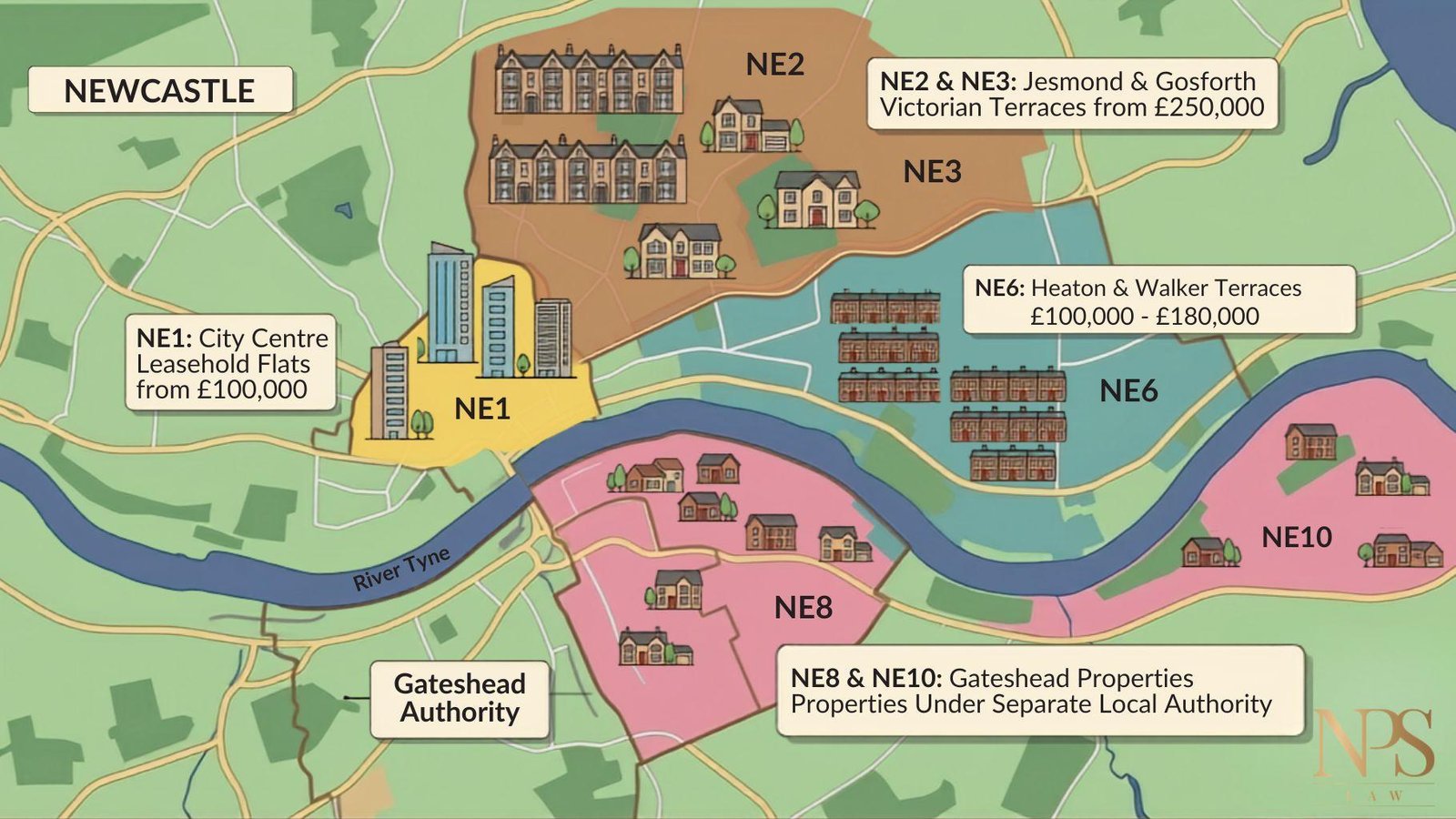
The River Tyne is the boundary between two separate local authorities. Properties in Newcastle city centre, Jesmond, Gosforth and Heaton are within Newcastle City Council. Properties south of the river, including Gateshead Quays, the MetroCentre area and Gateshead town centre, are within Gateshead Metropolitan Borough Council.
This matters for conveyancing because CON29 local authority searches are submitted to the relevant council. If a buyer instructs a solicitor without specifying the correct authority and the search goes to the wrong council, the results are worthless and the process restarts. The boundary is not always obvious from a postcode. NE8 is Gateshead. NE9 and NE10 are largely Gateshead. NE11, NE16 and parts of NE21 are also Gateshead. Your solicitor should confirm the local authority before submitting any search.
⚠ Common Pitfall
Many buyers assume all Newcastle NE postcodes fall under Newcastle City Council. NE8 is Gateshead, not Newcastle. Submitting a CON29 to the wrong authority wastes weeks and does not produce usable results. Always confirm the local authority for the specific property address before submitting searches.
| Postcode | Area | Typical Property Type | Price Range |
|---|---|---|---|
| NE1 | City Centre / Grainger Town | Leasehold flat, converted commercial | £100,000 to £200,000 |
| NE2 / NE3 | Jesmond / Gosforth | Victorian terrace, detached | £250,000 to £500,000+ |
| NE6 | Heaton / Walker | Terrace, former council housing | £100,000 to £180,000 |
| NE7 / NE12 | Longbenton / Forest Hall | Semi-detached, post-war suburban | £150,000 to £250,000 |
| NE15 / NE4 | Scotswood / Benwell | Terrace, RTB properties | £80,000 to £150,000 |
| NE8 / NE10 | Gateshead (separate local authority) | Mixed residential | £90,000 to £200,000 |
SUMMARY
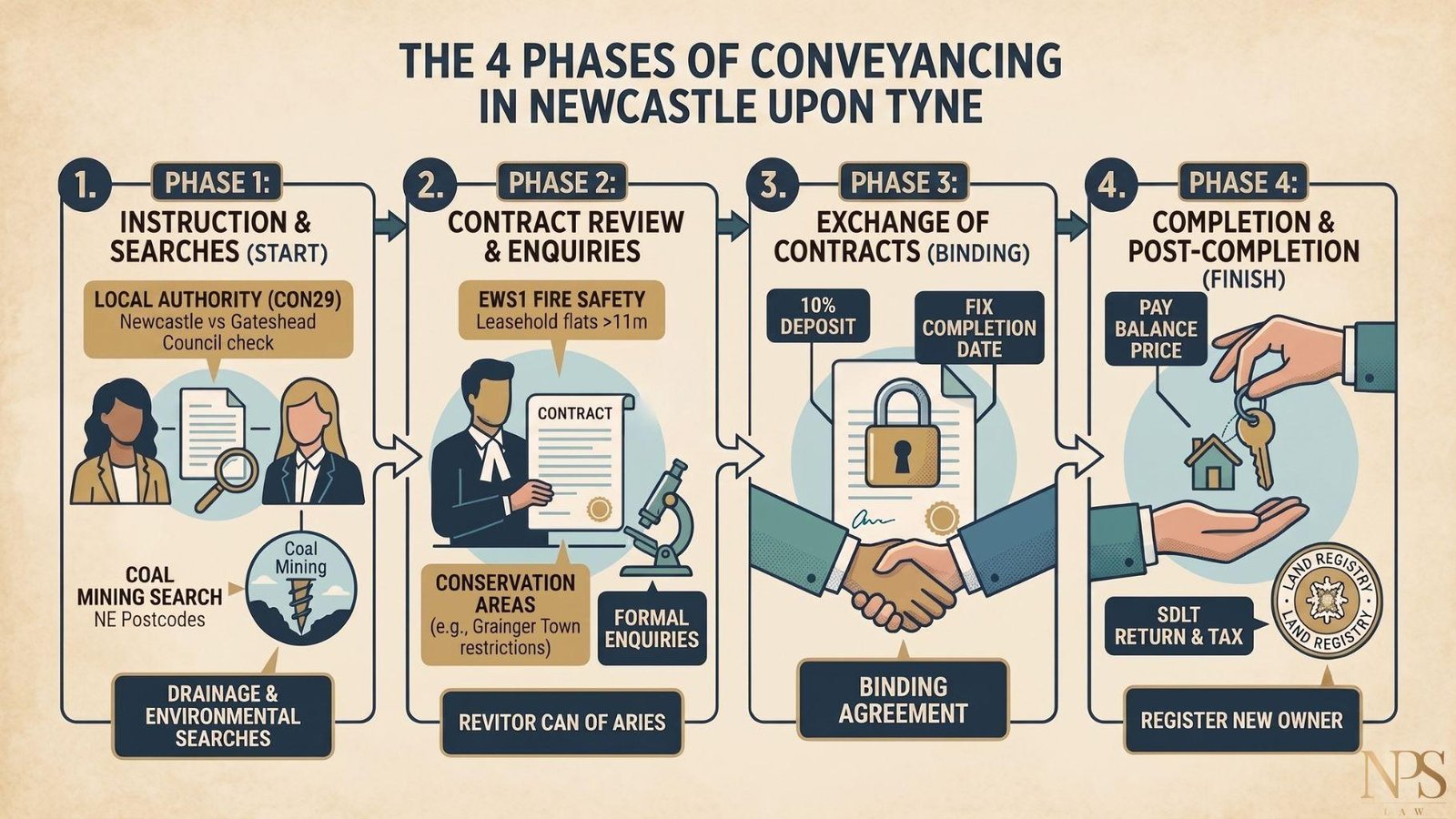
The four legal phases of conveyancing apply everywhere in England, but in Newcastle, Phase 1 takes longer than average because coal mining searches and flood risk assessments are near-universal requirements. Phase 2 involves additional scrutiny for leasehold flats, conservation area properties and Right to Buy titles.
The conveyancing process begins formally when you instruct a solicitor. Your solicitor commissions a set of property searches to identify risks before you commit to exchange. In Newcastle, the standard set is expanded by two requirements that apply across the whole of the Tyneside area.
Standard searches:
Additional searches required across NE postcodes:
⚠ Common Pitfall
Buyers sometimes try to save the coal mining search fee, which typically costs between £30 and £60. Their mortgage lender then requests the results independently as a condition of the formal offer, which adds weeks to the process and costs the same amount. In Tyneside this search is not optional if there is a mortgage.
When the seller’s solicitors provide the draft contract, your solicitor reviews every detail and raises formal enquiries to resolve anything that needs clarification before you sign. In Newcastle, four topics arise more frequently than in most other markets.
Grainger Town and conservation area properties:
Grainger Town is a nationally designated conservation area in the heart of Newcastle city centre. Properties here cannot be altered in ways that would affect their external appearance or structural character without Listed Building Consent or Conservation Area Consent, depending on the specific property. A standard planning permission does not cover these changes. Your solicitor will check whether any alterations to the property since it was built have the necessary consents, and whether the title includes any conditions that restrict future changes.
Leasehold flats and EWS1 certificates:
City centre apartment blocks, particularly those converted from commercial buildings in NE1 and the Quayside area, are predominantly leasehold and many exceed 11 metres in height. For buildings over that threshold, mortgage lenders require an EWS1 (External Wall System) fire safety certificate before they will lend. Where an EWS1 is not in place, the block must be assessed by a qualified engineer before a mortgage offer can be issued. The process can take months and the cost is borne by the building’s leaseholders through the service charge.
Right to Buy properties in NE4, NE6 and NE15:
Former council housing in Scotswood, Benwell, Walker and Byker was sold under the Right to Buy scheme and carries restrictive covenants and discount repayment obligations in the title deeds if resold within the specified period. Your solicitor will identify these from the title register before exchange.
HMO licensing for buy-to-let purchases in Jesmond and Heaton:
Newcastle and Northumbria Universities together have a student population of more than 50,000. Jesmond, Heaton and Sandyford are established student rental areas where many properties are operated as Houses in Multiple Occupation. An HMO licence from Newcastle City Council is required for properties with five or more occupants forming more than one household. Buying a property that is already let as an HMO without a valid licence creates immediate regulatory liability. Your solicitor will raise enquiries to establish the licensing status before exchange.
Exchange is the point at which the transaction becomes legally binding. Both parties sign identical contracts, the solicitors exchange them by telephone, and the buyer pays the deposit, typically 10 per cent of the purchase price. After exchange, neither party can withdraw without facing significant financial penalties. The completion date is fixed at exchange.
On completion day, the balance of the purchase price is transferred and you collect the keys. Your solicitor then handles the mandatory post-completion steps:
HM Land Registry’s official channel explains the registration process that follows completion, including the documents required, the timescales involved, and what happens when a leasehold property changes hands. This process is handled by your solicitor after completion.
Reference:
SUMMARY
At Newcastle’s typical price levels, most first-time buyers pay no Stamp Duty. However, leasehold service charges, coal mining search fees, and potential EWS1 assessment costs can add considerably to the cash required at completion, even on modestly priced city centre flats.
| Cost Category | Item | Typical Estimate | Payment Timing |
|---|---|---|---|
| Legal Fees | Solicitor professional service fee | £750 to £1,200 plus VAT | Deposit on instruction; balance at completion |
| Disbursements | Local authority CON29, water, environmental | £200 to £280 | Paid upfront on instruction |
| Disbursements | Coal mining search (required across NE postcodes) | £30 to £60 | Paid upfront |
| Disbursements | HM Land Registry registration fee | £20 to £270 | Paid at completion |
| Optional | EWS1 fire safety assessment (leasehold flats) | £400 to £2,000+ (shared) | Levied through service charge |
| Tax | Stamp Duty Land Tax | Often zero at Newcastle prices | Paid at completion |
NPS Law provides a fixed, itemised quote before you instruct. For residential transactions, we operate on a no completion, no fee basis: if the transaction does not complete for reasons outside your control, our professional legal fees are not charged.
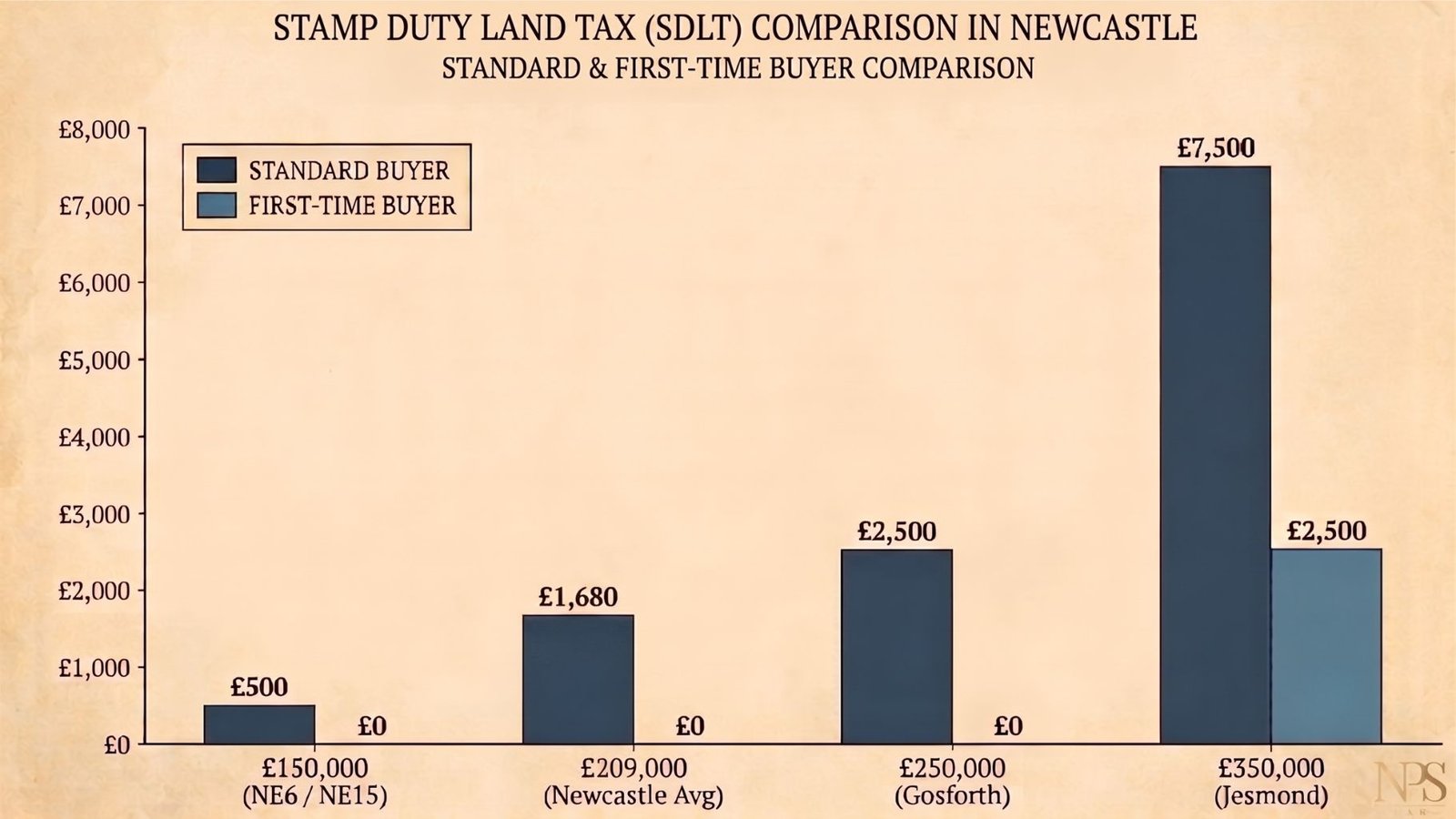
Stamp Duty Land Tax in England is calculated in bands from 1 April 2025, with the standard nil-rate threshold at £125,000. At Newcastle’s price points, the bills are among the lowest in England.
| Purchase Price | Standard Buyer | First-Time Buyer | Notes |
|---|---|---|---|
| £150,000 (NE6 area) | £500 | £0 | 2% on £25,000 above threshold |
| £209,000 (Newcastle average) | £1,680 | £0 | 2% on £84,000 above threshold |
| £250,000 (Gosforth lower end) | £2,500 | £0 | 2% on full £125,000 band |
| £350,000 (Jesmond) | £7,500 | £2,500 | 5% on £100,000 above £250,000 |
First-time buyer relief applies on purchases up to £500,000 and removes Stamp Duty on the first £300,000. At the prices where most Newcastle transactions occur, this means a zero bill for almost every first-time buyer in the city.
→ Related: What Is Stamp Duty and How Much Will You Pay in 2026?
Buying an additional property or buy-to-let? See: Stamp Duty on Second Homes and Buy-to-Let Properties in the UK
Reference:
SUMMARY
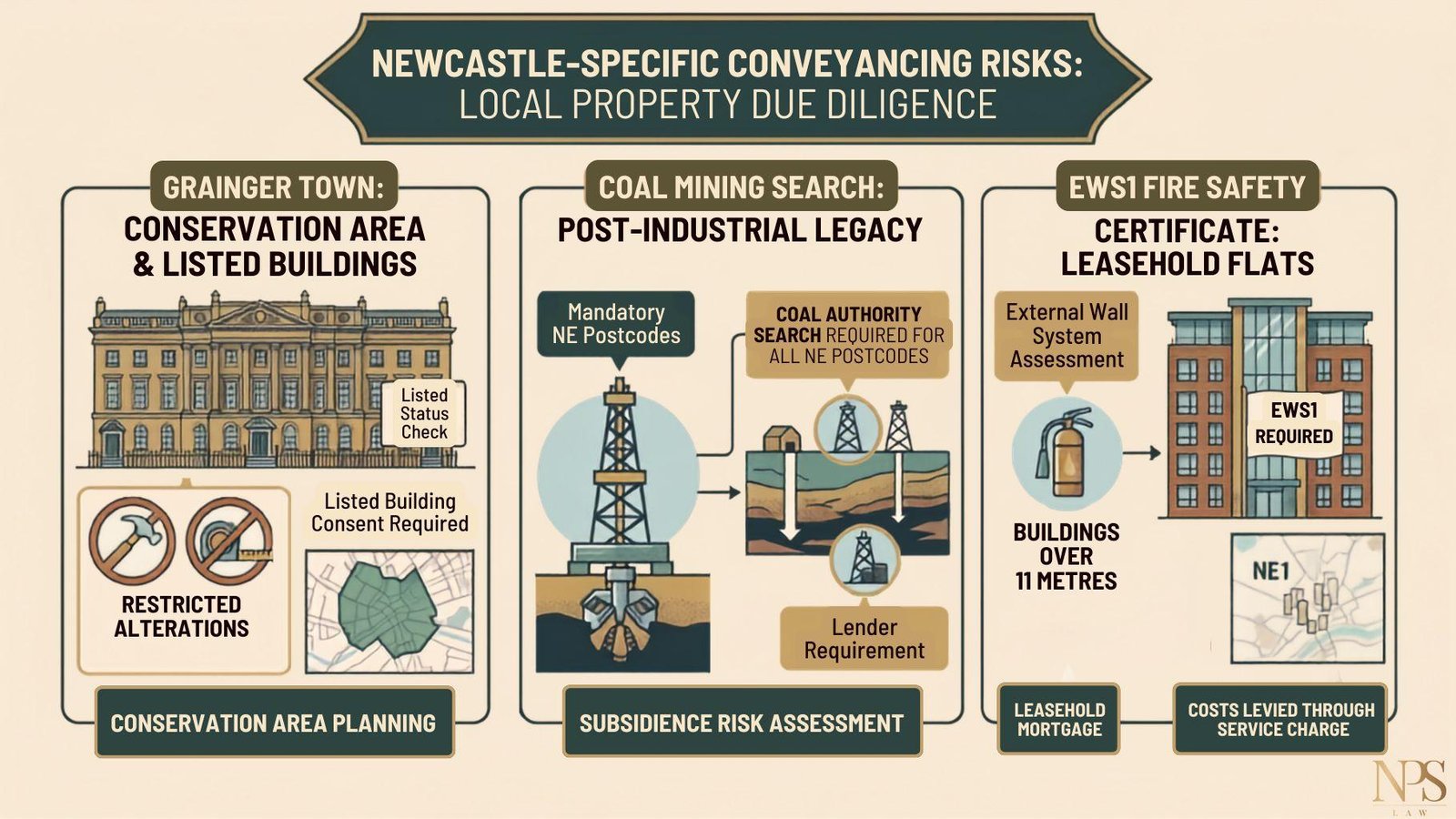
Three risks are specific to the Newcastle property market and receive little coverage in generic conveyancing guides: the Grainger Town conservation regime, the coal mining legacy beneath Tyneside, and the leasehold and fire safety structures in city centre flats. Each requires targeted due diligence that goes beyond the standard search pack.
Grainger Town takes its name from Richard Grainger, the developer who rebuilt the commercial centre of Newcastle between 1835 and 1842. Grey Street, Grainger Street, Clayton Street and the surrounding lanes form one of the most architecturally coherent Regency streetscapes in Europe. The area has been a designated conservation area since 1968 and many individual buildings are listed at Grade I or Grade II.
For buyers, this means:
The Northumberland and Durham coalfields extend beneath the Tyneside area. While active mining ceased decades ago, the legacy of underground workings, tunnels and shafts creates a residual ground subsidence risk that affects mortgage valuations throughout the NE postcode area. The Coal Authority maintains records of all historical workings and provides risk assessments for specific addresses.
The coal mining search can return one of three results: low risk, medium risk requiring monitoring, or high risk requiring a structural survey. A high-risk result does not necessarily prevent a purchase, but it will require a specialist survey and may affect the loan-to-value ratio a lender is prepared to offer.
SUMMARY
Arranging a coal mining search only after the mortgage application has been submitted is a common cause of delay in NE transactions. The lender requests the results before issuing a formal offer, and the search takes days to process. Instructing it at the same time as the other searches saves up to two weeks.
Following the Grenfell Tower fire in 2017, mortgage lenders introduced requirements for external wall fire safety assessments on residential buildings above certain heights. The EWS1 process was established in 2019 and requires a qualified professional to assess the external wall system of a building before lenders will approve a mortgage on any flat within it. For buildings above 18 metres, the assessment is mandatory. Between 11 and 18 metres, it is required if there are concerns about the cladding or external wall materials.
In Newcastle, this primarily affects:
If the building does not have a current EWS1 certificate and one is required, the freeholder must commission the assessment. In buildings with multiple leaseholders, this process involves coordination across potentially dozens of owners and can take many months. Buyers should ask their solicitor to establish the EWS1 position before exchange, not after.
Reference:
The Coal Authority – coal mining risk assessment service
SUMMARY
Newcastle’s commercial property market is shaped by three active zones: Grainger Town’s listed commercial buildings, the Ouseburn Valley’s post-industrial creative quarter, and the Newcastle Science Central development on the former Scottish and Newcastle Brewery site. Each zone has distinct legal requirements.
Commercial conveyancing involves higher financial stakes and more complex legal obligations than residential transactions. For the fundamentals, see our guide to commercial conveyancing in the UK.
Acquiring commercial space in Grainger Town requires scrutiny of planning conditions, listed building consents and use class restrictions that go beyond a standard commercial search. Ground floor retail units converted to office or hospitality use may have conditions attached to the original planning consent that restrict future changes. Your solicitor will review the planning history and title for any conditions that limit the permitted use.
The Ouseburn Valley, east of the city centre, is Newcastle’s established creative and cultural quarter. Former industrial buildings including mills, warehouses and foundry buildings have been converted to studios, offices and arts venues. For businesses acquiring space here:
Newcastle Science Central occupies the former Scottish and Newcastle Brewery site near the city centre. The development brings together Newcastle University, research institutions and commercial tenants. For occupiers:
Reference:
SUMMARY
NPS Law handles residential and commercial conveyancing across the North East from its Middlesbrough office at Boho 6, 5 Linthorpe Road, TS1 1RE. We advise proactively on coal mining searches, Gateshead boundary issues, EWS1 requirements and conservation area restrictions as standard, with fixed-fee quotes and no completion, no fee protection.
Need a solicitor? Start here: NPS Law Residential Conveyancing
The North East property market operates differently from the Midlands and the South. Search timelines, local authority response times and the prevalence of coal mining checks all affect transaction speed. Our team is familiar with these factors and builds them into every instruction rather than discovering them as they arise.
Our Middlesbrough base is approximately 35 miles from Newcastle city centre. We handle transactions across the Tees Valley, Wearside and Tyneside, and the specific search requirements for each local authority area are built into our standard instruction process.
As of August 2026, NPS Law holds a 4.5 out of 5 rating from 130 reviews on Trustpilot. Clients consistently highlight communication and proactive case management as the factors that made the difference.
“Communication was always clear, and I was kept informed at every stage of the transaction.”
Trustpilot, June 2026
Reference:
Not if they are ordered at the start of the process alongside the other searches. The search itself takes a few days to process. The delay happens when buyers leave it until after the mortgage application has been submitted, at which point the lender requests the results and holds the formal offer until they arrive. Instructing the coal mining search at the same time as the CON29 and environmental search eliminates this entirely. In Tyneside, if there is a mortgage, this search is not optional.
Yes. Properties south of the Tyne fall under Gateshead Metropolitan Borough Council, not Newcastle City Council. The CON29 local authority search must go to the correct council. Submitting it to the wrong authority produces results that are legally useless and the process restarts from scratch. Your solicitor should confirm the local authority from the property address, not the postcode, before submitting any search. NE8 is Gateshead. NE9 and NE10 are largely Gateshead. Always confirm before instruction.
It is both, depending on the specific property. Grainger Town as a whole is a designated conservation area, which means that works affecting the external appearance of any building within it require Conservation Area Consent rather than standard planning permission. Many individual buildings within Grainger Town are also listed at Grade I or Grade II, which means they additionally require Listed Building Consent for works affecting their character. Your solicitor will establish the listing status of the specific property and confirm what consents are required before recommending exchange.
NPS Law provides a fixed, itemised quote before instruction. The fee covers all stages from instruction to Land Registry registration, including coal mining search advice, Gateshead boundary confirmation if applicable, and the Stamp Duty return filed within 14 days of completion. There are no estimate ranges and no unexpected additions at completion. For residential transactions, we operate on a no completion, no fee basis: if the transaction does not proceed for reasons outside your control, our professional legal fees are not charged. Contact our team with your property address and transaction type to obtain a quote.
If a purchase collapses before exchange of contracts, NPS Law’s no completion, no fee policy applies and our professional legal fees are not charged. Third-party disbursements already incurred, such as coal mining search fees, CON29 search costs and environmental reports, remain payable as these are costs incurred directly with third parties on your behalf. If the transaction collapses after exchange, different contractual consequences apply. Your solicitor will explain your position clearly before exchange takes place.
SUMMARY
Newcastle’s affordability makes it one of the more accessible property markets in England. The due diligence requirements that come with the local market, coal mining searches, the Gateshead boundary, Grainger Town consents and EWS1 certificates, are manageable with the right preparation. The difference between a transaction that completes on time and one that stalls at the lender’s desk almost always comes down to whether these issues were identified in Phase 1 or discovered at Phase 3.
Before you make an offer on a Newcastle property, it is worth establishing three things: which local authority the property falls under, whether the building requires an EWS1 certificate if it is leasehold, and whether the property sits in or near the Grainger Town conservation area. None of these takes more than a few minutes to check, and each one affects how the transaction will run.
NPS Law handles residential and commercial conveyancing across the North East from Boho 6, Middlesbrough. We deal with coal mining searches, Gateshead boundary questions and EWS1 enquiries as part of every instruction. Fixed fees, no ranges, no completion, no fee protection. If you are also considering remortgaging or adding a co-owner to the title, our related guide covers the transfer of equity process in detail.
Related: Transfer of Equity: Costs, Process and When You Need a Solicitor
Ready to buy or sell in Newcastle?
NPS Law handles conveyancing across the North East from its Middlesbrough office at Boho 6, 5 Linthorpe Road, TS1 1RE. Fixed-fee quotes, coal mining and environmental search advice included as standard, and no completion, no fee protection on every residential instruction.
Disclaimer: This article is for general informational purposes only and does not constitute formal legal advice. For specific legal matters, please consult with a qualified solicitor.
©️ Copyright 2026 NPS Law is a trading name for NPS Law LLP. Solicitors of England and Wales. Authorised and Regulated by the Solicitors Regulation Authority. SRA Number 570169. A list of all Partners is available on the SRA directory for this firm. website designed by origin-media