
Open any property forum in 2026 and leasehold reads like a warning label. Ground rent traps. Service charges that double overnight. Flats that sit on the market for months because the lease has slipped below 80 years. The headlines are not invented. But they do not represent every leasehold purchase, and for buyers of flats in England and Wales, avoiding leasehold altogether is rarely a realistic option.
This guide cuts through the noise. It explains what freehold and leasehold actually mean in legal terms, where leasehold makes practical sense and where it does not, what the 2024 reforms have changed and what your solicitor must check before you commit to any purchase. Whether you are buying your first flat in Manchester or a period conversion in London, understanding ownership type is one decision you cannot afford to get wrong.
SUMMARY
Freehold is the most straightforward form of property ownership in England and Wales. You own the land and the building on it outright, with no expiry date on your ownership and no third party to whom you owe ongoing obligations beyond planning and neighbour law.
When you buy a freehold property, the Land Registry records you as the owner of both the building and the land beneath it. That registration has no expiry. There is no lease to run down, no landlord to seek permission from and no service charge to budget for. All maintenance decisions are yours alone.
Most freehold owners carry out structural works freely, subject to planning permission and building regulations where required. They also bear all repair costs themselves, with no shared maintenance fund to draw on. That is both the freedom and the responsibility of freehold ownership.
Freehold offers the cleaner ownership structure by some distance. The practical advantages are:
The trade-offs are fewer, but worth noting. All maintenance costs fall directly to the freehold owner. There is no reserve fund to cover a new roof or external works. Where properties share walls, gutters or roof structures with neighbours, repairs can require negotiation without any formal management structure to facilitate it.
For most buyers of standalone houses, freehold is the obvious starting point. The complications arise not because freehold is difficult, but because the property types that attract buyers in urban markets are rarely available as straightforward freehold.
→ Related: What Is Conveyancing? The Complete UK Guide for Buyers and Sellers
SUMMARY
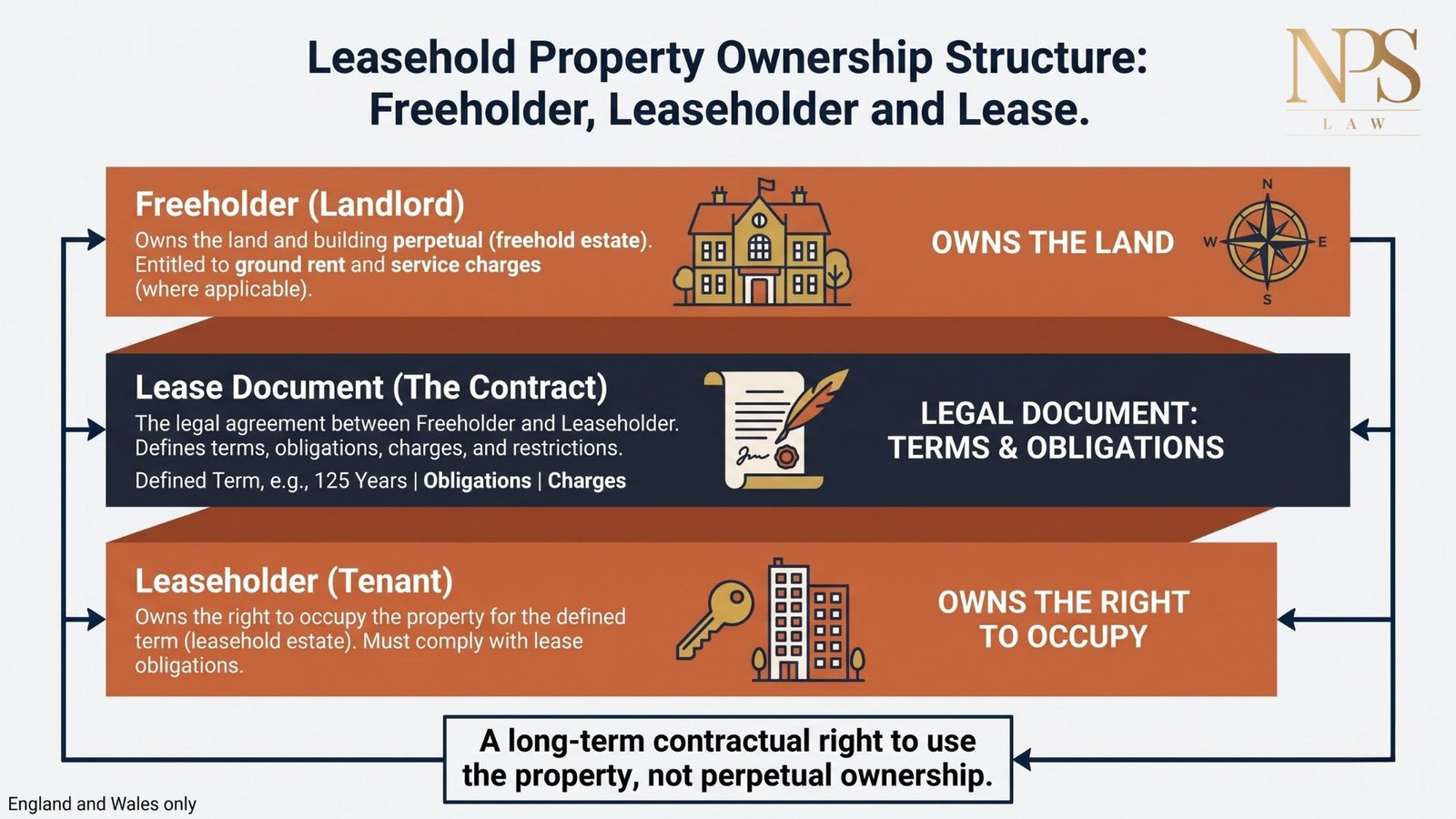
Leasehold means you own the right to occupy the property for a defined period set out in a lease. The freeholder retains ownership of the land beneath it. This is the ownership form that covers almost every flat in England and Wales, and it creates a legal relationship between you, the freeholder and in many cases a management company.
When you buy a leasehold property, you are buying a long-term contractual right to use it. That right is documented in a lease, which typically runs for 99, 125 or 999 years from the date it was originally granted. The number of years left on the lease, called the residual term, is one of the most significant numbers in any leasehold purchase.
Your relationship with the freeholder is entirely governed by the lease document. It sets out what charges you must pay, what alterations require consent, who is responsible for which parts of the building and under what conditions the freeholder can take action against you. Reading the headline price without reading the lease is one of the most expensive mistakes a flat buyer can make.
In legal terms, a leasehold estate is a proprietary interest in land that exists for a defined period. Unlike a freehold estate, which is perpetual, a leasehold estate will eventually expire unless it is extended or converted. In practice, the term appears in Land Registry documents, mortgage conditions and solicitor correspondence.
When a solicitor or lender refers to your leasehold estate, they mean the totality of your legal interest: the right to occupy the property, the obligations in the lease and the years remaining on it. Understanding this helps when calculating the cost of a lease extension, checking mortgage eligibility or considering whether to buy the freehold collectively with neighbours.
Most residential leases are originally granted for between 99 and 999 years. A 125-year lease granted in 1990 would have around 89 years left today. A 999-year lease, common in purpose-built blocks, is for practical purposes the same as freehold.
What matters to a buyer is not the original term but the residual term: what is left. A property with 85 years remaining is in a very different position from one with 125 years remaining, both in terms of mortgage eligibility and the cost of any future extension.
⚠ Common Pitfall
A lease below 80 years removes most mortgage lenders from the picture, which removes most future buyers too. The cost of extending also rises sharply at this point, as the freeholder gains the right to a share of the marriage value. Check the residual term before viewing, not after you have made an offer.
SUMMARY
The two ownership forms differ on four practical dimensions: who owns the land, how long the ownership lasts, what ongoing obligations it creates and how much freedom you have to alter or sell the property. The table below sets out the most important distinctions at a glance.
The distinction is not merely academic. It affects your mortgage options, your annual costs, your ability to make changes to the property and the ease of selling it in future. Both forms of ownership are common and both are entirely legal. The key is knowing what you are buying before you commit.
| Freehold | Leasehold | |
|---|---|---|
| Land ownership | Yes: you own the land outright | No: freeholder retains the land |
| Duration | Indefinite: no time limit | Fixed term, e.g. 125 years remaining |
| Ground rent | None | None on post-2022 leases; may apply on older contracts |
| Service charge | None: you manage costs directly | Annual charge for communal upkeep and management |
| Structural changes | Your decision, subject to planning | Usually requires freeholder's written consent |
| Mortgage eligibility | Standard across all lenders | Affected if residual lease falls below 80 to 85 years |
| Typical property type | Houses; most standalone buildings | Flats; historically some new build houses |
| Resale complexity | Standard process | More complex: lease length reviewed by buyer's solicitor |
The table shows typical positions rather than absolute rules. A 999-year leasehold flat in a well-managed block can be more straightforward to own than a freehold property with complex shared access or flying freehold complications. What determines the outcome is the specific terms of the ownership, not the category alone.
→ Related: Average Conveyancing Fees UK 2026: What Buyers and Sellers Should Expect
SUMMARY
The question is fair. After years of ground rent scandals, service charge disputes and leaseholders trapped in unsellable properties, the suspicion of leasehold is entirely understandable. But for most buyers of flats in England and Wales, leasehold is not a choice between two options. It is the only option available.
The leasehold system has real faults. Years of aggressive ground rent escalation, opaque management company charges and inadequate legal protections have left many owners worse off than they expected. The frustration is justified. The conclusion that leasehold should simply be avoided does not follow, because for flat buyers in particular, avoiding leasehold means avoiding flats.
Almost every flat in England and Wales is leasehold. Not some flats, not most flats. Almost all of them. A buyer looking at a two-bedroom flat in Birmingham, Leeds or London faces a market where leasehold is the default ownership structure, not an unusual variant.
Buyers who end up with leasehold properties did not choose leasehold over freehold as a preference. They chose a flat. The property type drives the ownership form, and that is unlikely to change significantly even as reforms improve leaseholders’ rights.
Freehold houses in prime urban locations are not cheaper than leasehold flats in the same area. They are almost always considerably more expensive. A buyer with a budget of £300,000 in central Manchester or outer London can access far more of the city, in better locations, through the leasehold flat market than by restricting the search to freehold only.
The financial trade-off is straightforward: leasehold properties often offer better value per square foot in high-demand areas. The cost of that better value is an ongoing obligation structure and a dependence on how well the building is managed. For buyers who go in with clear eyes about what that means, the trade-off can be worthwhile.
A freehold terraced house can be managed entirely independently. A ten-storey residential block cannot. Communal lifts, shared roofs, external walls, fire safety systems and communal grounds all require collective decisions, shared costs and organised maintenance. The leasehold structure provides that framework.
Where blocks are well managed, the system works. The service charge covers genuine costs, the management company is responsive and major works are planned transparently. The problems arise when it does not work, and historically leaseholders have had limited recourse. That is the gap the 2024 reforms are designed to close.
⚠ Common Pitfall
New-built houses were historically sold as leasehold in parts of England with ground rent terms that doubled every ten or twenty-five years. The 2022 and 2024 Acts have largely ended this practice. If a new build house is still being offered as leasehold, take immediate specialist legal advice before proceeding. This is a red flag, not a standard situation.
SUMMARY
Buying a leasehold property at the asking price is not the same as understanding what it will cost to own it. Several layers of ongoing cost sit beneath the headline figure, and they vary significantly between buildings, between management companies and between individual leases. Knowing what to expect before you buy is not optional.
The mortgage payment and the purchase price are the figures buyers focus on. The costs below tend to receive less attention, which is why they produce the most unpleasant surprises. Running through this list with your solicitor before exchange is part of standard due diligence on any leasehold purchase.
| Cost Item | Typical Range (England and Wales) | Notes |
|---|---|---|
| Ground rent (pre-2022 leases) | £0 to £500+ per year | Post-2022 new leases: peppercorn (effectively zero). Check older leases carefully. |
| Service charge | £1,000 to £5,000+ per year | Covers communal maintenance, building insurance and management fees. Not capped. |
| Reserve fund contribution | Included in service charge | Funds major future works. A low or zero fund can signal a special levy ahead. |
| Lease extension | £5,000 to £30,000+ | Cost depends on residual term and property value. Rises significantly below 80 years. |
| Enfranchisement (buying freehold) | £5,000 to £50,000+ | Collective purchase with other leaseholders. Varies by number of flats and location. |
| Permission for alterations | £50 to £500 per application | Payable to freeholder for consent to structural works. Varies significantly. |
| Section 20 major works levy | Varies: no upper cap | Notified separately when major works exceed £250 per leaseholder. Can be substantial. |
The annual service charge is typically the largest ongoing leasehold cost after the mortgage. It covers communal cleaning, maintenance, building insurance, management fees and contributions to a reserve fund for future major works.
Service charges are not capped. A block charging £1,500 per year when you buy can reach £4,000 or more if significant repairs are required. Before exchange, request the previous three years’ accounts, the current year’s budget and any outstanding Section 20 consultation notices. These notices signal that major works are being planned and that a bill is on the way.
The Leasehold Reform (Ground Rent) Act 2022 set ground rent on new residential leases at a peppercorn, effectively zero. For resale properties with a pre-2022 lease, the ground rent position is entirely governed by whatever the original lease says.
Some older leases contain doubling ground rent clauses that increase dramatically over time. Others have straightforward fixed amounts. Your solicitor will identify which applies and advise on the implications for your mortgage eligibility and future saleability. This is not a detail to skim over.
→ Related: What Is Stamp Duty and How Much Will You Pay in 2026?
⚠ Common Pitfall
Section 20 notices signal that major works are planned and a bill is coming. Buyers who exchange without checking for outstanding notices can find themselves liable for thousands of pounds within weeks of moving in. Your solicitor must raise specific enquiries on this before exchange.
SUMMARY
The Leasehold and Freehold Reform Act 2024 is the most significant piece of leasehold legislation in decades. It provides for 990-year lease extensions, the abolition of marriage value and stronger service charge transparency. However, as of August 2026, several key provisions, including the 990-year extension right and the abolition of marriage value, are not yet in force and remain subject to secondary legislation and ongoing court proceedings.
Leasehold reform has been debated for years. The 2024 Act moved the framework meaningfully in leaseholders’ favour, building on the ground rent ban in the 2022 Act. The changes do not fix every fault in the system, but they address some of the most significant barriers that made leasehold ownership more costly and more restrictive than it needed to be.
⚠ Common Pitfall
The 990-year lease extension right and the abolition of marriage value are widely discussed in the press and on property forums as if they are already in effect. As of August 2026, neither provision has been brought into force.
The government’s consultation on the required valuation methodology runs until September 2026, and major freeholder groups are pursuing appeals on marriage value. Buyers and leaseholders should base any financial decision, including whether to extend a lease now or wait, on the law as it currently stands, not on anticipated future changes. Always confirm the current position with a specialist solicitor before taking any action.
Of the six changes listed above, only two are in force as of August 2026: the removal of the two-year qualifying period (in force 31 January 2025) and the Right to Manage expansion (in force March 2025).
The 990-year extension right and the abolition of marriage value both remain subject to secondary legislation and, in the case of marriage value, ongoing appeals by major freeholder groups. Before making any decision based on the 2024 Act reforms, confirm the current legal position with a specialist solicitor. The direction of travel is clear; the implementation timeline is not.
→ Related: Transfer of Equity: Costs, Process and When You Need a Solicitor
SUMMARY
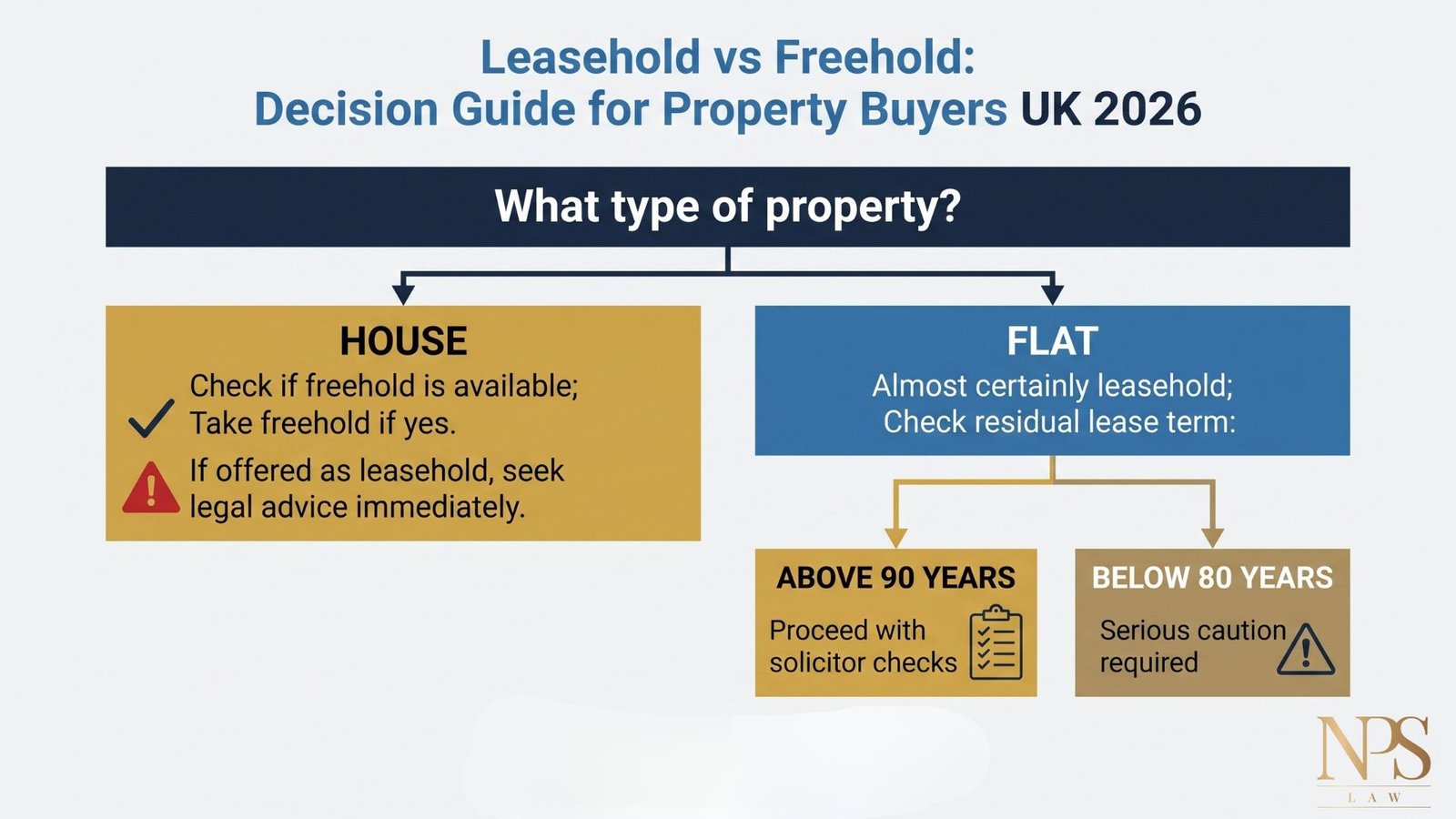
There is no universal answer. The right choice depends on the property type, the residual lease term, the quality of building management and your long-term plans. For most flat buyers the question is not whether to accept leasehold but which leasehold property is worth accepting.
The most common mistake is treating this as a binary preference when it is usually a function of what is available at a given price point in a given location. That said, where a genuine choice exists, the considerations below should guide the decision.
Freehold does not automatically mean better value, but it does mean fewer moving parts. For buyers who can access it at a comparable price point, it is almost always the cleaner choice.
A long-lease, well-managed leasehold flat in the right location is a perfectly sound purchase. The risks are concentrated in specific scenarios: short leases, aggressive ground rent terms, poorly managed blocks and opaque service charges. Remove those factors and the ownership form itself is not the problem.
Regardless of how attractive the property is or how competitive the asking price, the following must be verified by your solicitor before exchange of contracts:
This list covers the fundamentals. A specialist conveyancing solicitor will raise additional enquiries specific to the property, the block and the lease terms. What it does not cover is the question of whether the property itself is right for you. That judgement belongs to you. The legal due diligence belongs to your solicitor.
SUMMARY
Leasehold conveyancing is more involved than freehold. There are more documents to review, more parties to correspond with and more potential issues to identify. NPS Law’s residential conveyancing team handles leasehold transactions as standard, raising all relevant enquiries as part of the instruction.
When you buy a leasehold property, your solicitor is not simply transferring a title. They are reviewing a lease that may run to hundreds of pages, raising management pack enquiries, checking the service charge history, verifying the ground rent position, identifying any restrictions on alteration or subletting and confirming the residual lease term relative to your lender’s requirements.
If you want to know what the conveyancing process will involve for a specific property you are considering, contact NPS Law before you make your offer. We will explain the likely issues, the timeline and the cost at no charge and no obligation.
→ Related: Solicitor Fees for Buying or Selling a House in the UK 2026
→ Related: Residential Conveyancing with NPS Law
The questions below address the most common queries from buyers and owners dealing with leasehold and freehold property in England and Wales.
Freehold means you own the property and the land it stands on outright, with no time limit and no landlord above you in the ownership chain. Leasehold means you own the right to occupy the property for a defined period set out in a lease. The freeholder retains ownership of the land. Most houses in England and Wales are freehold. Almost all flats are leasehold, and this is unlikely to change significantly in the short term regardless of the ongoing reforms.
Yes, but the extent of that right depends on whether you are relying on current law or the 2024 reforms. Under current law (the Leasehold Reform, Housing and Urban Development Act 1993), you can extend your lease by 90 years with a peppercorn ground rent.
The Leasehold and Freehold Reform Act 2024 provides for extensions of up to 990 years with zero ground rent, but this provision is not yet in force as of August 2026: secondary legislation setting the required valuation rates is subject to a government consultation running until September 2026.
The two-year qualifying period has been removed (in force 31 January 2025). The cost of extending depends on the residual lease term, the property value and, where the lease is below 80 years, marriage value, which also remains payable under current law despite being abolished by the 2024 Act in principle. Instruct a specialist solicitor before taking any steps.
If a lease expires without being extended, the leaseholder’s right to occupy ends and the property reverts to the freeholder. In practice, most residential leases are extended long before they expire. A lease approaching 80 years is already a signal that action is needed. Waiting until it expires is not a realistic scenario for any leaseholder with a mortgage, as lenders require a minimum residual term well above zero.
A share of freehold means that the leaseholders in a building collectively own the freehold company that holds the land. Each leaseholder still has an individual lease, but as a group they control the freehold. This removes the external freeholder and gives leaseholders direct control over the management of their building. It is widely considered the most favourable leasehold arrangement after a full conversion to freehold.
It can be, depending on the residual lease term. Most lenders require at least 70 to 85 years remaining at the point of the mortgage application, with some requiring more. Lenders also consider the service charge level, the management company structure and in some cases whether the freeholder is a housing association or a private individual. A lease below 80 years will restrict your lender options significantly and raise the cost of any future extension.
NPS Law provides a fixed, itemised quote before instruction for every leasehold conveyancing matter. The fee reflects the complexity of the transaction, including the length and condition of the lease and the likely extent of management company enquiries. All fees are agreed in writing before instruction, with no hourly billing and no unexpected additions at completion. We operate on a no completion, no fee basis: if the transaction does not proceed for reasons outside your control, our professional legal fees for the conveyancing are not charged. Contact us for a free initial consultation and written quote.
The options depend on what the problem is. Some issues, such as an onerous ground rent clause in an older lease, can be negotiated before completion or factored into a revised offer price. Others, such as a residual term below 80 years, can be addressed by requiring the seller to obtain a lease extension before exchange. In some cases, the right response is to withdraw from the transaction entirely. NPS Law will identify any issues, explain the practical implications and advise on the available options before you commit to exchange.
Leasehold and freehold are not two versions of the same thing at different price points. They are structurally different forms of ownership that suit different property types, different buyers and different circumstances. For flat buyers in England and Wales, the question has rarely been whether to accept leasehold but how to navigate it well. For house buyers where freehold is available, the answer is almost always to take it.
The reforms of 2022 and 2024 have improved the position of leaseholders materially. Lease extensions are cheaper, the qualifying period is gone and service charge transparency is on an upward trend. The system has not been fixed entirely, but for buyers who do their due diligence, go in with realistic expectations and instruct a specialist solicitor, leasehold ownership is a manageable choice rather than an automatic trap.
The most important thing you can do before buying any leasehold property is have a specialist conveyancing solicitor review the full lease before exchange. NPS Law handles leasehold transactions as standard, with fixed fees agreed before instruction, a free initial consultation and no completion, no fee protection on every residential instruction. If you are considering a leasehold purchase, speak to our team before you make an offer.
Ready to discuss your conveyancing with NPS Law?
NPS Law handles leasehold and freehold conveyancing across England and Wales with fixed, transparent fees. Free initial consultation, no hourly billing and no completion, no fee protection on every residential instruction.
Disclaimer: This article is for general informational purposes only and does not constitute formal legal advice. The law described applies to England and Wales unless otherwise stated. For specific legal matters, please consult with a qualified solicitor.


©️ Copyright 2026 NPS Law is a trading name for NPS Law LLP. Solicitors of England and Wales. Authorised and Regulated by the Solicitors Regulation Authority. SRA Number 570169. A list of all Partners is available on the SRA directory for this firm. website designed by origin-media