

Are you buying a second home, a buy-to-let investment, or a holiday property in the UK? Before you fix your budget, there is one cost that regularly catches buyers off-guard: a 5 per cent Stamp Duty Land Tax surcharge that applies to the entire purchase price, not just the amount above the standard thresholds.
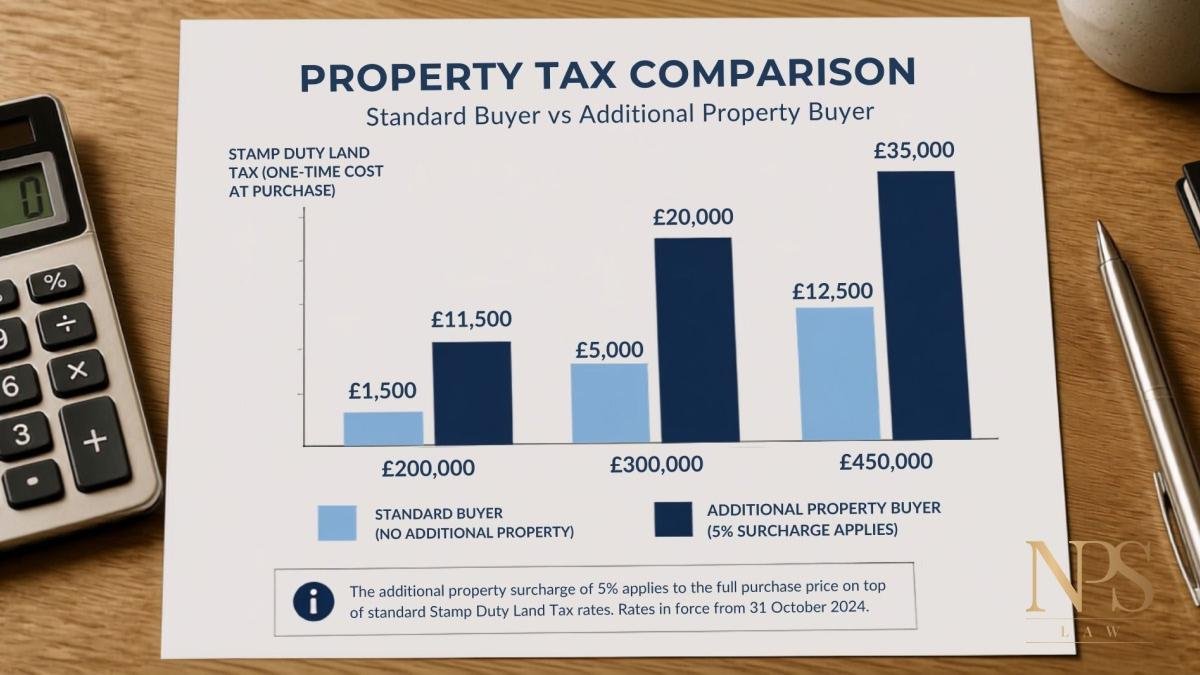
Since 31 October 2024, that surcharge has made the SDLT bill on an additional property significantly larger than many investors expect. On a £300,000 buy-to-let purchase, the total Stamp Duty comes to £20,000. On a £450,000 second home, it reaches £35,000. A first-time buyer purchasing the same properties would pay £0 and £12,500 respectively.
This guide explains the current rates, works through the numbers at four common price points, sets out every situation where the surcharge does and does not apply, and explains what a solicitor must do within 14 days of completion to keep your transaction legally compliant.
Summary
The 5 per cent surcharge on additional residential properties applies to any purchase over £40,000 where you will own two or more dwellings at the end of completion day, including properties held overseas, jointly, or through a limited company.
→ Related article: Do First-Time Buyers Pay Stamp Duty? What You Need to Know in 2026
When you buy a residential property in England or Northern Ireland, you pay Stamp Duty Land Tax on a banded basis: 0 per cent on the first £125,000, 2 per cent on the next £125,000, and 5 per cent above £250,000 up to £925,000.
If the property is an additional dwelling, a 5 per cent surcharge is added across every band. This surcharge applies to the full purchase price, not just the upper portion. That is why a £300,000 buy-to-let costs £20,000 in SDLT rather than the £5,000 a standard buyer would pay: the standard bill of £5,000 plus a £15,000 surcharge (5 per cent of £300,000). HMRC uses the formal term Higher Rates on Additional Dwellings, or HRAD, for this regime. The surcharge was first introduced in April 2016 at 3 per cent and raised to 5 per cent on 31 October 2024.
Reference:
HMRC – Stamp Duty Land Tax: higher rates for additional dwellings
Summary
From 1 April 2025, the standard nil-rate band for SDLT in England returned to £125,000. Additional property buyers pay standard rates plus 5 per cent across every band, meaning the surcharge adds exactly 5 per cent to the total purchase price in every case.
The table below shows the full rates for both standard buyers and additional property buyers. All figures apply to residential purchases in England and Northern Ireland from 1 April 2025.
| Purchase Price Band | Standard Buyer | Additional Property Buyer |
|---|---|---|
| Up to £125,000 | 0% | 5% |
| £125,001 to £250,000 | 2% | 7% |
| £250,001 to £925,000 | 5% | 10% |
| £925,001 to £1,500,000 | 10% | 15% |
| Over £1,500,000 | 12% | 17% |
These are the rates in force throughout 2026. No SDLT changes have been announced for the 2026/27 tax year.
The worked examples below apply these rates to the four purchase prices most relevant to investors and second home buyers in England.
| Purchase Price | Standard Buyer SDLT | Additional Property SDLT | Surcharge Component |
|---|---|---|---|
| £200,000 | £1,500 | £11,500 | £10,000 |
| £300,000 | £5,000 | £20,000 | £15,000 |
| £450,000 | £12,500 | £35,000 | £22,500 |
| £750,000 | £27,500 | £65,000 | £37,500 |
A critical point that many online calculators do not explain clearly: the surcharge component is always exactly 5 per cent of the full purchase price. Standard SDLT is calculated band by band; the surcharge is a flat 5 per cent loading applied on top. Budgeting for an additional property therefore means adding both figures to your cash requirement at completion.
Reference:
Summary
The surcharge applies whenever you will own two or more residential properties at the end of completion day. The definition is broader than most buyers realise and covers joint purchasers where only one party owns another property, overseas holdings, certain inherited properties, and all purchases through a limited company.
→ New to conveyancing? See: What Is Conveyancing? The Complete UK Guide for Buyers and Sellers (2026)
Use the reference table below to identify your position quickly before reading the full detail for your specific situation.
| Your Situation | Surcharge Applies? | Key Point |
|---|---|---|
| Buying a buy-to-let or second home | Yes | Applies to any additional dwelling over £40,000 |
| Completing on new home before old one sells | Yes (refundable) | 36-month window to sell and reclaim in full |
| Joint purchase: married couple, one already owns | Yes | Married and civil partners treated as one unit |
| Joint purchase: unmarried couple, one already owns | Depends | Only applies if the existing owner is party to the purchase |
| You own a residential property abroad | Yes | Worldwide holdings all count towards the test |
| Inherited less than 50% share (within 36 months) | No | Disregarded for surcharge purposes during that period |
| Property purchase price below £40,000 | No | Minimum threshold not met |
| Buying through a limited company | Yes | 5% surcharge; flat 17% on purchases over £500,000 |
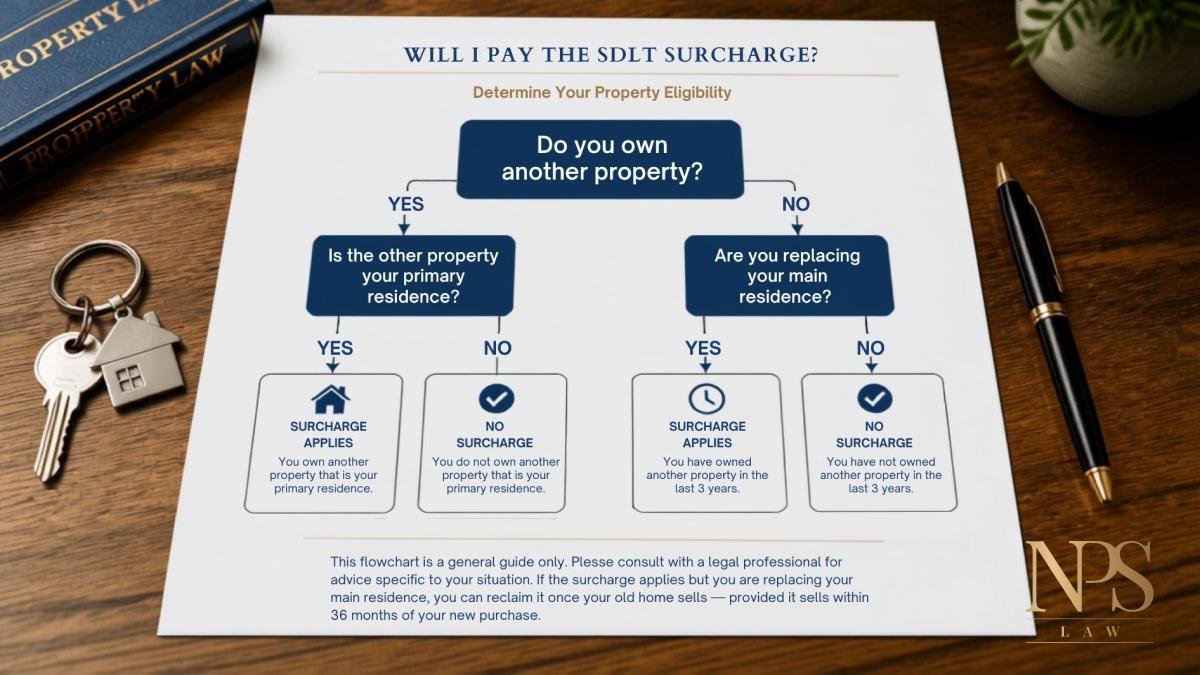
Any purchase of a residential property that is not your main residence triggers the surcharge, provided the price exceeds £40,000. This covers buy-to-let investments, holiday homes, second homes anywhere in the UK, and any other additional residential property. If the new property will become your main residence but you already own another property you are not selling on the same day, the surcharge also applies, though it may be reclaimed later under the 36-month rule.
If you complete on a new purchase before your previous main residence has sold, you will own two properties at the end of completion day and the surcharge will apply to the new purchase. This is one of the most common situations in which buyers face an unexpected SDLT bill. The refund route is available once the previous main residence sells within 36 months.
⚠ Common Pitfall
Many buyers assume the surcharge does not apply because they intend to sell their old home shortly after. HMRC does not take intention into account, if you own two properties at the end of completion day, the surcharge applies in full at that moment. Budget for it in cash from the outset, and apply for the refund once the old home sells.
For joint purchasers, HMRC applies the surcharge if any one buyer already holds a qualifying interest in another property. A couple where one partner owns a flat and the other owns nothing will pay the surcharge on their joint purchase because the transaction as a whole is treated as an additional dwelling acquisition. Married couples and civil partners are treated as a single unit for these purposes.
Unmarried partners are assessed individually on their own holdings. Where the surcharge is triggered solely because of one partner’s existing property, it may be possible for the non-owning partner to buy the new property alone, provided the full beneficial ownership genuinely belongs to that person. This is not regarded as tax avoidance by HMRC but it requires careful legal structuring. Speak to a solicitor before relying on this approach.
HMRC looks at your total worldwide residential property holdings to determine surcharge liability, not just your UK portfolio. A holiday apartment in Spain, an inherited share of a family home in France, or a property owned in the United States all count. If owning that overseas property means you will hold two or more residential dwellings at completion, the surcharge applies to the UK purchase.
Inheriting a share of a property does not automatically trigger the surcharge on a future purchase. If your inherited share amounts to less than 50 per cent of the property, and the inheritance occurred within the 36 months preceding your new purchase, that inherited share is disregarded for surcharge purposes. Once 36 months have passed since the inheritance, the inherited property is treated the same as any other holding.
A limited company or Special Purpose Vehicle buying a residential property pays the 5 per cent surcharge on every purchase from the first pound, regardless of how many properties the company already holds. For residential property purchases over £500,000, a flat 17 per cent SDLT rate applies to the company purchase, replacing the banded rate structure.
This does not make limited company ownership uneconomic. Income tax savings on rental profits can outweigh the additional upfront SDLT cost for higher-rate taxpayers, but the comparison must be modelled against your expected rental yield and hold period before you commit to a purchase price. NPS Law can advise on the conveyancing side of both individual and corporate residential purchases.
⚠ Common Pitfall
Buying through a limited company does not reduce your Stamp Duty bill. The 5 per cent surcharge applies to every residential purchase a company makes, and properties over £500,000 attract a flat 17 per cent rate. Tax efficiencies from corporate ownership relate to rental income, not to the upfront SDLT cost.
Summary
Several categories of purchase are exempt from the additional property surcharge, including properties under £40,000, caravans and houseboats, purchases completing simultaneously with the sale of your main residence, and mixed-use properties at the point of acquisition.
The surcharge does not apply to residential properties purchased for less than £40,000. This exemption rarely affects standard residential or buy-to-let transactions but covers certain low-value acquisitions.
These are not classed as dwellings for SDLT purposes. Buying one does not attract the surcharge, and owning one does not cause a subsequent property purchase to be treated as an additional dwelling.
If the sale of your previous main residence completes on the same day as, or before, your purchase of the new main residence, you will not own two properties at the end of completion day and the surcharge will not apply. Timing at completion matters: if the purchase completes even one day before the sale, the surcharge is triggered, though the 36-month refund route remains available.
A property containing both residential and commercial elements, such as a flat above a shop, is classed as mixed-use for SDLT purposes at the point you buy it. This means it is taxed under the commercial SDLT rates rather than the residential rates, and the additional property surcharge does not apply to the acquisition itself. However, if you already own a mixed-use property that includes a residential dwelling, it counts against you when you go on to buy another property.
Multiple Dwellings Relief allowed buyers purchasing two or more dwellings in a single transaction to calculate SDLT based on the average price per property, significantly reducing the bill on portfolio purchases. MDR was abolished on 1 June 2024. Buyers of portfolios now pay full SDLT, plus the surcharge where applicable, on each property’s individual value. If you are purchasing a block of flats or a portfolio from a single vendor, your solicitor can advise on whether the six-or-more dwellings rule applies, which allows the non-residential rate to be used instead.
Reference:
Summary
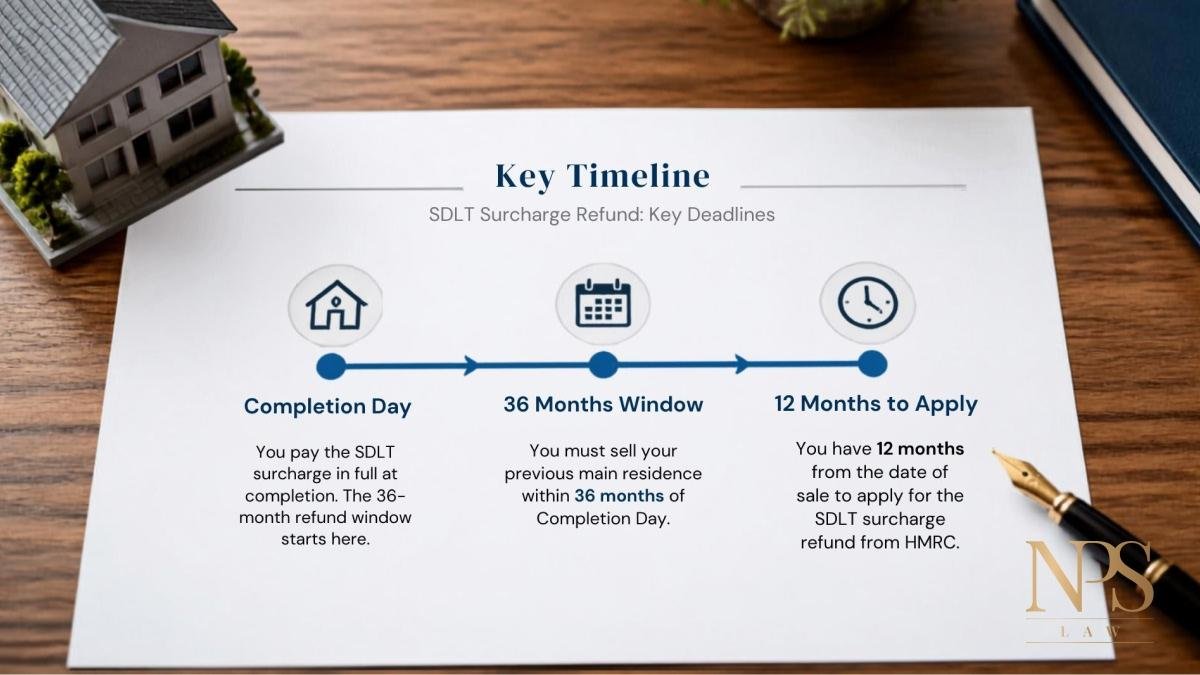
If you pay the surcharge because you complete on a new property before selling your old main residence, you can reclaim the full surcharge from HMRC, provided the old property sells within 36 months of the new purchase and you apply for the refund within 12 months of that sale.
HMRC permits a full refund of the surcharge when a buyer completes on a new property that will be their main residence before their previous main residence sells. The old home must sell within 36 months of the completion date on the new purchase. The refund applies to the disposal of any property that has been your only or main residence at some point during the 36 months before the new purchase. The length of time you lived there is not determinative, provided it genuinely qualified as your main residence.
Once the old main residence sells, you have 12 months from the date of that sale to submit the refund application to HMRC. If you miss this window, the right to a refund is lost. The application can be submitted online through HMRC’s repayment service, or by completing HMRC’s paper form and posting it directly.
⚠ Common Pitfall
The 12-month application deadline runs from the date your old property completes its sale, not from when you first paid the surcharge. Many buyers miss this window because they assume they have a year from when they moved. Ask your solicitor to set a reminder as soon as the old sale completes.
The surcharge must be paid in full at completion. It cannot be added to a mortgage, and lenders do not advance funds specifically to cover it. If you are completing on a new property before your old home sells, you will need the surcharge amount available in cash at completion, then claim it back once the sale goes through. On a £450,000 purchase, that means finding £22,500 in additional cash upfront. Factor this into your financial planning before exchanging contracts.
Key dates at a glance
| Event | Deadline | Consequence If Missed |
|---|---|---|
| Complete on new main residence | Day 0 | Surcharge must be paid at completion |
| Previous main residence must sell | Within 36 months of new purchase | Right to a refund is lost permanently |
| Submit refund application to HMRC | Within 12 months of old sale | Right to a refund is lost permanently |
| HMRC processes refund | Typically 15 to 30 working days | No penalty (HMRC processing time only) |
Summary
Scotland and Wales operate separate property tax regimes. Scotland charges an 8 per cent Additional Dwelling Supplement on the full purchase price, while Wales introduced a revised banded higher-rate structure for additional properties in December 2024. NPS Law advises on transactions in England and Wales only.
Scotland uses Land and Buildings Transaction Tax (LBTT), administered by Revenue Scotland. Additional dwellings in Scotland are subject to the Additional Dwelling Supplement (ADS) at 8 per cent of the full purchase price. Unlike the English surcharge, the ADS is applied as a flat percentage on the whole price from the first pound, not layered on top of banded rates.
On a £200,000 additional property in Scotland, the ADS alone amounts to £16,000. Buyers with Scottish transactions should instruct a solicitor regulated by the Law Society of Scotland.
Wales uses Land Transaction Tax (LTT), collected by the Welsh Revenue Authority. From 11 December 2024, Wales replaced its previous flat 4 per cent surcharge with a fully banded higher-rate structure for additional dwellings. The rates below apply to the full purchase price at each price band for additional residential properties in Wales.
| Purchase Price Band | Standard LTT Rate | Additional Property Rate |
|---|---|---|
| Up to £180,000 | 0% | 5% |
| £180,001 to £250,000 | 3.5% | 8.5% |
| £250,001 to £400,000 | 5% | 10% |
| £400,001 to £750,000 | 7.5% | 12.5% |
| £750,001 to £1,500,000 | 10% | 15% |
| Over £1,500,000 | 12% | 17% |
Rates in force from 11 December 2024. Verify current thresholds with the Welsh Revenue Authority before completion.
The table below shows the current surcharge structure across the three UK nations.
| Country | Property Tax | Additional Dwelling Surcharge | How It Applies |
|---|---|---|---|
| England and Northern Ireland | SDLT | 5% | Applied to every band, including the nil-rate band |
| Scotland | LBTT | 8% (Additional Dwelling Supplement) | Flat rate on the full purchase price |
| Wales | LTT | Banded higher rates (from December 2024) | Applied band by band under revised LTT structure |
Summary
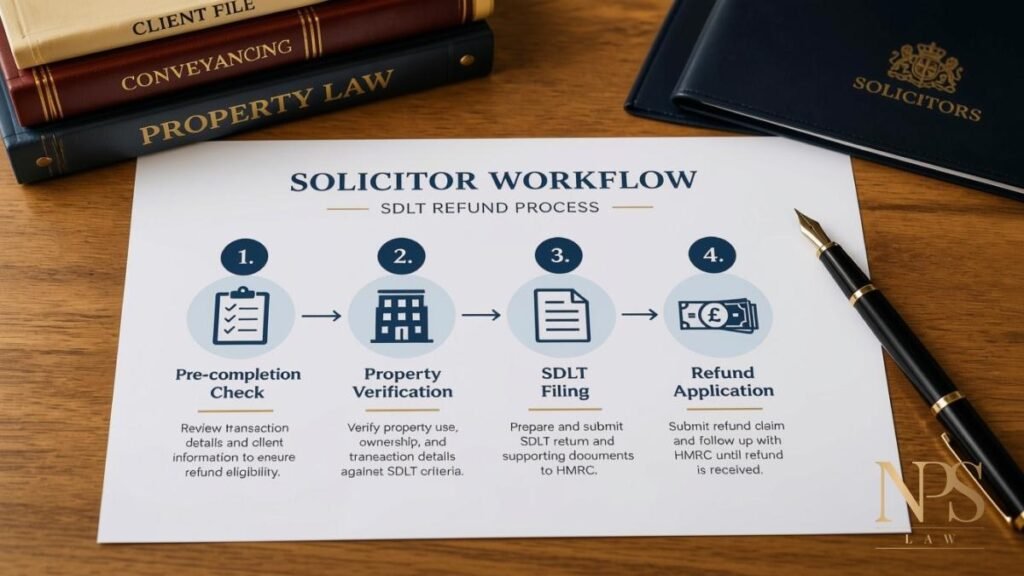
Additional property purchases carry specific legal obligations that do not arise in standard residential transactions. A solicitor handles the mandatory 14-day SDLT return and payment, verifies your worldwide property position before completion, carries out additional checks for company purchases, and manages the surcharge refund application when your old main residence eventually sells.
Online calculators can tell you how much Stamp Duty you owe. What they cannot do is file it. The following obligations sit with your solicitor, and missing any of them carries direct financial or legal consequences.
After completion, your solicitor must submit the SDLT return to HMRC and pay the tax due within 14 days of the effective date of the transaction. Missing this deadline triggers automatic financial penalties and interest on the unpaid amount from HMRC. For additional property purchases, the return must declare the correct buyer category, apply the 5 per cent surcharge, and confirm your property position as at completion day.
Before completion, your solicitor will ask you to confirm your full worldwide property holdings. SDLT is a self-assessed tax and HMRC takes the position that an inaccurate return is the buyer’s responsibility. If your return understates the surcharge because you forgot to disclose an overseas property or an inherited share, you face a potential underpayment penalty in addition to the unpaid tax. Your solicitor’s job is to ask the right questions and ensure the return accurately reflects your position on completion day.
If you are buying through a limited company or Special Purpose Vehicle, your solicitor will verify the company’s property register, check whether the flat 17 per cent rate applies for purchases over £500,000, and confirm the correct SDLT rate is declared on the return. The administrative requirements for company purchases differ from individual transactions, and the consequences of filing the wrong rate are the same: HMRC penalties.
When you sell your previous main residence and become eligible for a surcharge refund, your solicitor can prepare and submit the repayment application to HMRC on your behalf. The two critical deadlines are that the old property must sell within 36 months of the new purchase, and the refund application must be filed within 12 months of the sale. NPS Law handles these applications as part of the conveyancing instruction, ensuring no deadline is missed. To find out more about our service, visit our residential conveyancing page.
What NPS Law handles on your behalf
| Step | What your solicitor does | When |
|---|---|---|
| 1. Pre-completion check | Confirms your full worldwide property holdings and establishes the correct SDLT rate | Before exchange of contracts |
| 2. SPV check (if applicable) | Verifies the company property register and confirms whether the flat 17 per cent rate applies | Before completion |
| 3. SDLT return and payment | Submits the return to HMRC and pays the tax, including the 5 per cent surcharge where applicable | Within 14 days of completion |
| 4. Surcharge refund | Prepares and submits the repayment application to HMRC once the old main residence has sold | Within 12 months of the old sale |
HMRC’s official guidance channel explains the step-by-step process for filing an SDLT return, including how to declare additional property status and pay the tax due. This is the process your solicitor carries out on your behalf within 14 days of completion.
Reference:
Yes, worldwide holdings count.
HMRC looks at your worldwide residential property holdings to determine surcharge liability. A flat in Spain, a villa in Portugal, or an inherited share of a holiday home in France all count. If owning that overseas property means you will hold two or more residential dwellings at the end of completion day on the UK purchase, the 5 per cent surcharge applies.
Yes if you are married or civil partners; depends on structure if you are not.
Married couples and civil partners are treated as a single unit: if either one already owns another property, the joint purchase attracts the surcharge. Unmarried partners are assessed individually on their own holdings. Where the surcharge would be triggered solely by one partner’s existing property, it may be possible for the non-owning partner to buy alone, provided full beneficial ownership genuinely belongs to that person. Speak to a solicitor before structuring a purchase this way.
No. The 5 per cent surcharge applies to all company residential purchases.
For company purchases of residential property over £500,000, a flat 17 per cent rate applies instead of the banded structure. Limited company structures can still be tax-efficient for buy-to-let investors because of income tax advantages on rental income, but they do not reduce the upfront SDLT bill.
12 months from the date your old home completes its sale.
Your previous main residence must sell within 36 months of the date you completed on the new purchase. Once it sells, you have 12 months from that sale date to submit the refund application to HMRC. Your solicitor can manage this process. If both deadlines are missed, the refund right is lost permanently.
It was abolished on 1 June 2024.
Previously, purchasing two or more dwellings in a single transaction allowed the SDLT to be calculated on the average price per property, which significantly reduced bills on portfolio transactions. Since abolition, each property is taxed on its full individual price. If you are buying six or more dwellings in a single transaction, the non-residential SDLT rates may apply instead , ask your solicitor to review this if you are acquiring a portfolio.
Summary
The 5 per cent additional property surcharge makes Stamp Duty one of the most significant upfront costs for any buy-to-let or second home purchase. Understanding who it applies to, when it can be reclaimed, and how to file within HMRC’s 14-day window requires legal expertise alongside a calculator.
The surcharge has reshuffled the economics of property investment in the UK. In the 10 years since it was first introduced, the share of purchases made by landlords has fallen from around 14.5 per cent to 10.8 per cent in 2026. Investors have increasingly concentrated on more affordable regions where yields are higher and the fixed surcharge represents a smaller proportion of the total purchase cost. The West Midlands, with average buy-to-let prices well below the southern England norm, has become one of those regions. (Source: Hamptons Research, 2026)
Before you complete on an additional property, make sure you have addressed the following:
NPS Law provides fixed, itemised conveyancing quotes on additional property purchases, manages the SDLT return on your behalf, verifies your worldwide property position before completion, and handles surcharge refund applications when the time comes. There are no estimate ranges and no unexpected additions at completion.
If you are buying a second home, a buy-to-let investment, or your first property through a limited company in England or Wales, contact NPS Law today for a free, transparent quote. If you already own property jointly and are considering adding a co-owner or remortgaging, our guide to transfer of equity covers that related process.
Ready to buy your second home or buy-to-let property?
NPS Law provides fixed, transparent conveyancing quotes with no completion, no fee protection. We handle your SDLT return within 14 days of completion, verify your worldwide property position before exchange, and manage any surcharge refund application when your previous home sells. No estimate ranges. No unexpected additions.
Disclaimer: This article is for general informational purposes only and does not constitute formal legal advice. For specific legal matters, please consult with a qualified solicitor.

©️ Copyright 2026 NPS Law is a trading name for NPS Law LLP. Solicitors of England and Wales. Authorised and Regulated by the Solicitors Regulation Authority. SRA Number 570169. A list of all Partners is available on the SRA directory for this firm. website designed by origin-media