

Stamp Duty Land Tax is a one-off government tax on property purchases in England . It is calculated in bands, paid at completion, and handled by your solicitor on your behalf. Most buyers first encounter the bill as a line item on the completion statement, by which point it is too late to budget for it properly.
This guide explains exactly how SDLT is calculated, what rate applies to the price you are planning to offer, which reliefs reduce the bill for first-time buyers, when the payment falls due, and which situations produce a different outcome to the standard calculation.
Summary
Stamp Duty Land Tax is a one-off tax levied by HMRC on the purchase of property and land in England above specified thresholds. It is not an annual charge and is not related to Council Tax or any other ongoing payment.
NPS Law provides conveyancing services in England and Wales only.
Stamp Duty Land Tax was introduced in its current form by the Finance Act 2003, replacing the earlier Stamp Duty on property transactions. In the years since, successive governments have adjusted the thresholds, introduced reliefs for first-time buyers and added surcharges on additional residential properties. The current rate structure applies from 1 April 2025.
SDLT applies whenever you acquire a chargeable interest in land or property in England. In practice, this means:
SDLT does not apply to a direct inheritance of property, a straightforward gift with no outstanding mortgage, or a transfer between divorcing spouses under a court order.
The name causes confusion in three ways. First, SDLT is not an annual tax: you pay it once at purchase and never again unless you sell and buy again. Second, it has no connection to Council Tax, which is a separate local authority charge based on property value bands. Third, the common phrase ‘Stamp Duty’ refers specifically to SDLT in an English property context; in Scotland the equivalent is Land and Buildings Transaction Tax, and in Wales it is Land Transaction Tax.
Reference:
GOV.UK – Stamp Duty Land Tax overview
Legislation.gov.uk – Finance Act 2003 (SDLT provisions)
Summary
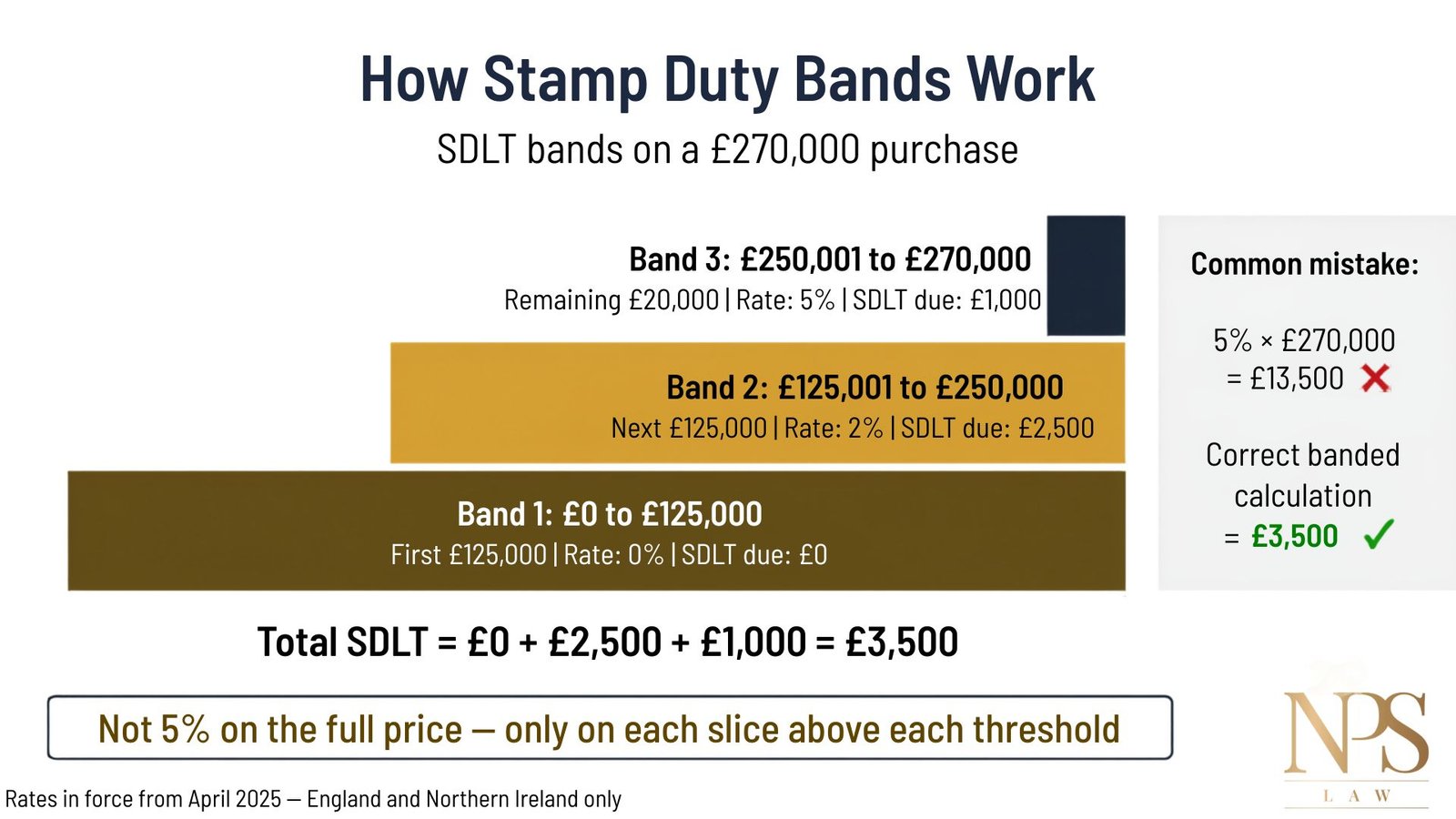
SDLT is calculated in bands, like income tax. You pay each rate only on the portion of the purchase price within that band. Buying at £270,000 does not mean paying 5 per cent on the whole sum, only the £20,000 above the £250,000 threshold is taxed at 5 per cent.
Most buyers initially assume SDLT works like a flat rate: pick your price, find your tax bracket, multiply. This is wrong, and it causes buyers to significantly overestimate their bill.
The correct method: divide the purchase price into the bands below, apply the percentage to each slice, and add the results together. A property purchased at £200,000 is not taxed at 2 per cent across the full £200,000. The first £125,000 is taxed at 0 per cent. Only the remaining £75,000 is taxed at 2 per cent, producing a bill of £1,500, not £4,000.
[Infographic placeholder: Step-by-step banded calculation diagram: show a £270,000 purchase split into three horizontal slices: £125,000 at 0%, £125,000 at 2% (= £2,500), £20,000 at 5% (= £1,000), total £3,500. Contrast with incorrect ‘flat rate’ assumption.]
| Purchase Price Band | SDLT Rate |
|---|---|
| Up to £125,000 | 0% |
| £125,001 to £250,000 | 2% |
| £250,001 to £925,000 | 5% |
| £925,001 to £1,500,000 | 10% |
| Over £1,500,000 | 12% |
These rates apply to residential purchases in England from 1 April 2025. No changes to the standard residential rates have been announced for the 2026/27 tax year.
The table below applies the banded rates to five price points, from below the nil-rate threshold to the upper end of the mainstream market.
| Purchase Price | SDLT (Standard Buyer) | How It Is Calculated |
|---|---|---|
| £120,000 | £0 | Below £125,000 nil-rate band, no SDLT due |
| £200,000 | £1,500 | 0% on £125k + 2% on £75k |
| £290,000 | £4,500 | 0% on £125k + 2% on £125k + 5% on £40k |
| £350,000 | £7,500 | 0% on £125k + 2% on £125k + 5% on £100k |
| £500,000 | £15,000 | 0% on £125k + 2% on £125k + 5% on £250k |
Buying an additional property or buy-to-let? See: Stamp Duty on Second Homes and Buy-to-Let Properties
Reference:
Summary
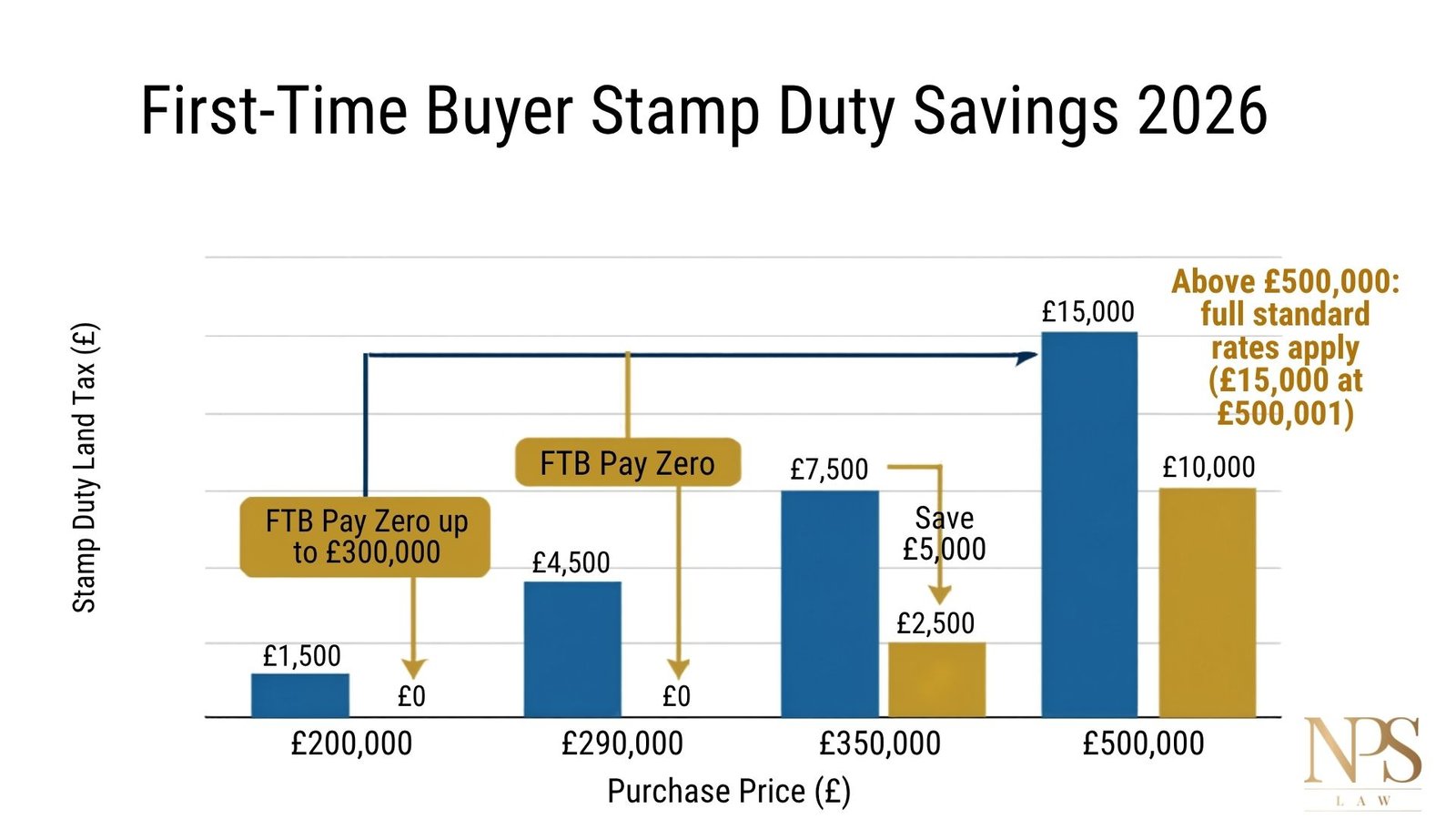
First-time buyer relief gives 0 per cent SDLT on the first £300,000 of a purchase up to £500,000. Above £500,000, standard rates apply in full. Both buyers in a joint purchase must qualify as first-time buyers, and neither can have owned residential property anywhere in the world.
HMRC’s definition is strict. A first-time buyer is an individual who has never owned, and does not currently own, a major interest in a residential dwelling anywhere in the world. Inheriting a share in a property, owning an overseas property, or having previously owned a buy-to-let all disqualify a buyer from the relief, even if they have never occupied a property as their main home. For a joint purchase, every buyer must meet this test; if one does not, neither receives the relief.
| Purchase Price | Standard Buyer | First-Time Buyer | Saving |
|---|---|---|---|
| £200,000 | £1,500 | £0 | £1,500 |
| £290,000 | £4,500 | £0 | £4,500 |
| £350,000 | £7,500 | £2,500 | £5,000 |
| £500,000 | £15,000 | £10,000 | £5,000 |
First-time buyer relief is only available on purchases up to £500,000. If the agreed price is £500,001, the relief disappears entirely and the buyer reverts to standard rates on the full price. There is no gradual reduction. According to GOV.UK’s official guidance, a £1 difference in the purchase price at this threshold can cost a first-time buyer several thousand pounds.
⚠ Common Pitfall
At £500,001, a first-time buyer loses the entire relief and pays standard rates on the full purchase price. A £499,999 offer produces a bill of £10,000. A £500,001 offer produces a bill of £15,000. Always check whether negotiating the price down below £500,000 is feasible before finalising an offer above this threshold.
This is the most common misunderstanding in the first-time buyer rules. Many buyers assume that if one of them is a first-time buyer and the other is not, they receive partial relief. They do not. For a joint purchase, HMRC applies an all-or-nothing test: every buyer must qualify, or none of them do.
The consequence goes further. If one buyer already owns another residential property, the purchase may attract the 5 per cent additional property surcharge as well as losing first-time buyer relief. The two effects combined can increase the SDLT bill significantly.
⚠ Common Pitfall
A couple buying jointly where one partner already owns a flat do not receive half the first-time buyer relief. They receive none. The buying partner’s existing property also means the 5 per cent surcharge may apply to the entire purchase price. This is one of the most expensive misunderstandings in property conveyancing.
Summary
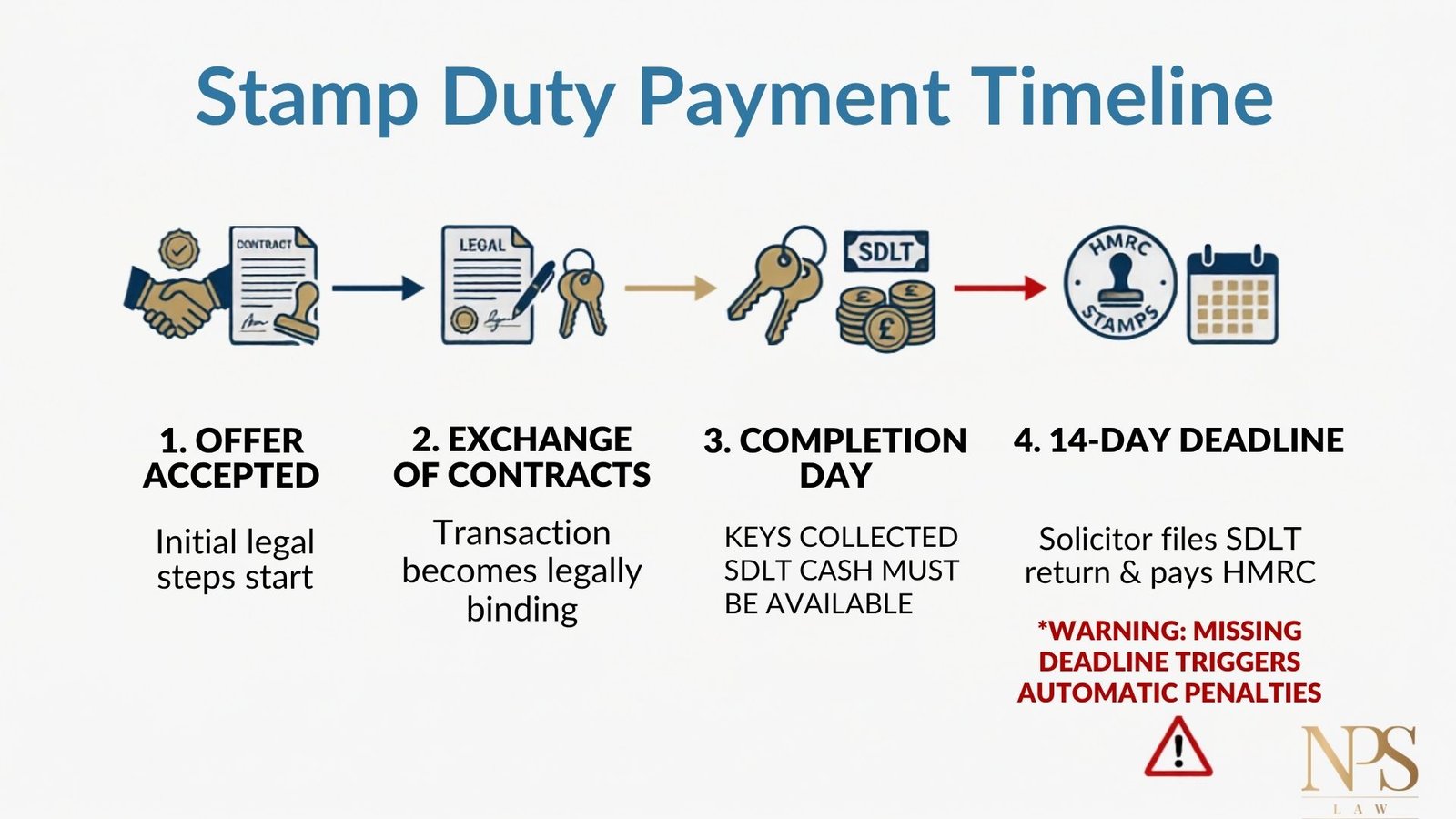
SDLT is due within 14 days of the completion date. Your solicitor submits the return to HMRC and pays the tax on your behalf as part of the completion process. You do not contact HMRC directly.
The legal deadline for filing an SDLT return and paying any tax due is 14 days from the effective date of the transaction. For most purchases, the effective date is completion day, the day you receive the keys and the remaining funds transfer to the seller. Missing this deadline triggers automatic financial penalties from HMRC, even if no tax is due and even if the delay is a matter of days.
The 14-day clock runs from completion, not from exchange of contracts, not from the date you made your offer, and not from when the property was advertised. Exchange and completion are separate legal events; only completion triggers the SDLT deadline.
Filing and paying SDLT is a standard part of your solicitor’s conveyancing instruction. On completion day, your solicitor submits the SDLT return to HMRC electronically, pays the tax from the funds you have provided for completion, and obtains a unique transaction reference. HM Land Registry requires this reference before it will register your ownership.
You do not register with HMRC, file any form directly, or make any payment to HMRC. All of this is handled by your legal team as part of the conveyancing process.
Need a conveyancing solicitor? See: NPS Law Residential Conveyancing
No. Mortgage lenders do not advance funds to cover SDLT, and the amount cannot be rolled into your mortgage balance. The full SDLT bill must be available as a separate cash sum in your solicitor’s client account on or before completion day. Buyers who have calculated their maximum budget as the sum of their deposit and mortgage offer, without leaving room for SDLT, risk being unable to complete.
⚠ Common Pitfall
Budget for SDLT separately from your deposit and mortgage. If your total funds are £250,000 and you plan to use £50,000 as a deposit and borrow £200,000, you still need an additional £4,500 in cash on completion day for the SDLT on a £290,000 property. This is a distinct, separate requirement.
A late SDLT return triggers penalties from HMRC on a sliding scale: a fixed penalty for being late by a few days, rising to a percentage-based penalty for returns that are months overdue, plus interest on any unpaid tax. If the delay is caused by your solicitor’s administrative failure rather than any fault on your part, the liability for penalties may rest with the solicitor. This is one reason why the SDLT return is a priority task in conveyancing practice and is handled within the 14-day window as a matter of standard procedure.
Reference:
SUMMARY
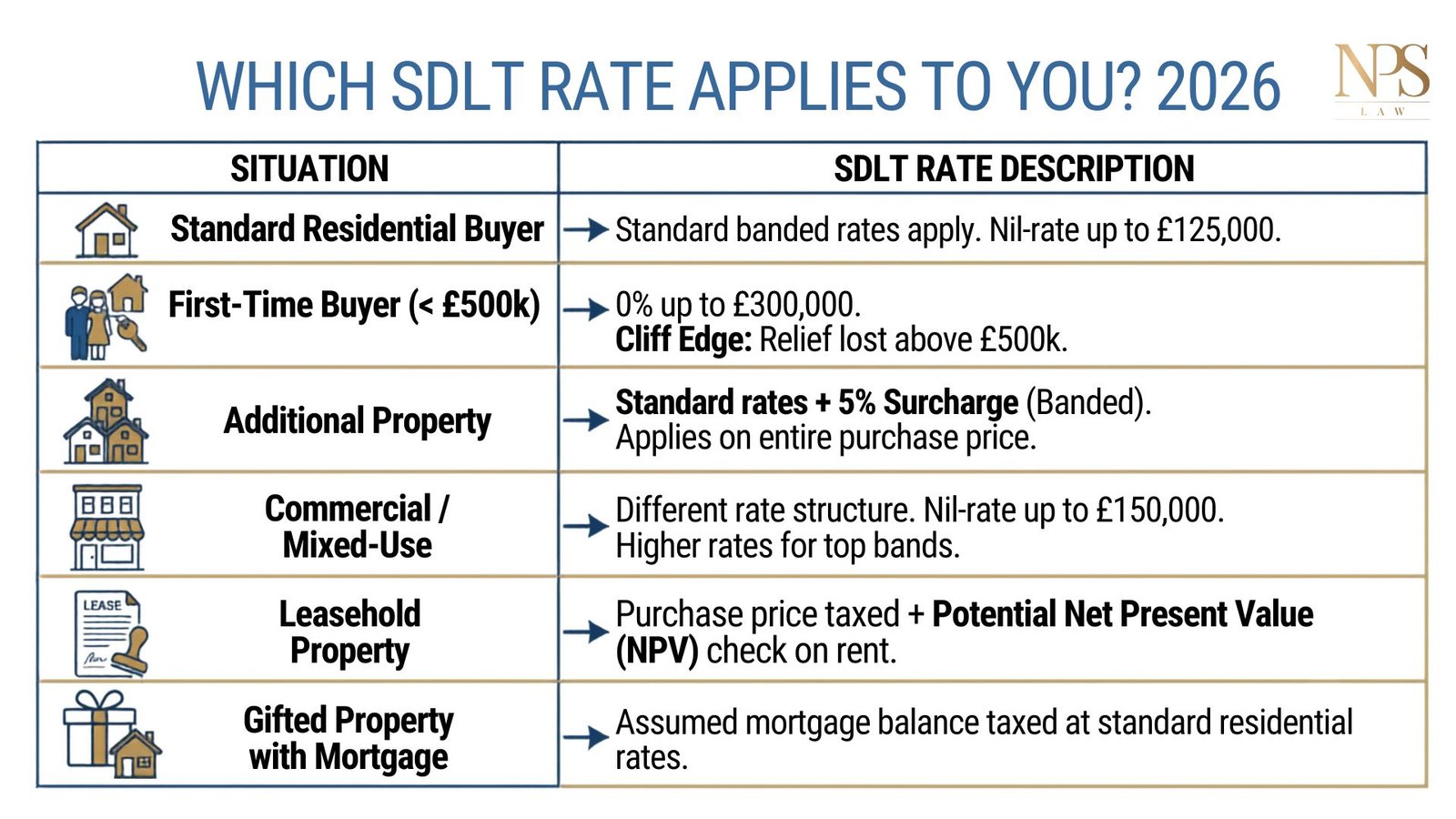
Standard residential rates apply to most straightforward purchases. Five specific situations produce a meaningfully different SDLT outcome: additional properties, commercial and mixed-use transactions, leasehold properties, gifted property with a mortgage, and properties purchased in Scotland or Wales.
Buyers who will own two or more residential properties at the end of completion day pay a 5 per cent surcharge on top of standard rates. This applies to every band across the full purchase price. On a £300,000 second home, the surcharge alone adds £15,000 to the standard SDLT bill. The rule applies to buy-to-let investors, holiday homes, properties purchased by limited companies, and buyers completing on a new home before selling their previous one.
Full guide including refund rules and Scotland/Wales rates: Stamp Duty on Second Homes and Buy-to-Let Properties in the UK
Non-residential and mixed-use property is taxed under a different SDLT rate structure. The threshold for the nil-rate band is £150,000 (not £125,000), and the top rate is 5 per cent above £250,000 (not 12 per cent as in the residential system). A flat above a shop, or a property that includes any commercial use element at the point of purchase, may qualify as mixed-use and therefore fall under the non-residential rates. This distinction can significantly reduce the tax bill on qualifying properties, and is worth confirming with your solicitor before exchange.
| Purchase Price Band | Non-Residential / Mixed-Use SDLT Rate |
|---|---|
| Up to £150,000 | 0% |
| £150,001 to £250,000 | 2% |
| Over £250,000 | 5% |
Most residential property conveyancing guides mention leasehold in passing. Few mention that buying a leasehold property can trigger two separate SDLT calculations rather than one.
The first calculation is identical to any other purchase: the premium (purchase price) is taxed at standard banded rates. The second calculation applies specifically to leases with a significant ground rent: if the net present value (NPV) of the total rent over the lease term exceeds £250,000, SDLT at 1 per cent applies to the excess above that threshold.
For most modern residential leasehold flats, where ground rents have been zero or minimal since the Leasehold Reform (Ground Rent) Act 2022 came into force for new leases, this second calculation produces a nil result. However, buyers of older leasehold properties with historically higher ground rents, particularly those in London or central Birmingham, should ask their solicitor to confirm whether the NPV calculation applies before exchange.
Ground rents on new residential leases granted on or after 30 June 2022 are legally restricted to zero under the Leasehold Reform (Ground Rent) Act 2022. This removed the second-calculation risk for the majority of new-build leasehold purchases.
A direct inheritance does not trigger SDLT. Where a property passes to a beneficiary under a will or intestacy, no SDLT return is required because there is no chargeable consideration, no payment changes hands.
Gifted property, however, requires more care. If a property is transferred as a gift with no money paid, there is normally no SDLT liability. But if the property carries an outstanding mortgage, the act of assuming that mortgage constitutes chargeable consideration for SDLT purposes. The amount subject to SDLT is the outstanding mortgage balance, taxed at the standard residential rates.
Partial gift arrangements, where a parent, for example, transfers a property to a child for a price below market value, are taxed on the amount actually paid, not the market value, unless the arrangement forms part of a tax avoidance scheme.
⚠ Common Pitfall
Receiving a gifted property as a deposit arrangement, where a parent gifts a property with an existing mortgage and the buyer assumes that mortgage, can trigger an unexpected SDLT bill on the full outstanding mortgage balance. Always confirm the SDLT position with your solicitor before completing a gifted transfer involving any outstanding debt.
SUMMARY
Buyers in Scotland pay Land and Buildings Transaction Tax administered by Revenue Scotland. Buyers in Wales pay Land Transaction Tax administered by the Welsh Revenue Authority. NPS Law advises on transactions in England and Wales only.
The devolved administrations of Scotland and Wales each operate their own property tax systems, separate from SDLT. The rates, thresholds and reliefs differ from those in England and should not be confused with the figures in this guide.
| Country | Property Tax | Administering Body |
|---|---|---|
| England | Stamp Duty Land Tax (SDLT) | HMRC |
| Scotland | Land and Buildings Transaction Tax (LBTT) | Revenue Scotland |
| Wales | Land Transaction Tax (LTT) | Welsh Revenue Authority |
Short answer: No. The standard nil-rate band means no SDLT is due on a residential property purchased for £125,000 or less.
This covers most properties in lower-price markets such as parts of the North East of England. However, buyers should be aware that if the property is an additional dwelling, the 5 per cent surcharge applies from the first pound of the purchase price and there is no nil-rate threshold equivalent.
Short answer: Yes, and you may also pay a surcharge.
For a joint purchase, every buyer must qualify as a first-time buyer for the relief to apply. If one partner already owns another property, neither buyer receives first-time buyer relief, and the 5 per cent additional property surcharge may also apply. The final SDLT bill can be substantially higher than both buyers expect.
Short answer: Not if it is a genuine gift with no mortgage. If there is an outstanding mortgage, SDLT applies to the mortgage balance.
A property transferred as a gift with no mortgage and no payment of any kind triggers no SDLT liability. However, if the property carries an outstanding mortgage and you assume responsibility for that mortgage, the outstanding balance constitutes chargeable consideration and SDLT applies at standard rates on that amount.
Short answer: In some circumstances, yes.
The most common route to a refund is the replacement of main residence rule. If you paid the 5 per cent additional property surcharge because you completed on a new home before selling your old one, HMRC will refund the surcharge in full if the old property sells within 36 months, provided you apply within 12 months of that sale. Standard SDLT on a straightforward purchase is not refundable after completion.
Short answer: HMRC issues automatic penalties. The responsibility may rest with your solicitor.
Missing the 14-day deadline triggers an automatic fixed penalty from HMRC, plus interest on the unpaid tax. If the delay was caused by your solicitor’s failure to act rather than any issue on your part, the solicitor may be liable for those penalties and any interest. This should be addressed as a professional negligence matter with your solicitor’s firm directly.
SUMMARY
SDLT is a fixed obligation that attaches to the property price you agree. Calculate it before your offer, not after. Know whether you qualify for first-time buyer relief, whether the 5 per cent surcharge applies, and confirm with your solicitor that the cash is ring-fenced for completion.
Stamp Duty Land Tax is not complicated, but it catches a disproportionate number of buyers off-guard because it is rarely discussed in the same detail as the deposit or the mortgage. Understanding it before you make an offer changes your negotiating position and your financial planning.
If you are close to a threshold, particularly £500,000 for first-time buyer relief, the price you agree can have a larger impact on your SDLT bill than a movement in interest rates. That is worth knowing before you submit your offer rather than after you have exchanged.
NPS Law handles the SDLT return, payment and any subsequent refund applications as part of every residential conveyancing instruction. There are no estimate ranges on our conveyancing quotes and no unexpected additions at completion. If you are also considering a transfer of equity or a remortgage, our related guide covers the process in detail.
Related: Transfer of Equity: Costs, Process and When You Need a Solicitor
Get a fixed-fee conveyancing quote from NPS Law
NPS Law handles your SDLT return within 14 days of completion, advises on first-time buyer eligibility and additional property surcharges before exchange, and manages any refund applications when they fall due. Fixed fee. No move, no fee.
Disclaimer: This article is for general informational purposes only and does not constitute formal legal advice. For specific legal matters, please consult with a qualified solicitor.

©️ Copyright 2026 NPS Law is a trading name for NPS Law LLP. Solicitors of England and Wales. Authorised and Regulated by the Solicitors Regulation Authority. SRA Number 570169. A list of all Partners is available on the SRA directory for this firm. website designed by origin-media